
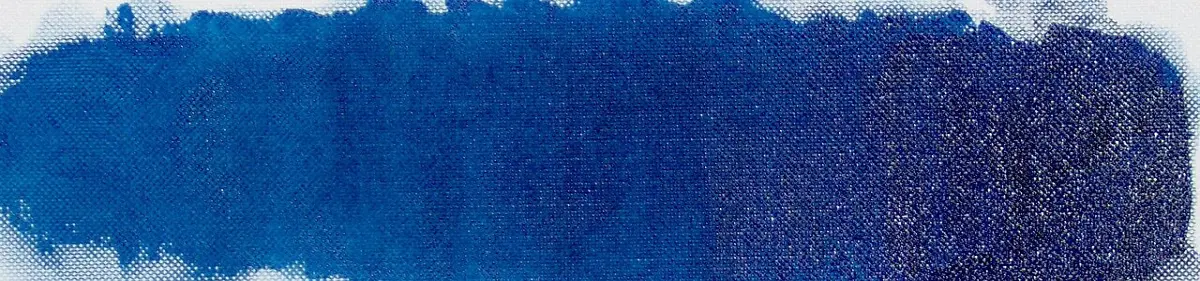
Konjō (Prussian blue) is a pigment obtained as a deep blue precipitate by adding an excess amount of iron ions to an iron cyanide complex. To distinguish it from the traditional Japanese natural pigment, Iwa-konjo (azurite), it is sometimes referred to as Hana-konjo.
However, generally, Hana-konjo is another name for smalt.
Depending on the manufacturing process, it is known by various names such as Iron Blue, Prussian Blue, Berlin Blue, Turnbull's Blue, Milori Blue, Chinese Blue, and Paris Blue. In Japan, it was called "Bero blue" as a corruption of "Berlin blue." It is also known as Hiroshige Blue, Hokusai Blue, and Japan Blue because it was strikingly used in the works of artists such as Utagawa Hiroshige and Katsushika Hokusai.
It is said to have been discovered accidentally in 1704 in Berlin by Johann Jacob Diesbach, who was working under the alchemist Johann Conrad Dippel, during the production of pigments (the Dippel-Diesbach method). At that time, the relatively inexpensive blue pigment "azurite" was imported into Europe through Venice, Italy, but it did not reach countries like Germany to the north of Italy. Prussian blue quickly replaced the expensive Afghan-made lapis lazuli pigment "ultramarine," which had been a major pigment until the time of Vermeer and Rembrandt, and it was widely used for coloring ceramics. Later, it was also produced in Paris by one of his students, but the manufacturing process was kept secret. In 1724, John Woodward of England announced that the pigment could be produced from plant ash and ox blood, and the manufacturing method became widely known.
Image by public domain.






