
Tourists and short-term residents who are not fully fluent Chinese readers miss out on the subtle delights of Taiwan’s gentle version of Chinese culture. On this this blog, I will share some of the less obvious cultural treasures I have collected and continue to amass. Welcome to Taiwan “Sign” Language!
Alphabetic writing was first promulgated by the ROC government in 1918: Bopomofo (BPMF, a semi-alphabetic system with letters derived from parts of Chinese characters). Ten years later, in 1928, a parallel Latin alphabet system called Gwoyeu Romatzyh (AKA GR Tonal Spelling) was introduced. GR Tonal Spelling, as its name implies, uses mnemonic spelling variations to indicate the four tones of Mandarin Chinese in an unforgettable manner.
Ever since then, dictionaries published in China (and then in Taiwan) have used both BPMF and GR (original names: 國音字母第一、第二式 National Phonetic Alphabet 1 & 2) side by side. In 1958, the PRC government adopted a tone-optional system with tiny, hard to type marks above vowel letters to show tones.
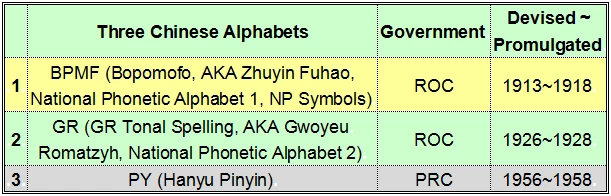
A comparison between the three systems shows that Pinyin adopted most of GR’s innovations. Each Chinese syllable has a very simple (Cv)V(-n, -ng) structure: an optional initial consonant and/or medial vowel, a main vowel, and an optional nasal ending.
The B, D and G groups (ㄅㄆㄇㄈ,ㄉㄊㄋㄌ,ㄍㄎㄏ) are exactly the same and the J group (ㄓㄔㄕㄖ) has one small difference (ㄓ = Zh instead of J). The Ji (ㄐㄑㄒ) and Tz (ㄗㄘㄙ) groups show major differences. Unfortunately for foreigners, the letter choices are rather idiosyncratic and hard to guess at. ㄑ = Q is similar to Ch in English, ㄒ = X is similar to Sh, ㄗ = Z is similar to Dz, and ㄘ = C is similar to Ts. GR Tonal Spelling, which was devised by 趙元任 [https://en.wikipedia.org/wiki/Yuen_Ren_Chao] a brilliant Chinese linguist, is thus much more transparent for foreigners who don’t know any Chinese.
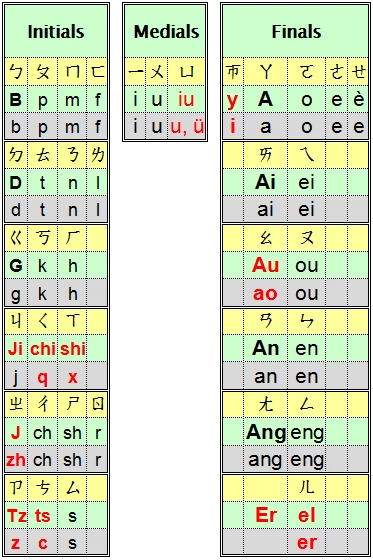
The vowels also show some variation. The GR vowel iu (like a French u or German ü) and its tonal variations (yu = rising tone, eu = long, low tone) is rendered sometimes as u and sometimes as ü in Hanyu Pinyin, which can be rather confusing. In Hanyu Pinyin, i stands for two very different vowels (i and y in GR).
Because this is a Taiwan-centric blog which focuses on the ROC’s unique cultural heritage, GR Tonal Spelling will be the main romanization.






