
If you are wondering “what is crypto yield farming” or “how does yield farming work” then you are in the right place.
In this article we will break down the fundamentals of yield farming in a way that is easy to understand. Let’s go!
What is yield farming?
Crypto yield farming is a way to earn rewards (aka yield) by investing cryptocurrency in various platforms (aka farming).
How does yield farming work?
Decentralized exchanges (DEXs) and decentralized finance (DeFi) loan platforms need liquidity to grow. They incentivize investment by giving reward tokens in exchange for cryptocurrency. Rewards are distributed using smart contracts.
These tokens can be invested and earn additional rewards tokens as well. Some tokens can be traded on exchanges and have a price value.
The more investment a platform gets, measured as total volume locked (TVL), the more the platform grows. As a platform grows, the value of its tokens typically increase. Farmers can then sell their tokens for profits.
What are examples of yield farming platforms?
Yield farming platforms typically include decentralized exchanges, DeFi loan platforms, and DEX/DeFi aggregators. These platforms are not mutually exclusive.
Decentralized exchanges use investor funds (in liquidity pools) to allow others to swap cryptocurrencies. They charge a fee to swap cryptocurrencies and pay a portion of that fee back to the investors. Uniswap, Quickswap, SushiSwap, PancakeSwap, Curve Finance, and Balancer are all examples of DEXs.
DeFi loan platforms use investments to fund collateralized loans. As the loans are repaid, a portion of the interest paid is distributed to the investors. Aave and Compound Finance are examples of DeFi loan platforms.
Different DEXs and DeFi platforms provide different rewards for various cryptocurrencies. DEXDeFi aggregators are platforms that take your crypto and invest it automatically in the DEXDeFi platform offering the best rewards. These platforms pool together large volumes of crypto and take a portion of the rewards. Yearn Finance, Beefy Finance, and Harvest Finance, are examples of DEX/DeFi aggregators.
What are examples of yield farming strategies?
There are many yield farming strategies to maximize rewards and profit, and they are constantly changing!
Each platform has different rewards that can change based on asset price, liquidity volume, etc.
Here are a couple of examples of yield farming strategies to illustrate how yield farming works.
Example 1: Investing in Compound
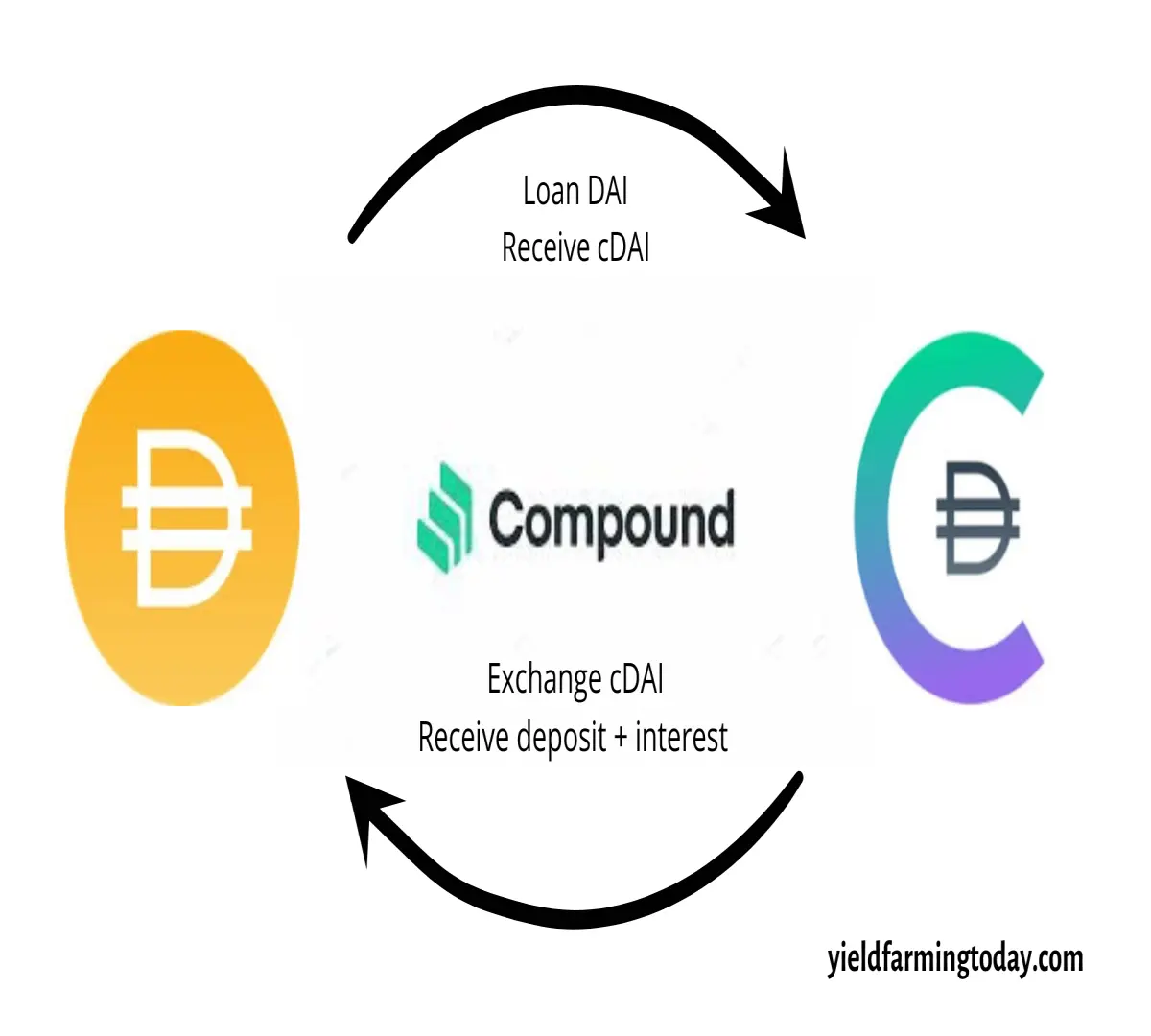
When you invest in a DeFi loan platform you can invest a single cryptocurrency into a liquidity pool. On compound you receive cTokens that are redeemable for your investment.
Compound will loan the funds in the pool to borrowers and charge an interest rate. As the loan is repaid the interest will be distributed to the contributors in the liquidity pool.
The value of the cToken will increase as interest is distributed. You can then exchange your cTokens for your original cryptocurrency at a profit or reinvest to compound yields.
Example 2: Investment in SushiSwap whose rewards can be reinvested through Badger
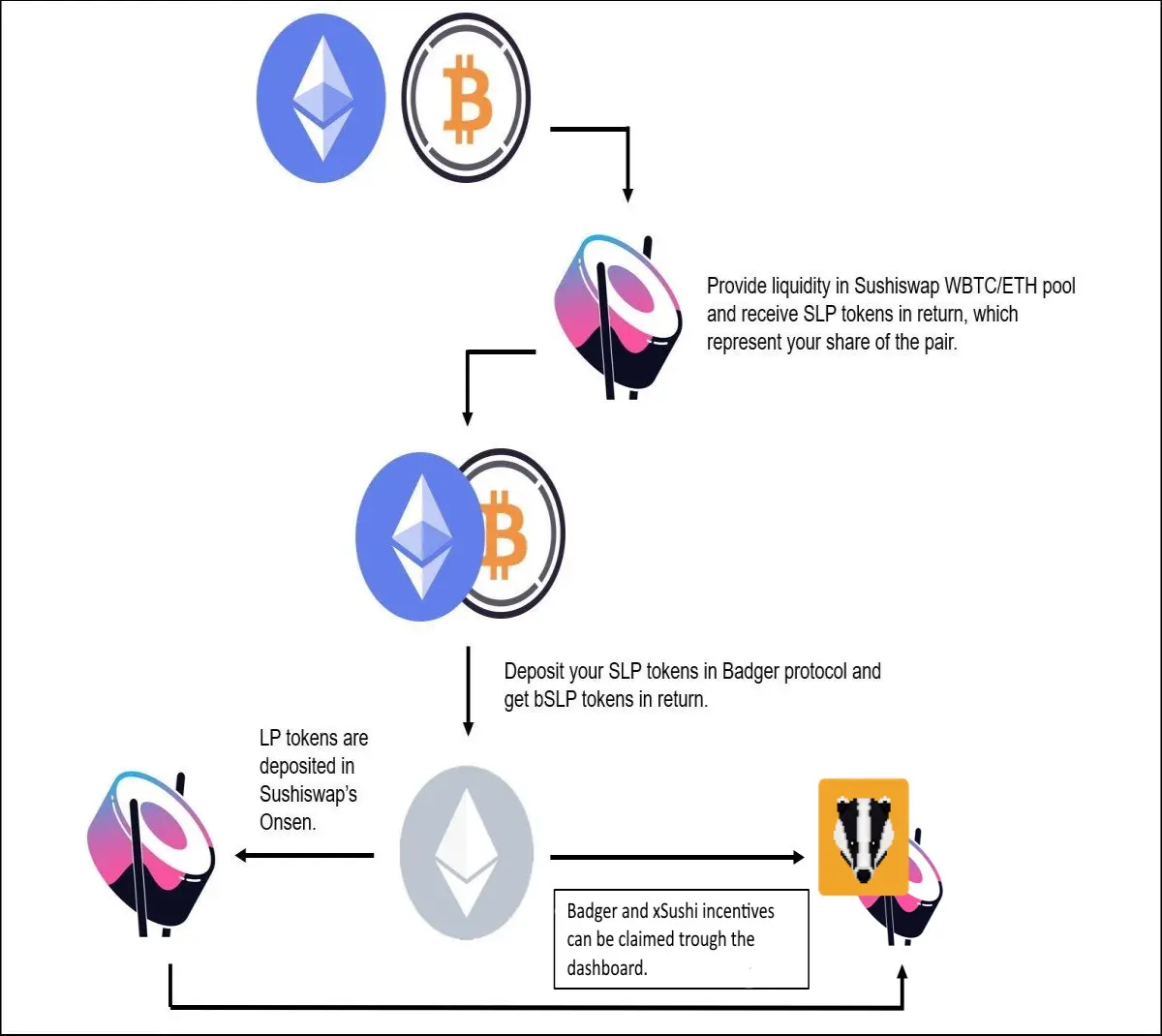
Source: Badger
DeFi platforms are sometimes referred to as “financial legos” because they can be combined to create more complicated financial structures. In this example equal amounts of wrapped Ethereum (wETH) and wrapped Bitcoin (wBTC) are invested in a SushiSwap liquidity pool. You receive sushi liquidity pool (SLP) tokens based on your investment
You can then invest your SLP tokens through the Badger protocol. Badger will reinvest these tokens within SushiSwap to earn you additional yields. In this manner you are increasing your yield by reinvesting your liquidity tokens.
What are the risks to yield farming?
There is risk in every investment, but yield farming can be particularly risky. Some risk is comes from the platform you invest with, while other is inherent to crypto. Here’s an overview of the major risks associated with yield farming.
Impermanent loss:
When the difference in price between two coins in a liquidity pool changes so if you withdrew from the pool your profit would be less than if you held the coins instead of investing
Smart contract code vulnerabilities:
Smart contracts can’t change once they are on the blockchain. Over time hackers can find loopholes and vulnerabilities to exploit to steal funds. Newer projects whose code has not been audited are particularly vulnerable.
Liquidation:
Some strategies involve leverage - depending on the leverage position and market conditions you could risk liquidation.
Money Lego’s:
One of DeFi’s greatest strengths is also a weakness. Many platforms depend on one another. If there is an issue on one platform, all connected platforms suffer.
Dilution to nothing:
This depends on token minting mechanism but essentially if a coin is not scarce it will not hold its price and become worthless.
Scams:
Be aware, the barrier to entry for making a yield farming site is pretty low making it easy for scammers to make yield farming sites.
Gas Fees:
Watch out, higher volume still causes higher gas fees.
What are common yield farming blockchains to reduce gas fees?
Yield farming started with the Ethereum blockchain, but high transaction fees (gas fees) limited operability. Other blockchains with lower fees have been developed and are at the heart of yield farming and DeFi development. These blockchain include (but are not limited to):
Polygon
Binance
Fantom
Conclusion
Yield farming can be as rewarding as it can be complicated. It’s a way to put your cryptocurrency to work and generate relatively passive income, but it comes with a lot of risk. If you don’t do your research you could end up losing your investment (aka get rekt).
Our goal is to provide great content to help you on your learning journey. We do not provide investment advice, and recommend speaking with a financial advisor if you have financial investment questions. Thanks for reading!





