
In the fast-evolving world of cryptocurrency, Ethereum and Bitcoin have emerged as two of the most prominent players, captivating the imagination of investors and tech enthusiasts alike. While both cryptocurrencies are based on blockchain technology, they serve vastly different purposes and have distinct features that set them apart. In this article, we delve into the top differences between Ethereum (ETH) and Bitcoin (BTC), shedding light on their unique characteristics, use cases, and underlying technologies. But let’s start with a brief explanation of Bitcoin vs Ethereum opposition in general.
Bitcoin (BTC)
Launched in 2009 by an unidentified individual or group using the pseudonym Satoshi Nakamoto, Bitcoin holds the distinction of being the inaugural and most recognized cryptocurrency. Bitcoin functions on a decentralized peer-to-peer network that eliminates the necessity for intermediaries like traditional banking institutions. The execution of Bitcoin transactions is transparently documented on a public ledger, referred to as the blockchain, and protected by cryptographic methods. The supply of Bitcoin is restricted to 21 million units, which imparts it a deflationary character. The price of Bitcoin, known for its fluctuations, is contingent upon market demand. Digital wallets enable users to store and transfer Bitcoin, facilitating worldwide transactions at a swift pace with comparatively low charges. Undoubtedly, Bitcoin has transformed the economic scene and stimulated the expansion of the overarching cryptocurrency market.
Ethereum (ETH)
Ethereum, a decentralized blockchain ecosystem, was introduced by Vitalik Buterin in 2015. It extends beyond being merely a digital currency, as Bitcoin does, by providing a platform for developers to create and launch smart contracts and decentralized applications (DApps). Its inherent cryptocurrency, Ether (ETH), serves dual purposes – facilitating transactions and acting as the energy required to implement smart contracts. Ethereum's standout feature is its Turing-complete programming language that allows the development of intricate and adaptable DApps. Unlike Bitcoin's proof-of-work (PoW) consensus mechanism, Ethereum operates on a proof-of-stake (PoS) system, which enhances scalability, security, and energy efficiency. With its multifaceted applications, Ethereum has become a pivotal component in the rapidly growing sector of decentralized finance (DeFi) and in the generation of Non-Fungible Tokens (NFTs).
Key Differences Between Bitcoin and Ethereum
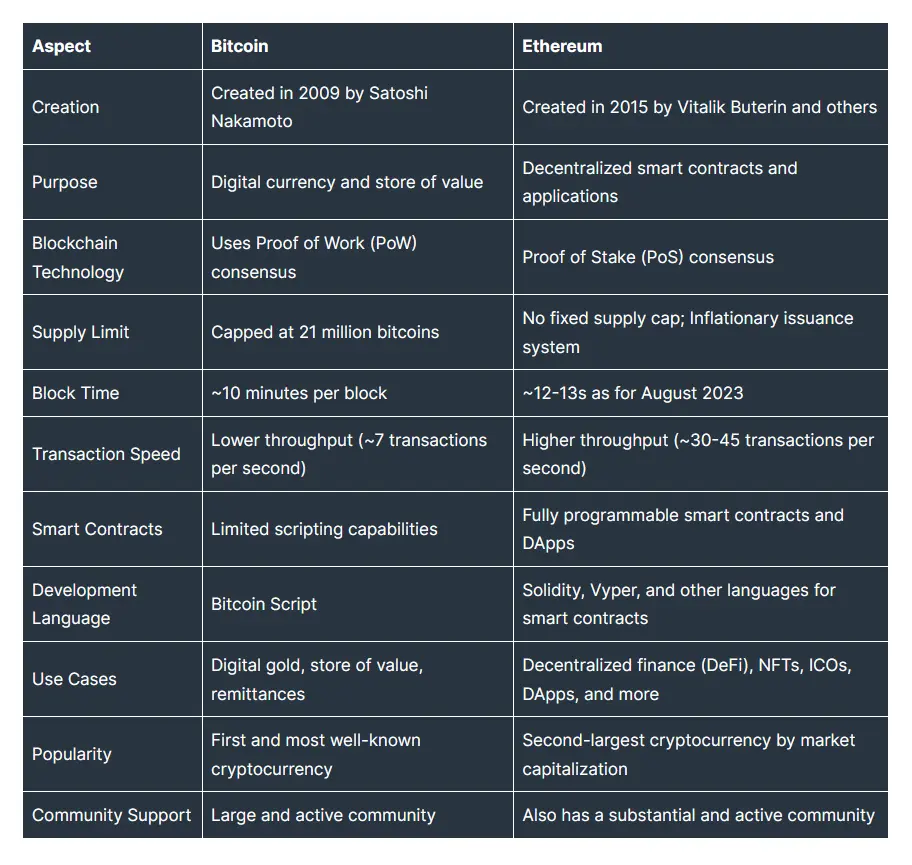
- Purpose and Role: Bitcoin was established as a decentralized digital currency aimed at functioning as a store of value and a means of exchange. Ethereum, conversely, is a decentralized platform allowing the creation and operation of smart contracts and decentralized applications (DApps) that exceed mere transactions.
- Blockchain Technology: While both employ blockchain technology, they use it differently. Bitcoin's blockchain is essentially dedicated to recording transactions and maintaining a ledger of ownership. In contrast, Ethereum's blockchain is engineered to execute intricate smart contracts and preserve application data.
- Consensus Mechanism: Bitcoin utilizes a proof-of-work (PoW) consensus mechanism, with miners vying to crack cryptographic puzzles to authenticate transactions and append blocks to the blockchain. On the other hand, Ethereum has shifted to a proof-of-stake (PoS) consensus mechanism, in which validators are chosen to generate new blocks based on the amount of coins they commit to "stake" or offer as security.
- Supply Cap: Bitcoin possesses a fixed supply limit of 21 million coins, thereby inherently deflationary. Conversely, Ethereum does not impose a supply cap, and its issuance rate varies, indicating that there is no predefined boundary on the quantity of ETH tokens that can be minted.
- Native Cryptocurrency: Bitcoin's native cryptocurrency is Bitcoin (BTC), while Ethereum's is Ether (ETH). Although both can be employed for transactions, Ether assumes a more multifaceted role within the Ethereum ecosystem, serving as the "gas" needed to run smart contracts and interact with DApps.
- Smart Contract Capability: Ethereum's blockchain is Turing-complete, enabling developers to craft sophisticated smart contracts capable of executing complex logic and automating a variety of processes. Conversely, Bitcoin features a more basic scripting language.
- Community and Applications: Both Bitcoin and Ethereum boast committed and dynamic communities, but they cater to distinct applications. Bitcoin is often deemed "digital gold" and a buffer against inflation, appealing to investors seeking a store of value. Ethereum's versatility has facilitated its uptake across diverse sectors, notably in the creation of decentralized finance (DeFi) protocols, NFTs, and enterprise applications.
BTC and ETH – Similarities
- Blockchain Technology: Both Bitcoin and Ethereum employ blockchain technology, leveraging a distributed ledger system to securely and transparently log transactions.
- Decentralization: These two digital currencies operate on decentralized networks, which means they function without a central governing entity or middleman, granting users enhanced control over their funds and information.
- Cryptocurrency Characteristics: Bitcoin and Ethereum, as native cryptocurrencies, are utilized for executing peer-to-peer transactions, transferring assets, and compensating for services within their individual ecosystems.
- Global Reach: Anyone with internet access can make use of both cryptocurrencies, facilitating transactions without borders and promoting worldwide financial inclusion.
- Unalterable Transactions: Once validated, transactions documented on the Bitcoin and Ethereum blockchains are immutable, which means they cannot be modified or deleted, thereby ensuring the security and integrity of data.
- Public Accountability: Both networks provide public transparency, enabling anyone to scrutinize and authenticate transactions via their blockchain explorers, bolstering trust and responsibility.
- Volatility: The prices of Bitcoin and Ethereum are known to fluctuate significantly, with their values being influenced by factors such as market demand, supply, and overall sentiment within the cryptocurrency sector.
- Community Involvement: Both cryptocurrencies are supported by enthusiastic and engaged communities, which contribute to their continuous development, acceptance, and progress.
Ethereum vs Bitcoin – Highest Price Ever – ATH
In April 2021, Bitcoin, the pioneer cryptocurrency, reached an all-time high price of over $63,000 per coin. This surge was largely fueled by increased institutional interest, corporate adoption, and growing mainstream recognition of Bitcoin as a potential hedge against inflation and economic uncertainties.
Similarly, Ethereum, the second-largest cryptocurrency, witnessed a substantial price surge during the same period. In May 2021, Ethereum reached its all-time high price, soaring to over $4,300 per coin. The surge was primarily driven by the growth of decentralized finance (DeFi) applications and the booming non-fungible token (NFT) market, both of which heavily rely on the Ethereum blockchain for their operations.
Summary
The cryptocurrency world is dominated by two formidable players: Bitcoin and Ethereum. While both digital assets share the same blockchain roots, they serve distinct purposes and employ different technologies. Bitcoin, the pioneer cryptocurrency, was designed as a decentralized digital currency and a store of value, offering scarcity with a fixed supply limit of 21 million coins. On the other hand, Ethereum revolutionized the landscape with smart contracts, enabling developers to create decentralized applications and ushering in the era of decentralized finance (DeFi) and non-fungible tokens (NFTs). Bitcoin’s simplicity and widespread recognition as digital gold continue to attract investors, while Ethereum’s versatile ecosystem and programmable capabilities appeal to developers and entrepreneurs alike.

Frequently Asked Questions About ETH vs. BTC
What Is Bitcoin and Ethereum?
Bitcoin and Ethereum are two different cryptocurrencies. Bitcoin, created by an anonymous person or group using the pseudonym Satoshi Nakamoto, was the first cryptocurrency and is often referred to as digital gold. Ethereum, proposed by Vitalik Buterin in late 2013 and launched in 2015, is a blockchain platform that enables the creation of smart contracts and decentralized applications (DApps).
How does Bitcoin Differ from Ethereum?
While both are cryptocurrencies, their primary purposes and underlying technologies differ. Bitcoin is mainly designed as a decentralized digital currency and a store of value. Ethereum, on the other hand, is a decentralized platform for creating smart contracts and DApps.
What Are Smart Contracts?
Smart contracts are self-executing contracts with predefined rules written into code. They automatically enforce the terms of the agreement between parties without the need for intermediaries, making them tamper-resistant and transparent.
Which Cryptocurrency Is More Widely Accepted?
Bitcoin is more widely accepted as a means of payment compared to Ethereum. However, both cryptocurrencies are increasingly gaining acceptance in various sectors.
What Are the Transaction Speeds of Bitcoin and Ethereum?
Bitcoin’s transaction speed is relatively slower compared to Ethereum. Bitcoin’s block time is approximately 10 minutes, whereas Ethereum’s block time is around 30 seconds. This means Ethereum can process more transactions per second on average.
Which Cryptocurrency Is More Secure?
Both Bitcoin and Ethereum are considered secure due to their decentralized nature and cryptographic protocols. However, Bitcoin’s longer history and larger network make it generally perceived as more secure.
Can Ethereum Overtake Bitcoin in Value?
It’s challenging to predict future market dynamics accurately. While Bitcoin has established itself as a dominant cryptocurrency and store of value, Ethereum’s potential lies in its broader use cases and utility through smart contracts. Whether Ethereum can overtake Bitcoin in value depends on various factors like technological developments, market trends, and overall adoption.
This article is not supposed to provide financial advice. Digital assets are risky. Be sure to do your own research and consult your financial advisor before investing.





