
My original Ukrainian version below.
We have a wonderful anthem, and at the same time, over the last 10 years or so, I've often heard people say that certain moments in it sound somewhat pessimistic. That's why, in the cover, I created not only new music but also slightly adjusted the lyrics.
For example, the line: "We shall lay down our body and soul for our freedom..."
(In the Ukrainian language, you can understand "положим" (shall lay down) as: we shall sacrifice our body (life) and even lose our soul for our freedom).
I adjusted this to: "We shall lay down our enemies for our freedom."
Agree, such a change gives a more optimistic mood focused on victory, instead of a mood focused on one's own demise.
Similarly, in a few other places, I made very minor changes to the words, and thanks to this, the entire message becomes more life-affirming and inspiring.
The completely updated (my version) of the entire Anthem verse in Ukrainian will follow, and in this short intro, which is already finished, with a length of 55 seconds, the following words are used:
"We shall lay down our enemies for our freedom,
And we shall show that we, brothers, are of Cossack ancestry.
We shall stand, brothers, in a bloody battle from the Sian to the Don,
We won't allow anyone to rule in our native land;"
The teaser-video sequence itself is AI-generated (with the exception of the moment showing a salvo from Multiple Launch Rocket Systems in foggy weather – that is actual combat footage). While this doesn't need explaining to Ukrainians, I'm writing this blog for people all over the world who might not know, so I'll clarify: in the clip, I "animated" or brought to life in video format the photos of several Ukrainian cultural figures, poets, male and female, who passed away 100 or more years ago. Furthermore, I "animated" the statue of "Ukraine-Mother" (Batkivshchyna-Maty) into the appearance of a living woman. This statue is deeply symbolic for us. You can see this monument in Kyiv in the area of the National Museum of the History of Ukraine in the Second World War (on Lavrska Street), and at 102 meters tall, it is 9 meters taller than New York's Statue of Liberty.
Significantly, the "Ukraine-Mother" statue stands with a sword raised to the sky in her right hand and a shield in her left, and looks toward Russia (!). Therefore, it can be said, without exaggeration, that this is Europe's "Statue of Liberty." Moreover, while the statue in New York holds the torch of enlightenment and the law (the Book of the Constitution) in its hands, the "Ukraine-Mother" statue with a sword and a shield symbolizes the most direct readiness to defend our values and freedoms.
UPD: Initially, there was only a teaser here, but now I've replaced it with the full version:
Do you like my creativity?
Support my music project at the start:
PrivatBank Envelope https://www.privat24.ua/send/hxt1g
(I will be happy with any contributions, even if it's 50 cents. But if a thousand people contribute, that will be significant support for the project).
Bonus for patrons: You will be able to request songs (for example, a fresh remix of your favorite track)!
Stay with me, and you won't regret it: epic updates will be regular!
A Glimpse into the Ukrainian Anthem's History
The journey of our anthem is as resilient as Ukraine itself. The poem "The glory and freedom of Ukraine has not yet perished" (which I have now corrected in my cover to "Ukraine's glory and freedom are flourishing") was written in 1862 by the ethnographer Pavlo Chubynsky. The music was composed a year later by the priest Mykhailo Verbytsky. For its powerful patriotic message, it was banned during the Soviet era, a time when our cultural identity was systematically suppressed. The anthem was officially reinstated only after Ukraine regained its independence in 1991.
This is yet another reason why these words carry such profound weight for every Ukrainian.
And yet, over the past 163 years, much has changed; our nation has grown stronger even in the face of the most difficult challenge in history. So, I hope my minor edits to the lyrics have not offended anyone's feelings and that the absolute majority of Ukrainians will perceive them as correct and positive. The anthem should be a song that doesn't demoralize us, but inspires us the most.
The 'Ukraine-Mother' Statue (actual photo).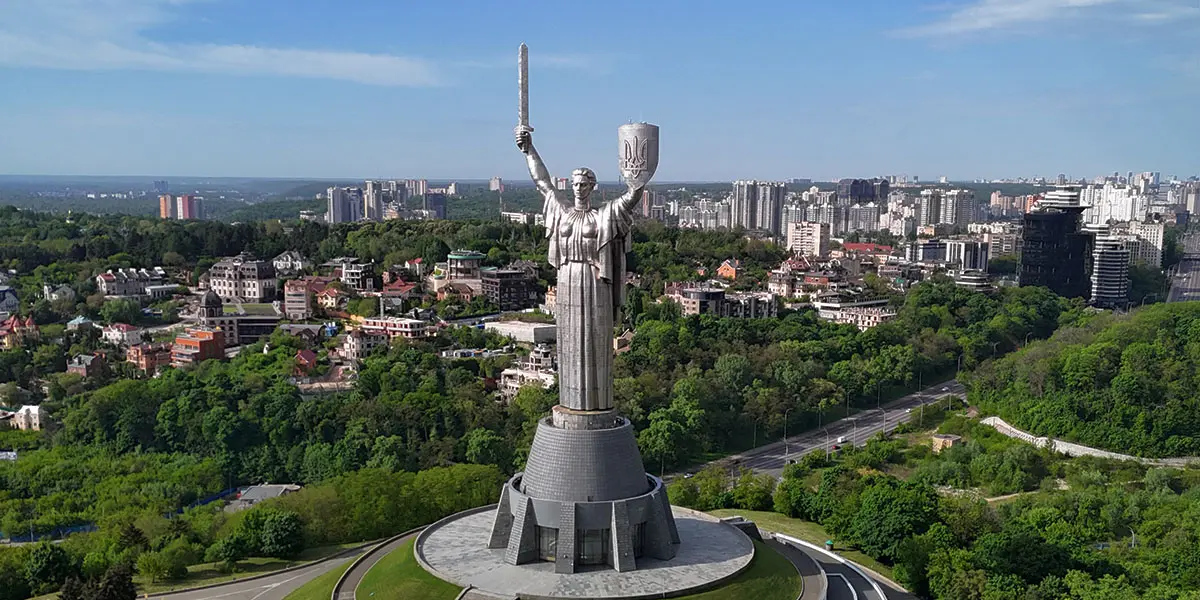
У нас чудовий гімн, і при цьому в останні років 10 я часто чув від людей, що певні моменти в ньому звучать дещо песимістично. Тому в кавері я створив не лише нову музику, але і трохи скоригував вірші.
Наприклад, строку "Тіло й душу ми положим за нашу свободу..." я скоригував на: "Ворогів своїх положим за нашу свободу".
Погодьтеся, така зміна дає більш оптимістичний настрій на перемогу, замість настрою на власну загибель.
Аналогічно і в деяких інших місцях я вніс зовсім незначні зміни в словах, та завдяки цьому весь меседж стає більш життєстверджуючим і надихаючим.
Оновлений вірш Гімну України повністю:
[Приспів]
Ворогів своїх положим за нашу свободу,
І покажем, що ми, браття, козацького роду.
[Куплет 1]
Розквітає України і слáва, і воля.
Ще нам, браття молодії, усміхнеться доля.
Гинуть наші вороженьки, як роса на сонці,
Вже пануємо ми, браття, у своїй сторонці.
[Приспів]
Ворогів своїх положим за нашу свободу,
І покажем, що ми, браття, козацького роду.
[Куплет 2]
Станем, браття, в бій кривавий від Сяну до Дону,
В ріднім краю панувати не дамо нікому;
Чорне море усміхається, дід Степан радіє,
Ще у нашій Україні доленька наспіє.
[Приспів]
Окупантів ми положим за нашу свободу,
І покажем, що ми, браття, козацького роду
(Козацького роду).
[Куплет 3]
А завзяття, праця щира свого ще докаже,
Ще ся волі в Україні піснь гучна розляже,
За Карпати відоб’ється, згомонить степами,
України слава стала поміж ворогами.
[Приспів]
Ворогів своїх поклали за нашу свободу,
Показали, що ми, браття, козацького роду
(Козацького роду).
[Вихід]
Окупантів ми поклали за нашу свободу,
Показали, що ми, браття, козацького роду
(Козацького роду!).
Трохи історії для зацікавлених
Історія нашого гімну така ж стійка, як і сама Україна. Вірш "Ще не вмерла України і слава, і воля" був написаний етнографом Павлом Чубинським у 1862 році. Музику до нього роком пізніше створив священник Михайло Вербицький. За свій потужний патріотичний посил гімн був заборонений за радянських часів, коли нашу культуру та ідентичність намагалися знищити. Офіційно його відновили лише після здобуття Україною незалежності в 1991 році. Це ще одна з причин, чому наш Гімн має таку глибоку вагу для кожного українця. І при цьому, за минувші 163 роки багато що змінилося, наша нація зміцніла навіть перед обличчам найтяжчого в історії виклику. Тож сподіваюся мої невеликі правки, внесені у вірш, не образили чиїхось почуттів і абсолютна більшість українців сприйме їх як коректні і позитивні. Гімн має бути тією піснею, яка не деморалізує нас моментами, а найбільше надихає в усьому.
Богдан Карасьов, 30 вересня 2025 р.,
з любов'ю до нашої Батьківщини і з великою повагою до наших героїв.






