
Spiti valley has got sobriquet of Moonland (or Martian Land) due to its Martian landscapes and near absence of flora/vegetation.
This region falls under the rain shadow of Greater Himalayan ranges. The rainclouds and the moisture-laden air is blocked by the towering mountains of Greater Himalayan range.
Due to this phenomenon, Spiti valley receives little to no rain precipitation.
However, heavy snow precipitation occurs during the winter months, majorly due to Western Disturbances.
This unique climate makes Spiti valley suitable for only rare kind of mammal species, bird species, ungulates and other fauna like:
- Snow leopard
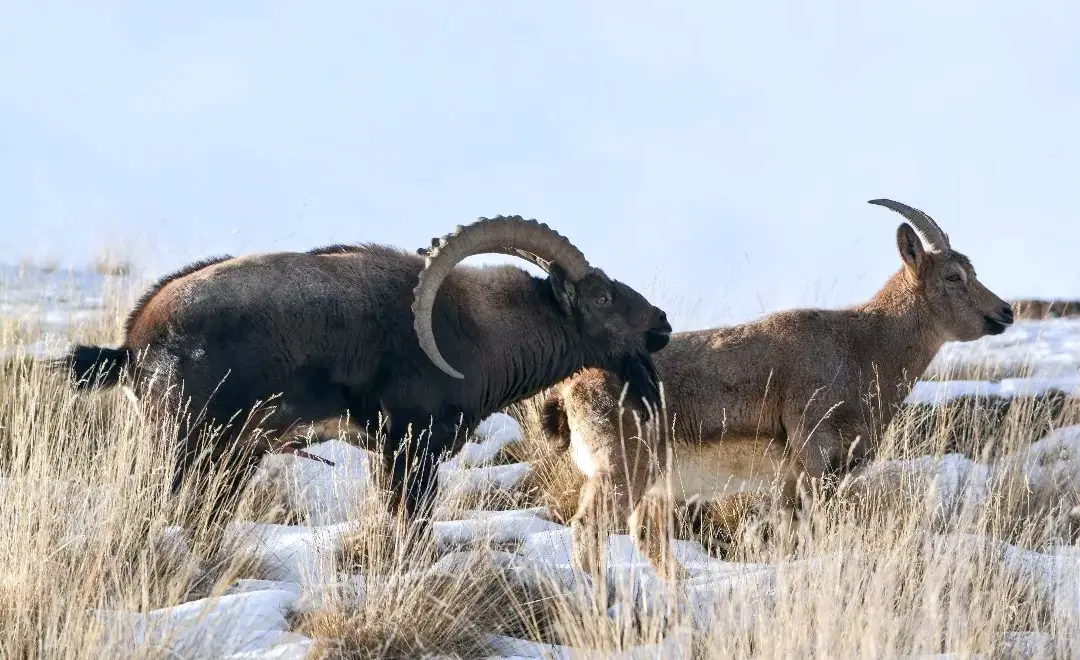
- Himalayan ibex (Capra ibex)
- Blue sheep (Pseudois nayaur)
- Red fox (Vulpus vulpus)
- White breasted stone / beech marten (aka Himalayan Weasel),
- Eurasian Lynx
- Tibetan Sandgrouse
- Himalayan wolf (Canis lupus)
- Long tailed marmot (Marmota caudata)
- Wooly Hare (Lepus oiostolus)
- Royal’s pika (Ochotona roylei)
- Snow cock
- Chukar partridge
- Himalayan griffon
- Lammergeyer
- Golden eagle
- Birds like Kestrel, Finches, Chough, Larks, Red starts.
Though the landscape and terrain in Spiti valley is rugged and bare (without trees and shrubs covered with snow in winter), photographing them in their natural habitat is still a challenge. There are a couple of reasons for this.

First, the habitat of snow leopards in Spiti are — majorly in regions of Kibber and Chicham — full of deep gorges, caves, steep cliffs and rocky outcrops. In fact, snow leopards find such topography and landscape suitable for them due to availability of prey (mostly ungulates like blue sheep and Ibexes) and they find it easy to stalking their prey from such vantage points.

Second challenge is posed by the frigid winter climate of Spiti valley. Day temperature in this region falls to -30 degrees in winter. Waiting for snow leopard sighting and staying still in such frigid conditions tests the limits of your grit and tenacity.
Moreover, the air is so thin here that it takes about 2-3 days to get acclimatized if you're visiting a high-altitude Himalaya region for the first time.
Unlike many of their big cat cousins, in Spiti valley, these elusive grey ghosts have never harmed a soul. Their presence whispers through the valleys, a fleeting glimpse of fur against the stark rocks. They are shy big cats who get uncomfortable if they find any human presence near them.
This is the reason we photograph snow leopards from a long distance (~500 meters far) on the first day of the sightings. On the third day, when snow leopard gets accustomed to our presence, we walk towards them and photograph them from near distance (about 150 to 200 meters). As snow leopard is a sensitive mammal, we try to keep as quiet as possible when photographing them from short distances.






