
If you have never ventured into the world of trading with proprietary firms, boy...well, I would say it is like a treat, but is it really?
On the face of it prop firms are awesome.
Increase your exposure without necessarily increasing your risk.
Sounds great. Especially if you have a winning system you have established. You can stay cool as a cucumber in the face of uncertainty because your system is built to handle the uncertainty that comes with doing your dance with the markets day in and day out.
So where is this first hidden truth, exactly? Well - right in front of you at the jump.
You sign up for a prop firm thinking, "Wow, this is the bee's knees - I get a $150k account for just $150!"
(or whatever the heck the firm is advertising...)
But it's not really a $150k account. Sure, you can get that as far as the amount of margin/leverage you have access to, but check that max draw down amount in that account. What's that? It's more like $4500? $6k?
That max draw down amount, that is your actual account size.
Your risk management approach of just 1% of the account risked per trade, won't necessarily work out very well if you are calculating that against $150k when in reality all you really have to wiggle around with is $4500.
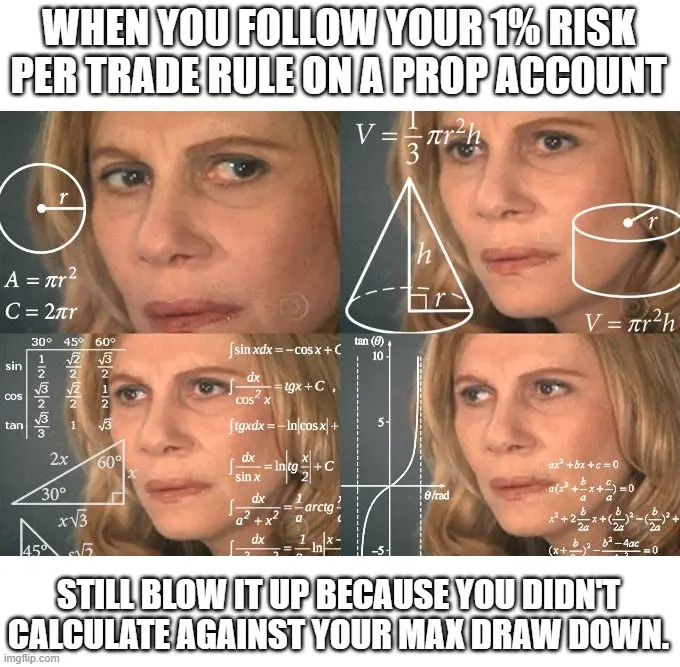
Not to mention that lots of these prop firms out there have some pretty tight risk management rules, like your max daily draw down amount could DQ you and forfeit your account. In the world of full-time trading you could have a draw down of 6% in a day. Shoot sometimes even 8% in a day. Does that invalidate your system to take an L that big?
No.
Not at all.
It is literally just a random distribution of probabilities.
Remember - it is not about being right all of the time. It's about not losing your pants when you are wrong.
If I may go back and bring back in the equity curve calculator and bring your attention to the little stat: Max Consecutive Losses.
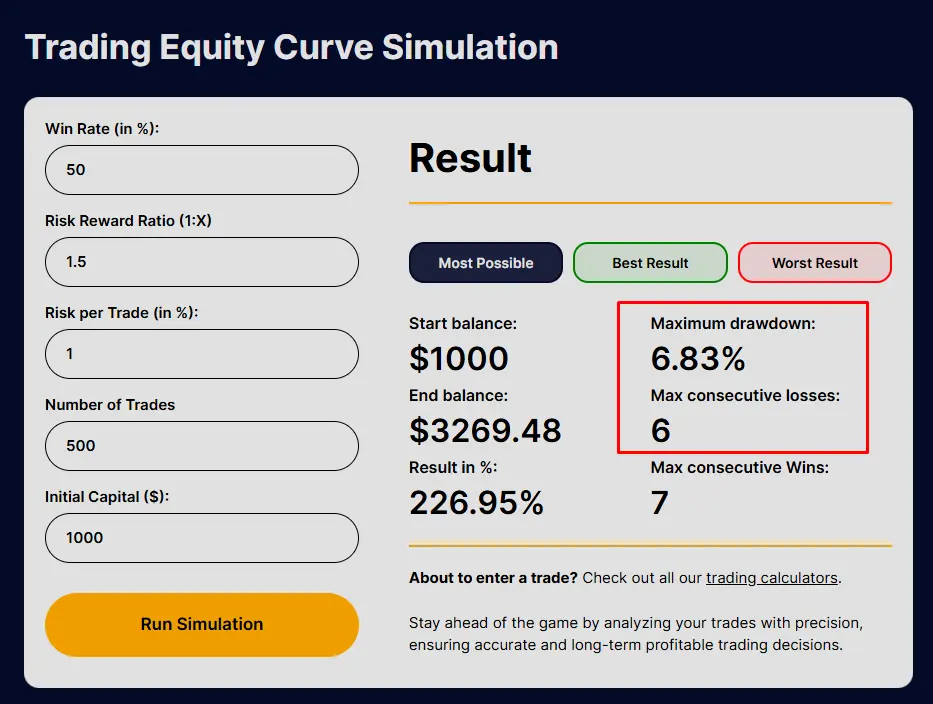
This calculation was run using the "Most Possible" setting - and with this roll of the dice, we are looking at a max drawdown of 6.83% and a max consecutive losing streak of 6.
To do some more math for the example of an account with a max drawdown of $4500.
1% of the account ($4500) is $45.
Is it realistic for your system to only risk $45 in each trade? Not usually. Especially if you are trading futures. There is definitely some drift and some time that price may move around your entry. You only get 100 times at bat with that risk profile. If you are trading traditional futures markets or FX, and even with some crypto based firms, you are trading contracts or standard lots. Those are already leveraged instruments, and if you are not using micros to scale into positions or manage your risk by padding your account with less risk, it is really easy to get wiped out in just a few ticks.
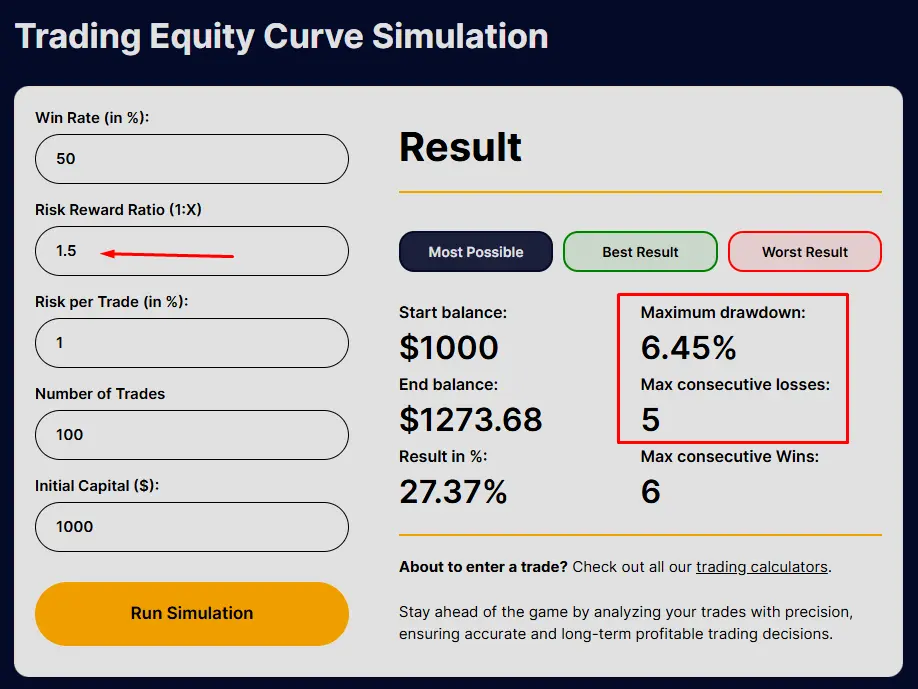
As long as your rewards are bigger than your losses, then even with a 50% hit rate, you're still winning. Even with max consecutive losses stacking up and making you question your decisions life.
So - how do you actually go about trading prop firms?
As systematically and disciplined as possible, of course.
More conservatively, too.
Of course, it makes perfect sense to stick with crypto firms. You have all of the best data and visibility into market data possible, why not increase your exposure without the proportional risk?
You can also alter your criteria for entries and become even more picky. Of course, if you only have a few ticks to wiggle, you have to have razor sharp invalidation criteria, and in the crypto markets - the ability to scale out and collect profits before you get round tripped on your entry and end up with a small loss because of exchange fees.
The other truth that people seem to overlook - To Proprietary Firms, You are a customer.
There are very few, true proprietary firms out there. Meaning, these are firms that have their own proprietary system that they teach traders - usually with tools that were developed in-house, and those traders work on those desks risking firm capital and never their own. These traders get a commission, of course. But if they really blow it bad, like hands in the air and decide that the system and check lists mean nothing, then you get the boot.
With firms that are selling you accounts, they are providing you a service. Read the fine print. Read the reviews.
They make money off you buying evaluation accounts, and hopefully not passing them so you keep forking over subscription fees month after month. Or they find some reason to deny your payout after you request it and followed their rules.
Ultimately - buyer beware. Use TrustPilot. Use Reddit. Check out their Discord servers. See what people on X are saying about them. Then decide.





