With its next-generation infrastructure powered by Hyperledger Iroha v2 and tested on the Fujiwara Testnet, SORA V3 is building the backbone for scalable, fast, and programmable digital economies. But just how big could this become?
If the success of Cambodia’s Bakong CBDC is any indicator, the answer is: very big.

The Cambodia Benchmark: 99,000+ Daily Transactions
Cambodia’s Bakong system processed 36.3 million transactions in 2023, amounting to more than 3x the national GDP (~$29 billion). That’s an average of ~99,000 daily transactions, driven by retail payments, interbank transfers, and digital remittances.
This level of adoption sets the gold standard for what a well-executed CBDC can achieve—especially in a mobile-first, underbanked economy.

Projecting CBDC Volume in the Pacific Region
Let’s extrapolate SORA V3’s potential transaction load if it powers similar systems in:
1. Papua New Guinea (PNG): Digital Kina
-
Population: ~9.9 million
-
Similar per-capita usage to Bakong: 2.14 tx/person/year
-
Projected transactions/year: ~21.2 million
-
Daily average: ~58,000 tx/day
PNG is already piloting the Digital Kina with help from Soramitsu. With a largely cash-based economy and increasing mobile coverage, the Digital Kina could mirror Bakong’s success.

2. Solomon Islands: Bokolo Cash
-
Population: ~720,000
-
Projected transactions/year: ~1.5 million
-
Daily average: ~4,100 tx/day
The Central Bank of Solomon Islands is working closely with Soramitsu to bring Bokolo Cash to life.

3. Palau: Blockchain Bond & USDP Stablecoin
-
While Palau is not launching a full CBDC, its stablecoin pilot (USDP) and blockchain-based treasury bonds form the backbone of its digital finance strategy.
-
Population: ~18,000
-
Projected transactions/year (conservatively): 100,000+
-
Daily average: ~300 tx/day
Palau’s approach is smaller in volume but extremely innovative.

Total Regional Transaction Load Estimate
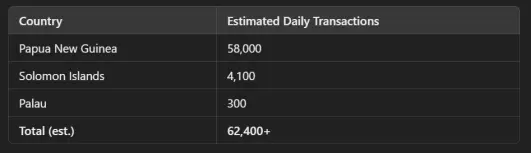
This doesn’t even account for scaling. As usage deepens and expands into B2B, government payments, and cross-border corridors, daily volumes could 2x to 5x within 2–3 years—potentially reaching half a million daily transactions across these countries alone.
So yeah—imagine your entire national treasury, your retail payments, your government bonds, and maybe even your cursed Excel-based subsidy system… all on a SORA V3 chain, with Hyperledger Iroha v2 under the hood, humming like a Japanese sports car.
And the kicker? It’s not some theoretical whitepaper thing.
Papua New Guinea? Testing it.
Solomon Islands? Building it.
Palau? Already issuing bonds with it.
The memes were right: “Money printer go brrr”... but now it's programmable, auditable, and runs in WebAssembly.