
indonesia is facing a plastic emergency, and Asia is at the center of it.
According to the OECD Global Plastics Outlook, Indonesia generates 9.1 Million Tonnes of plastic waste per year, making it the 5th largest plastic waste generator in the world. According to research published in Science, Indonesia is also the 2nd largest contributor to ocean plastic pollution in the world, with an estimated 196,000 tonnes of plastic entering the ocean annually. In the global Top 10 list, six countries are from Asia: Philippines, India, Malaysia, China, Indonesia, and Vietnam.
Despite a national target to reduce marine plastic by 70%, the recycling rate in Indonesia remains below 10%. Over 70% of plastic pollution comes from rural areas and small industrial cities where formal waste management does not exist. Industrial plastic waste is abundant but has no value.
What if we flip the model? What if plastic waste is not a cost, but a resource? And what if Solana is the funding rail that makes it possible?
Introducing FuelDAO: A Green DePIN on Solana
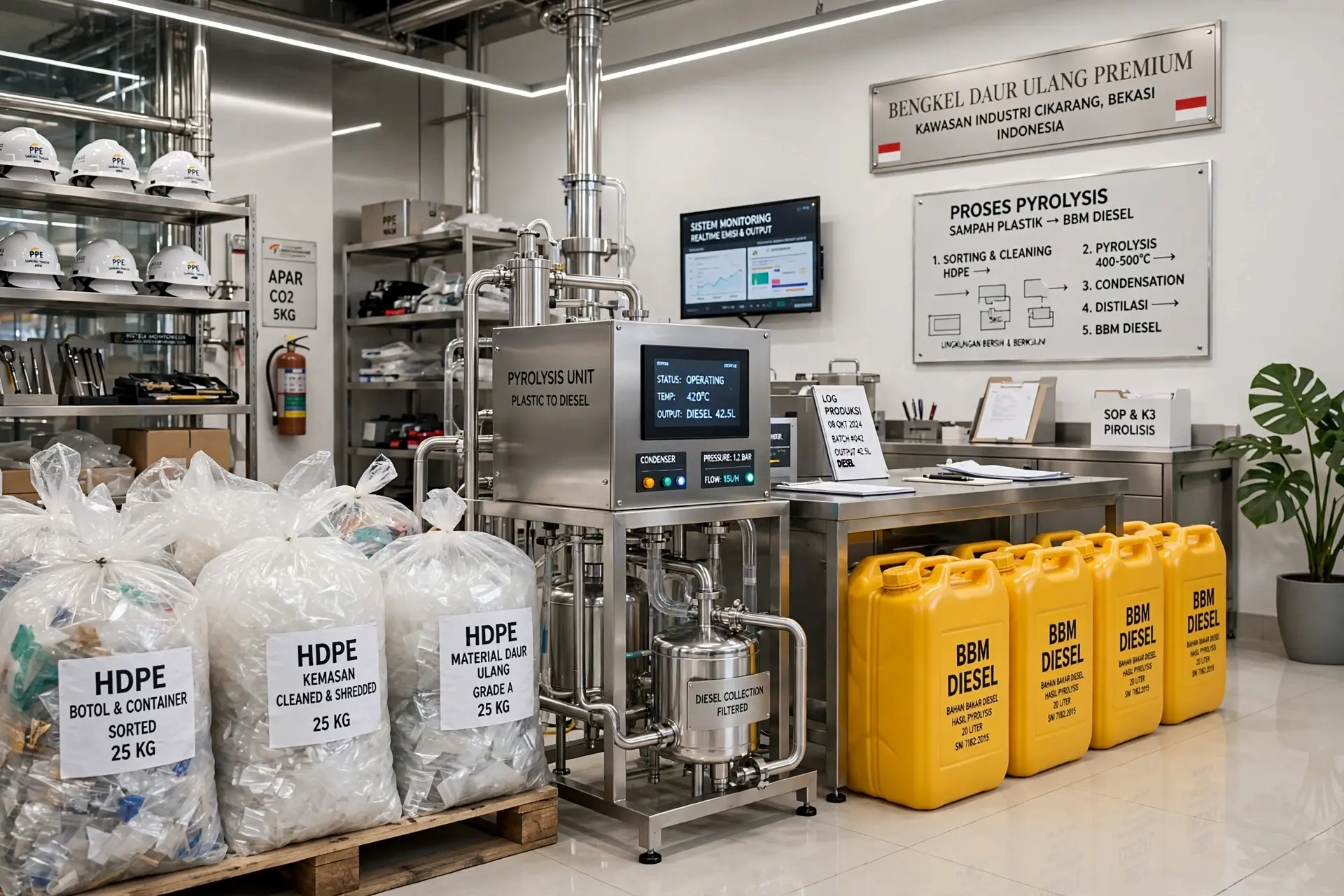
The technology to turn plastic into fuel already exists. It is called pyrolysis. Using high heat without oxygen, 1kg of industrial plastic (LDPE, HDPE, PP) can be converted into 0.8 to 1 liter of diesel-like fuel. The fuel can be used for fishing boats, diesel generators, and trucks after basic filtering.
A small-scale pyrolysis machine that processes 100kg per day costs $5,000 to $7,000. The problem is not technology, it is capital. Local operators in Indonesia cannot afford the upfront cost, and banks will not fund a waste business.
This is where Solana solves the funding and payment gap.
How FuelDAO Works
Phase 1: Funding via Solana
We create a DAO called FuelDAO on Solana. Global investors can invest as little as $10 in USDC or SOL. All funds are locked in a Solana smart contract with multi-sig. Funds are only released to purchase verified pyrolysis machines. The first pilot will deploy 10 machines in Indonesia's most polluted industrial zones across Java, Kalimantan, and Sumatra. Investors receive $FUEL governance tokens.
Phase 2: Buying Plastic Waste with SOL
Collection points are set up near rivers and industrial estates. Villagers and waste banks bring industrial plastic waste. Instead of cash, they are paid instantly in SOL or USDC via Phantom Wallet.
Rate: 1kg plastic waste = $0.05 USDC paid instantly.
A worker collecting 20kg per day earns $1 extra per day directly in crypto. No bank account is needed. Just scan QR and get paid in 2 seconds. Solana transaction fee is $0.001, making micro-payments feasible. This creates a direct incentive to clean rivers. This is DePIN cleaning the environment.
Phase 3: Selling Recycled Fuel with Solana Pay
Recycled diesel is sold 20% cheaper than official fuel at mini stations near fishing ports and farms. Fishermen, farmers, and drivers buy fuel using Solana Pay.
Price: 1 liter recycled fuel = $0.75 USDC or equivalent in SOL.
They open Phantom Wallet, scan the QR code using Solana Pay, and pay in 2 seconds. The operator receives USDC instantly. This gives SOL token real-world utility beyond trading. It becomes fuel money.
Phase 4: On-Chain Profit Distribution
Every liter sold is recorded. Profit is automatically distributed by a Solana smart contract weekly:
70% to investors worldwide - weekly USDC payout
20% to local operators for maintenance and labor
10% to Treasury for buyback and burn of $FUEL token and to buy more machines
Everything is transparent on-chain.
The Business Case: From Trash to Cash
One machine: 100kg plastic per day = 80 liters fuel per day
Cost: 100kg x $0.03 = $3 per day
Revenue: 80 liters x $0.75 = $60 per day
Net profit per machine: $57 per day
10 machines pilot: $570 per day = $17,100 per month = $205,200 per year.
100 machines across Indonesia: $1.7M per month, $20.5M per year.
1000 machines across Asia (Indonesia, Philippines, Malaysia, Vietnam): $17M per month, over $200M per year, all from plastic that would have polluted the ocean.
The environmental impact: 100 machines prevent 3,650 tonnes of plastic per year from entering the ocean.
Why Solana and Not Ethereum?
1. Fees: Ethereum gas is $3-$10 per transaction. You cannot pay $0.05 for plastic if fee is $5. Solana fee is $0.001.
2. Speed: Solana settles in 2 seconds. Perfect for queues at fuel stations.
3. Solana Pay: It is already built as a QR standard for real-world payments. Helium and Hivemapper proved DePIN works on Solana. Now we need Green DePIN.
The Question for the Solana Community
This is more than a green project. This is a DePIN with real economic impact and ESG value. Helium did it for internet, we can do it for fuel.
Should the Solana Foundation fund a Green DePIN like this in Indonesia, the epicenter of Asia's plastic crisis? Can we turn Asia's biggest environmental problem into Asia's biggest DePIN opportunity?
If you are from Indonesia, Philippines, Malaysia, or Vietnam and want to join as an operator or investor, comment below with your city.
Follow for the next post: a full cost breakdown of the first pyrolysis machine and video tour of industrial plastic waste in Indonesia.
#Solana #DePIN #GreenCrypto #Indonesia #Asia #PlasticToFuel #SolanaPay #RWA





