
How could it be easy to guess, in the collective imagination, if the capitals remain "still" in the sense of not invested, it does not work and therefore it does not produce profitability.
Not only that, if the assets that remain stationary are cash, in addition to not producing income, they can be devalued for obvious inflationary reasons.
Following the pandemic from which we are emerging, the United States has activated a Helicopter Money procedure, the so-called "stimulus".
This financial maneuver caused $ 1200 to “fall” into the wallets of all citizens. Promptly, some subjects who had the right advice immediately transformed them into Cryptocurrencies.
In the following chart we see the $ 1200 spike in Coinbase deposits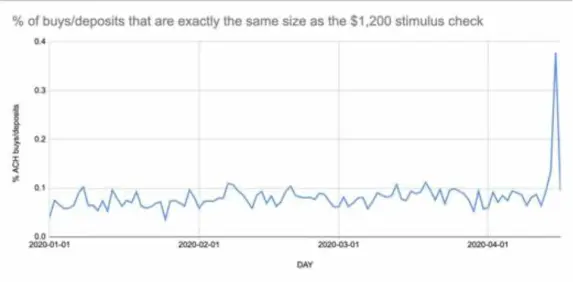
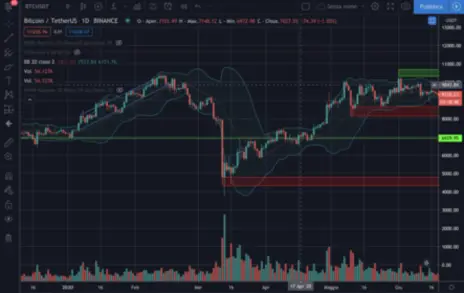
By doing so they invested them in an alternative market, which, although still young, has given good evidence of itself through the trend of BTC, in the graph below we see how there was a rather pronounced decline at the beginning of the Lockdown and then resumed and return to the February values.
In this way, however, the government's intention to oppose the recession has been thwarted: Helicopter Money aims to "give" money to citizens hoping that they will spend it on purchases to avoid blocking the supply chains.
Here, precisely, the reason that baptized it as "stimulus"!
For example, a greengrocer has the opportunity to stock up on raw materials with some peace of mind because buyers, with state subsidies, are not broke and continue to buy.
With the introduction of a new currency, it is possible to circulate it faster in order to keep production active.
Since we have understood how we can keep production going, we need to make sure that citizens can also profit from this operation.
The first thing you need to do is protect the value of your savings, but how can we prevent them from devaluation?
A good investment method that preserves value, and is applicable during the recession, can be on precious metals.
The key points in investments and trading
The recession induces a physiological fear in investors as the feeling of risk is amplified by uncertainty about the future; Nonetheless, Matthew Frankel, financial planner for The Motley Fool, says investing in a recessionary situation can be an opportunity to grow your wealth.
To be able to achieve an appreciable result despite a period of recession, Matthew Frankel recommends to follow 3 fundamental points:
1. Have large emergency savings;
2. Do not touch the investment portfolio for at least 7 years (in order to do so, it is necessary to strictly adhere to point 1);
3. "Forget" about the investment, in the sense of not being compulsive in monitoring.
Two fundamental situations that retail investors find it difficult to create immediately catch the eye.
First of all, they may find it difficult to create a large enough emergency fund to be able to divert a percentage of it into an investment.
Second, immobilizing a figure for seven years requires a series of very thoughtful evaluations, including an accurate estimate of the risk / return ratio of the designated asset.
Once the appropriate R/R evaluations have been made, time can be considered a variable that contributes to the success of the investment.
This strategy was refined by Hartman, adding three more points that he defined to be fundamental:
• Invest in what is profitable;
• The investment must be solid in the future
• Avoid the leverage effect.
Extremely important is the third point, namely not to use the leverage effect.
What is it?
The leverage effect is the trick used in Trading to be able to commit an Asset X times greater than that available.
The part of the Asset that we do not have is provided by various brokers on the platform.
In practice, if I enter the market with a Size of 1 and a leverage effect of 1:50, the Profit will be 50 times the size of the opening and vice versa. This is why special attention and scrupulous use of Stop Losses is required.
These Stop Losses will have to be as tight as possible so that if the market has a sudden decline the position will be liquidated, but in this way we limit the loss. But how much tight the Stop Loss should be? We are going to talk about it via my video-analysis that I am going to share soon on the Blog (https://www.publish0x.com/trading-with-mike-zillo)
We are aware that trading is not for everyone and in particular on cryptocurrencies due to their volatility; for this reason the literature recommends a provisioning strategy: the PACC.
We can consider the PACC (Cryptocurrency Cumulative Accumulation Plan, in the English version) the prince of the Smart Provisions that we can do in a time of recession.
Clearly this provision will have to follow an extremely prudent management of savings and the percentages of Payday that will be hijacked must in no way affect the family budget in any way.
The results of this provision will certainly not be visible in the short term: let us remember that time plays a very important role in investments, if we take BTC as an example from 2009 to date there has been no loss of any kind. The market has been fluctuating and in some periods, like this one, very high volatility, but the absolute value of BTC has always been growing.
To get the most out of your investment, you also need to diversify the forms of income, for example as I am doing with my plan, which I have explained to you in this article.
https://www.publish0x.com/smart-crypto-investing/how-many-ways-i-have-to-earn-with-cryptocurrencies-1-xvrodpd
Warning: with this I don't want to push anyone to do what I'm doing, it's just to bring my experiences and discuss them together.






