
14 million. That’s how many payments AI agents alone made in USDC over the last 30 days — not traders, not people tapping a screen, but autonomous software settling transactions in a token pegged to the US dollar, per CoinGecko. That’s where stablecoins are in 2026: no longer a crypto-native curiosity, but plumbing that both humans and machines route money through by default.
Banks close at 5pm. Wire transfers pause on weekends. SWIFT payments can take three business days to cross a border. None of that applies to a stablecoin. That gap explains why it has become the most-used category of crypto assets, even among people who have never bought Bitcoin.
A stablecoin is a cryptocurrency designed to maintain a stable value, typically pegged to the US dollar, by being backed by reserves — cash, short-term government debt, or other liquid assets. While Bitcoin can swing 8% in a day, a stablecoin like USDT or USDC is built to stay as close to $1.00 as possible, transaction after transaction.
That stability is the whole point. It turns a blockchain from a speculative casino into something you can actually use to hold value, pay someone, or park money between trades — without a bank account standing in the way.
By mid-2026, the total stablecoin market had grown to $308 billion, up 14.3% year over year, though it was about 4.5% below its May 2026 peak. Tether’s USDT alone accounts for roughly 59% of that supply, with USDC in second place near $75–78 billion. The top two together control over 80% of the market.
How Do Stablecoins Work?
Every stablecoin uses one of two mechanisms to hold its peg. Reserve-backed models (fiat, crypto, and commodity-backed) hold assets equal to or greater than the tokens in circulation and rely on redemption: if the market price drifts from $1, arbitrageurs buy the cheap token and redeem it for the underlying asset, or mint new tokens and sell them, pulling the price back toward parity. Algorithmic models skip the reserve and instead expand or contract supply through code based on demand — a mechanism that works until confidence in the token breaks down, at which point there’s no hard asset backing the price.
What Are Stablecoins Used For?
Trading and DeFi collateral are among the biggest use cases, offering a stable unit of account that lending, yield, and derivatives protocols can price against without exposing them to crypto volatility. Cross-border payments and remittances are also growing rapidly, as stablecoin transfers can settle in seconds, regardless of banking hours or borders. Businesses are increasingly using them for treasury management and cross-entity settlement, where waiting on wire transfers can create operating costs. For individuals, they can serve as an on/off ramp between fiat and crypto and as a way to step out of volatility without leaving the blockchain. A newer category is also emerging: machine-to-machine payments, where AI agents can transact directly in stablecoins without a human in the loop.
Why Stablecoins Exist in the First Place
Crypto’s biggest early weakness wasn’t security — it was volatility. A merchant accepting Bitcoin for a coffee in 2013 might have found the payment worth 20% less by the time it settled. A trader closing a profitable position often had nowhere “safe” to sit in crypto without cashing out to a bank, only to lose hours or days to settlement delays.
Stablecoins were created to solve crypto’s volatility by pegging their value to a trusted currency. The idea first showed up in the 2012 Mastercoin documentation as a theoretical proposal, but it did not become tradable until Tether Limited launched USDT in 2015. Adoption picked up in the late 2010s and accelerated from 2020 onward, as decentralized finance introduced lending, trading, and yield products that needed a stable unit of account.
The Main Types of Stablecoins
Not all stablecoins are built the same way. Understanding the type tells you exactly what risk you’re taking on. There are four standard categories, based on what actually backs the token:
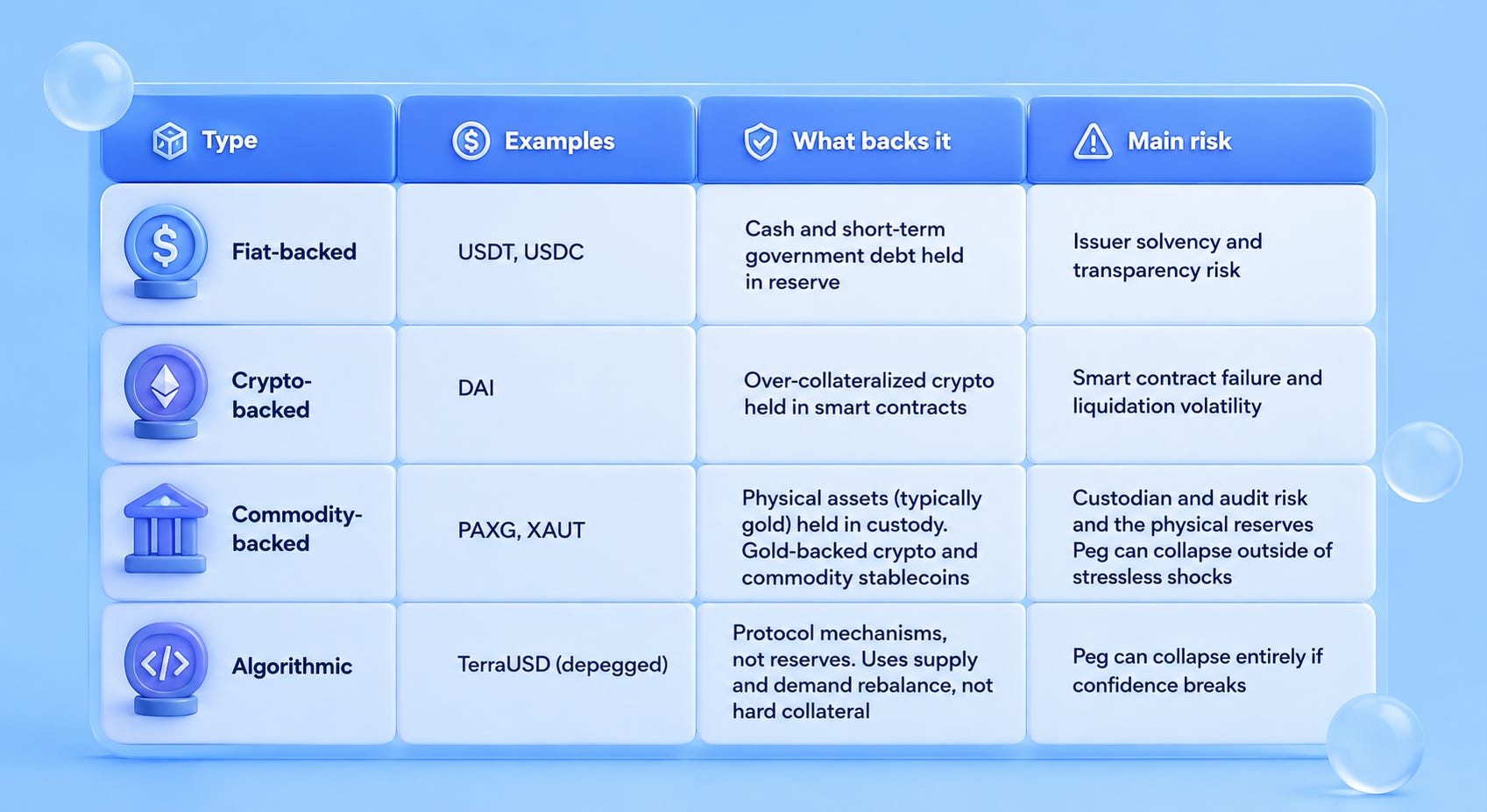
Fiat-backed stablecoins (USDT, USDC) are the simplest and most widely used. A company holds real dollars or dollar-equivalent assets in reserve and issues one token per dollar held. You’re trusting the issuer’s reserves and its willingness to redeem, which is why reserve transparency matters so much when comparing them. Tether publishes quarterly attestations of its reserve composition; Circle has leaned harder into full audits and a reserve structure built almost entirely around cash and short-dated US Treasuries.
The concentration runs deep: on TRON, the second-largest stablecoin network, roughly $85 billion of its $87 billion in stablecoin supply is USDT alone, over 97% of the network’s liquidity sitting in a single token, according to Bitcoin Foundation data.
Crypto-backed stablecoins, like DAI, are backed by other cryptocurrencies locked in a smart contract and are usually over-collateralized to help cushion price swings. No single company controls issuance — the code does. The trade-off is that smart-contract and liquidation risks replace issuer risk: if the collateral drops sharply, automated liquidations can occur faster than a person at a firm can step in.
Commodity-backed stablecoins, like PAXG or XAUT, are tied to a physical asset, almost always gold, that the issuer keeps in custody. Each token stands for a claim on a set amount of that metal. Here, the main trust is in the custodian and the audit trail — you are relying on the gold in the vault matching the tokens in circulation, and on redemption actually working when needed.
Algorithmic stablecoins aim to hold their peg through supply-and-demand rules built into a protocol rather than hard collateral. They are the most experimental category, and TerraUSD’s collapse in May 2022 remains the clearest warning: once confidence broke, the system’s stabilization mechanism exacerbated the sell-off rather than absorbing it. The token lost nearly all its value within days. That failure also points to why many newer designs move toward hybrid stablecoin models that combine different mechanisms to improve resilience.
Newer entrants are usually hybrids rather than a separate fifth category. Multi-collateral or synthetic tokens like USD3 or sDAI combine several stablecoins or add yield mechanisms on top of a fiat- or crypto-backed base, spreading issuer risk across multiple baskets. Compliance-forward, programmable stablecoins like Aave’s GHO or PayPal’s PYUSD use the same fiat- or crypto-backed reserve logic but are designed to integrate more smoothly into regulated financial systems and DeFi protocols, with reserve audits built in from the start. This is also the category quietly powering machine-to-machine payments: AI agents made roughly 14 million payments in USDC over a recent 30-day period, and nearly all of them used this stablecoin.
How Stablecoins Are Regulated: The GENIUS Act
The US GENIUS Act, signed into law in 2025, established the first federal licensing and reserve framework for “payment stablecoins,” requiring 1:1 backing and prohibiting issuers from paying yield directly. The full rules are still being worked out, but major payment companies like Visa and Stripe are already building stablecoin rails as if this will become standard financial infrastructure rather than just a workaround.
That’s the direction stablecoins are heading: less experimental, more like basic infrastructure that people only notice when it isn’t there.
What This Actually Means for You
If you’re holding crypto and want to get off the volatility rollercoaster without leaving the blockchain entirely, a stablecoin is that off-ramp. If you’re sending money across a border where local banking is slow, expensive, or simply unavailable, a stablecoin is often faster and cheaper than the alternative.
Worth keeping in perspective: of the tens of trillions of dollars in stablecoin transfers that happened in 2025, only an estimated $350–550 billion was genuine real-economy payments; the rest was trading activity and funds moving between wallets and exchanges, per Reap’s 2026 stablecoin data. Stablecoins are becoming a payments rail, but right now they’re still mostly a trading rail that also happens to work for payments.
Getting Your First Stablecoin: What the Process Actually Looks Like
For someone new to this, the practical question isn’t “what is a stablecoin” in the abstract — it’s “how do I actually get one without making a costly mistake?” SimpleSwap is a self-custodial swap aggregator that pulls liquidity from 20+ sources and routes across 2,800+ assets. It converts existing crypto directly into a stablecoin, such as USDT or USDC, and sends it straight to a wallet address you control.
As a SimpleSwap crypto exchange transaction, the process works like this: you choose what you’re sending, choose the stablecoin you want to receive, paste your wallet address, and confirm. Specifically for crypto-to-crypto conversions, does SimpleSwap require KYC? Identity verification is triggered mainly when a fiat payment partner is involved, since those partners operate under their own regulatory obligations — but it isn’t the only trigger across the industry. Some platforms also verify users above certain transaction thresholds, in specific jurisdictions, or as part of standard sanctions screening, regardless of whether fiat is involved in the trade. That distinction matters if you’re comparing platforms: some require full account verification before you can swap even between two crypto assets, while non-custodial aggregators generally don’t, as long as no fiat currency touches the transaction and no other trigger applies.
A Word on Risk, Because Every Stablecoin Carries Some
It’s honest to say that “stable” describes the intent, not an absolute guarantee. USDC briefly slipped from its dollar peg in March 2023 when Silicon Valley Bank was seized by regulators; it held part of Circle’s reserves at the time. It recovered within days once the reserves were confirmed intact. TerraUSD’s algorithmic collapse the year before never recovered. The lesson isn’t that stablecoins are inherently unsafe: it’s that the backing model determines how a shock plays out, and understanding that model before you hold a large position is worth ten minutes.
FAQ
Is a stablecoin actually risk-free?
No. It removes price volatility, not risk entirely — you’re still exposed to issuer solvency risk, smart-contract bugs, or regulatory action, depending on the type.
Which stablecoin is the safest?
There’s no single answer; it depends on how much you weigh issuer transparency, liquidity, and decentralization against each other. Diversifying across multiple options is a common approach.
Can I lose money holding a stablecoin?
Yes, if the peg breaks (a “depeg” event) or the issuer fails to honor redemptions — which is why understanding what backs a stablecoin matters more than its price on any given day.
Do I need to verify my identity to buy a stablecoin?
Usually, only if fiat currency is involved in the transaction. Crypto-to-crypto conversions to a stablecoin on non-custodial platforms typically don’t require an account, though some platforms add checks above certain volume thresholds or in certain jurisdictions.
How is a stablecoin different from a regular cryptocurrency?
Regular cryptocurrencies like Bitcoin or Ethereum have no price peg and can fluctuate freely with market demand; stablecoins are specifically engineered to minimize fluctuations relative to a reference asset, usually the US dollar.
How does a stablecoin stay at $1?
Through reserve backing plus redemption arbitrage, if the price drifts, traders buy or redeem the token until it returns to parity. Algorithmic stablecoins instead adjust supply through code, which is a less reliable mechanism, as TerraUSD showed.
What backs a stablecoin?
It depends on the type — cash and short-term government debt for fiat-backed tokens, other cryptocurrencies locked in a smart contract for crypto-backed tokens, physical assets like gold for commodity-backed tokens, or, for algorithmic tokens, no hard collateral at all.
What is an example of a stablecoin?
USDT and USDC are the two largest fiat-backed examples. DAI is a widely used crypto-backed example, and PAXG is a common commodity-backed example.
Is USDT a stablecoin?
Yes. USDT (Tether) is the largest stablecoin by market cap, a fiat-backed token pegged to the US dollar and backed primarily by cash and short-term government debt.
What happens when a stablecoin depegs?
Its market price moves away from its $1 target. The outcome depends on the backing model: USDC recovered within days of its March 2023 depeg once its reserves were confirmed intact, while TerraUSD’s 2022 depeg triggered a collapse it never recovered from.

This article was written by SimpleSwap — a self-custodial multi-source swap aggregator. 2,800+ assets, 20+ liquidity providers across CEX and DEX sources, 20M+ swaps since 2018. Wallet-to-wallet by design, with routing handled under the hood.
The information in this article is not a piece of financial advice or any other advice of any kind. The reader should be aware of the risks involved in trading cryptocurrencies and make their own informed decisions. SimpleSwap is not responsible for any losses incurred due to such risks. SimpleSwap’s only official domain is simpleswap.io.






