
A stablecoin sitting in a wallet waiting for the next trade earns nothing. A stablecoin lent, pooled, or parked in a tokenized Treasury earns something, and the something always has a source. This SimpleSwap guide is about finding the source before you commit, because every yield that ended in losses had one thing in common: the people earning it didn’t know where it came from.
Stablecoin yield comes from one of four places: borrowers paying interest to lend your dollars, traders paying fees to swap through a pool you funded, US Treasury bills backing a tokenized fund, or the funding rate paid in perpetual futures markets. In 2026, yields vary widely. Tokenized Treasury products generally track short-term Treasury rates, while major on-chain lending markets can move from low single digits into double digits when borrowing demand and utilization rise. Higher yields usually reflect higher borrowing demand, incentives, or additional risk, so understand the source before depositing. The safest way to earn is from a wallet you control, on a protocol whose code and reserves you can inspect, and never through a service that asks you to deposit first and explains later.
Where stablecoin yield comes from
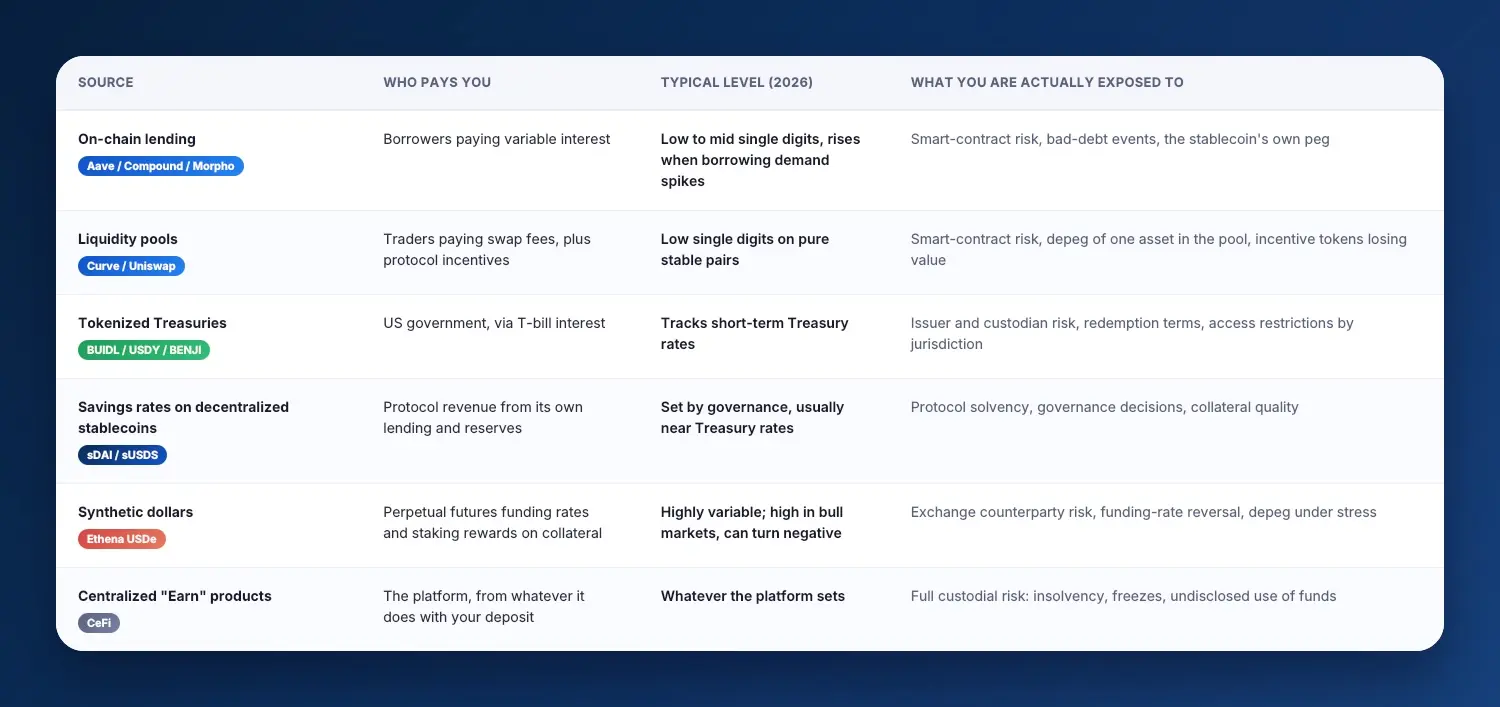
The first five leave the mechanism visible. The last one does not, and that difference is the whole subject of the next section.
The risks, in order of how often they cost people money
Custodial risk. Celsius, Voyager, and BlockFi all offered stablecoin yield in 2021 and 2022. All three froze withdrawals and filed for bankruptcy. Depositors were unsecured creditors. The yield was real until it wasn’t, and once deposits were on the platform, they never legally belonged to the depositors. This is the single largest source of stablecoin yield losses in the industry’s history, and it has nothing to do with blockchain technology.
Depeg risk. Terra’s UST was backed by the Anchor protocol, which paid roughly 20% until May 2022, when the peg broke, and about $40 billion in value disappeared in a week. The yield was funded by subsidies, not by any economic activity that could sustain it. More recently, USDC traded at about $0.87 for two days in March 2023 after Silicon Valley Bank failed. Anyone who had lent USDC or pooled it against USDT absorbed that move.
Smart-contract risk. Lending protocols and pools are code. Code has bugs. Audits reduce the probability but don’t eliminate it. The 2022 bridge exploits (Ronin, Wormhole, Nomad) took over $1 billion combined from contracts that had been reviewed.
Incentive decay. Many advertised APYs include a protocol’s own token as a reward. If that token falls 80%, most of the yield does too. Read the breakdown: base rate from fees or interest versus reward tokens.
Funding-rate reversal. Synthetic dollars earn when traders pay to hold long positions. During a prolonged downturn, funding turns negative, and the model pays out rather than earns. The design accounts for this with reserve funds, which have limits.
Regulatory change. The US GENIUS Act, signed in July 2025, prohibits issuers of payment stablecoins from paying interest directly to holders. Yield now sits above the stablecoin, at protocols and platforms, where the risk also lies.
How to spot a scheme before it takes your funds
Yield fraud has a recognizable shape.
-
A fixed, guaranteed rate that never changes. Real yield moves with borrowing demand and rates. A number that has held at 1% per day for months is a promise, not a market.
-
Rates far above the risk-free alternative with no explanation. If US Treasuries pay around 4% and a platform pays 15% on the same dollars, ask what it does with the money. If the answer is “trading bots” or “arbitrage” with no detail, that is the answer.
-
Referral bonuses as the main growth engine. Multi-level referral structures are how Ponzi schemes recruit their next round of depositors.
-
Withdrawal friction. Minimum lock-ups appear after you deposit, “processing” takes longer each time, or withdrawals require an upfront “tax.”
-
No verifiable on-chain footprint. A DeFi protocol has contracts you can read on a block explorer and a total value locked you can check. A platform that only shows you a dashboard number is asking you to trust the dashboard.
-
Pressure. Limited-time rates, countdown timers, a “manager” messaging you on Telegram. Real yield does not need a sales funnel.
Before depositing to any platform’s address, registered SimpleSwap users can run it through Address Check in the Customer Account to see a third-party risk level and known connections. A clean result is not an endorsement of the platform. A flagged one is a reason to stop. The Safety Academy covers broader scam patterns.
A practical approach
-
Decide how much of your stablecoin position should earn anything. Don’t put money you may need this week in a protocol.
-
Prefer sources where you keep custody. On-chain lending and tokenized Treasuries let you hold the position in your own wallet. A centralized Earn account does not.
-
Prefer sources with a legible mechanism. You should be able to say in one sentence who pays you and why.
-
Diversify across stablecoins and across protocols. A peg failure or an exploit should cost you a slice, not the whole.
-
Start with a small deposit and withdraw it. Confirm the round trip works before scaling.
-
Track the base rate, not the headline. Reward tokens are a bonus that can vanish.
Keeping custody while your stablecoin works
Every custodial yield failure began with the same step: sending stablecoins to an address controlled by someone else and receiving a balance in return. Self-custodial yield skips that step. You connect a wallet you control to a protocol, the position is recorded on-chain in your name, and you can exit whenever the protocol’s rules allow.
SimpleSwap is a self-custodial swap aggregator, and it does not offer yield. It fits in the movement around a yield position. If a protocol wants USDC on Base and you hold USDT on TRON, SimpleSwap converts one to the other and delivers it to your wallet without an exchange account and without a balance held on the platform. When you exit, the same route works in reverse.
The rate shown before you confirm is what you are expected to receive, with 0.2% fees included. A fixed rate holds the quote for 20 minutes. SimpleSwap routes across 20+ liquidity providers and holds no long-term user balances. The only official domain is simpleswap.io.
FAQ: stablecoin yield
How do you earn yield on stablecoins? By lending them on a protocol, supplying them to a liquidity pool, holding a tokenized Treasury product, or holding a stablecoin with a built-in savings rate. Each pays from a different source and carries a different risk.
What is a realistic stablecoin APY in 2026? Low to mid single digits on major lending markets and tokenized Treasuries. Rates can spike temporarily when borrowing demand surges. Sustained double-digit rates require a verifiable explanation.
Is stablecoin yield safe? No yield is risk-free. The main risks are custodial failure, depeg, smart contract exploits, and reward token collapse. Self-custodial positions on established protocols remove the first risk and leave the others.
Can you stake USDT? USDT itself has no staking mechanism; it is a token, not a proof-of-stake asset. “USDT staking” offers are lending or platform products under another name. Read the mechanism, not the label.
Why did Celsius and Terra collapse? Celsius took customer deposits, lent and invested them at a loss, and could not meet withdrawals. Terra’s UST paid subsidized yield its economics couldn't sustain; when confidence broke, the algorithm that maintained the peg failed.
Do stablecoin issuers pay interest? In the US, the GENIUS Act of 2025 prohibits payment-stablecoin issuers from paying interest directly to holders. Yield is available only through third-party protocols and platforms.
Do I pay tax on stablecoin yield? In most jurisdictions, yield is taxable as income when received. Rules vary; check your local requirements.
This article is for educational purposes only and is not financial, investment, or tax advice. Yields and protocol terms change; verify current figures before relying on any number here. SimpleSwap does not offer yield products. SimpleSwap’s only official domain is simpleswap.io.
Originally published on the SimpleSwap blog.






