
Ask a crypto user where their money is, and you will usually hear a wallet address or an exchange name. Neither answer settles much. The question worth asking is which database can freeze a balance while its owner watches.
That distinction has a price history. 850,000 BTC vanished in the Mt. Gox collapse of February 2014. FTX filed for bankruptcy in November 2022, with roughly $8 billion in customer funds missing, and its founder was sentenced to 25 years in prison. The two cases had almost nothing in common beyond the arrangement that made both possible: one party holding all the parties’ assets.
The industry absorbed that lesson as a slogan about keys. It works better as a map.
The four places crypto sits
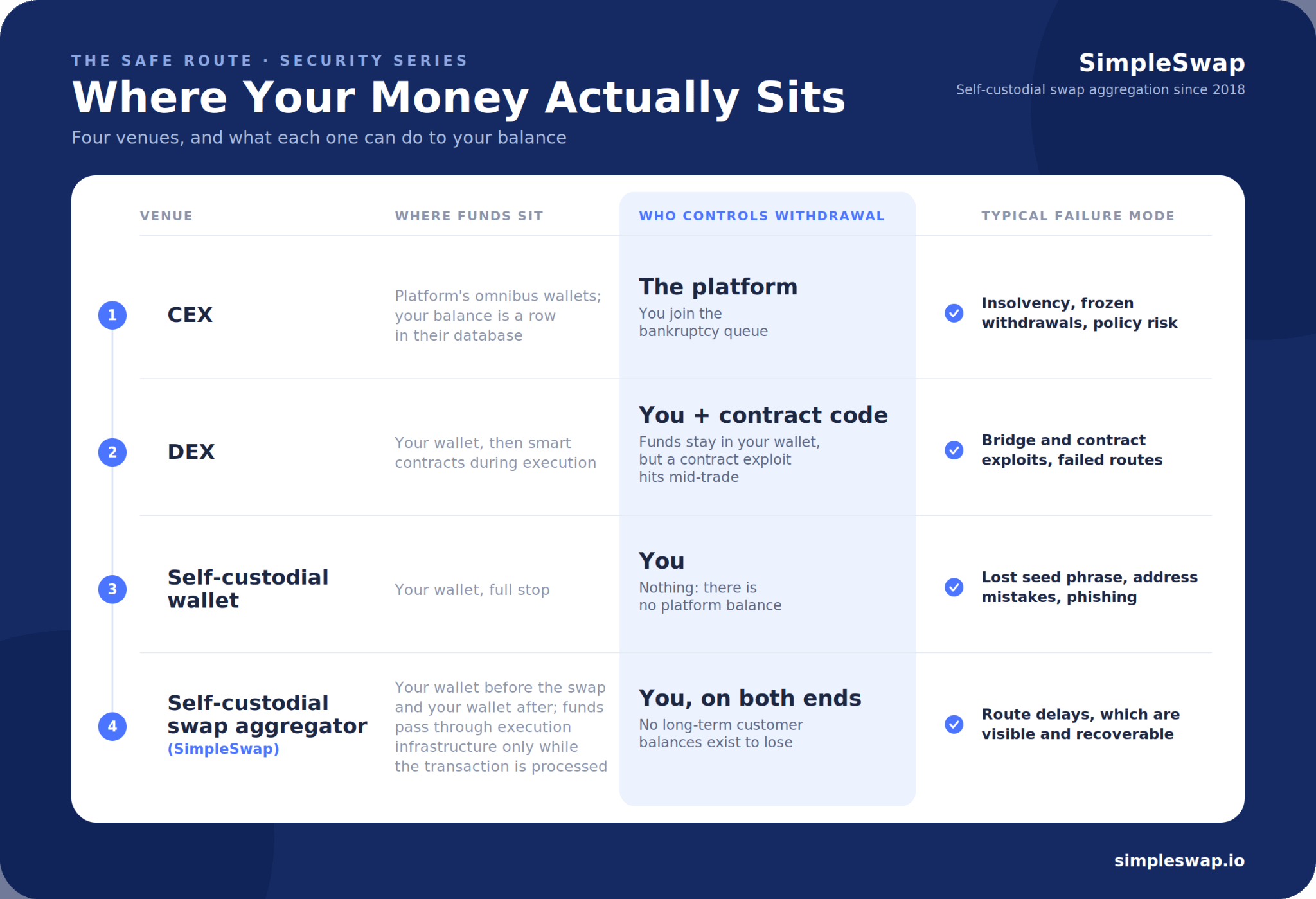
Rows three and four are not safer, only differently exposed
Read the table honestly, and it does not say self-custody wins. It says the risk changes shape.
An exchange balance carries counterparty risk, meaning someone else’s solvency and policy decisions are yours to live with. A wallet balance carries operator risk, meaning your own mistakes are yours to live with permanently. Nobody reverses a transfer to a poisoned address because the sender had good intentions.
The fourth row inherits that trade and adds one of its own. Funds are not parked anywhere; they pass through the execution infrastructure for the minutes it takes to execute a swap. That window is real. Calling it minutes rather than months changes the math without erasing it.
Why the hard part moved
The first version of self-custody was about ownership. The second is about execution, and execution got harder while the industry was busy congratulating itself on the first part. Liquidity in 2026 is scattered across dozens of venues, chains, bridges, RFQ systems, and aggregators built atop other aggregators. For a given pair and check size, the best executable route can change within the hour. The default expectation is that the user assembles it by hand, every time.
This is also where the size of an exchange stops meaning what people assume it means. A single venue prices against its own order book and whatever flow is passing through it at that moment. When depth runs thin for a specific pair, the quote reflects the limits of a single source, regardless of how large the brand on the door is.
“The argument about who holds your money is won. The one about how you move it is still open. SimpleSwap has spent eight years on the second argument while keeping the first intact.”
— Stefan Lauer, Head of Infrastructure, SimpleSwap
What the fourth row looks like in practice
SimpleSwap is one implementation of that row. A user gives a receiving address and sends funds from a wallet they control. The conversion routes span 20+ liquidity providers across CEX and DEX sources, and the output is sent to the specified address. Nothing accumulates between swaps because there is no account balance to accumulate.
The scale behind that single input: 2,800+ supported assets, 3.2M+ trading pairs, 20+ providers, 6,000+ partner integrations, online since 2018 through every cycle in between.
Which is why filing this under “exchange” misses the point. An exchange asks for a funded account and a standing relationship with an order book. An aggregator handles one transaction and then forgets you exist. Those are different products with different failure modes, and the table above is the shortest way to see it.
How to check any of this, including us
Whether SimpleSwap is safe is not a question about anyone’s good intentions. It is a question about what the structure permits, and the same test applies to every row above:
-
Where liquidity actually comes from, and whether the provider set is disclosed at all
-
How a quote is calculated, and what can move it between the estimate and the settlement
-
What happens to funds when a route stalls halfway through
-
Whether support answers a specific transaction ID or sends back a template
A reader deciding whether SimpleSwap is legit has sharper tools at their disposal than brand reputation. The long version of that evaluation, including the four engineering layers behind every aggregated swap, is in our self-custody guide on CryptoSlate.
None of it makes a swap risk-free, and any service claiming otherwise is selling something. What the fourth row does buy is a smaller promise: not “your money is safe with us for years,” but “your money is only here for the length of one transaction.” Smaller promises are easier to keep. That is the entire pitch.
The first decade of crypto was about who holds the coins. The second is about how they move.

This article was written by SimpleSwap — a self-custodial multi-source swap aggregator. 2,800+ assets, 20+ liquidity providers across CEX and DEX sources, 20M+ swaps since 2018. Wallet-to-wallet by design, with routing handled under the hood.
The information in this article is not a piece of financial advice or any other advice of any kind. The reader should be aware of the risks involved in trading cryptocurrencies and make their own informed decisions. SimpleSwap is not responsible for any losses incurred due to such risks.






