
Global investor attention is heavily focused on the crypto/blockchain market right now and the auxiliary opportunities emanating from it. In recent months, a particular focus for the big capital market has been on the tokenization of Real World Assets (RWAs).
The tokenization of RWAs presents an opportunity to transform traditionally illiquid, inaccessible, or exclusive assets into digital tokens. These tokens can then be traded on a digital exchange with no regard to geographical borders and other obstacles.
Note that this monumental opportunity includes both physical and non-physical assets like Real Estate, Precious Metals, Artwork, Intellectual Property, Fiat Currency, Commodities, Financial Instruments, Collectibles, Equipment and Machinery, Infrastructure Assets, etc.
The tokenization of Real-World Assets (RWA) is revolutionizing traditionally illiquid markets such as real estate, art, and maritime assets by making high-value assets more accessible.
By breaking these assets into smaller, tradable units, tokenization allows retail investors to participate in markets that were once dominated by wealthy individuals and institutions. This process democratizes ownership and introduces liquidity into markets that have long been difficult to trade. Simply put, tokenization gives people the opportunity to own a portion of valuable assets, much like buying shares in a company.
Vikas Pandey, Founder of Shipfinex

Dainis Tka also gave further insights:
From my experience in the crypto space, what makes me especially excited about RWA (Real World Asset) tokens is how they break down barriers that have kept so many people from participating in traditional finance. In the past, you needed serious capital to invest in assets like real estate or stocks, but tokenization allows for fractional ownership, making it possible for almost anyone to get a piece of the action. It’s a huge shift that I’ve been following closely, and I see it opening doors for people who’ve never had access before.
Dainis Tka, Co-Founder / Chief Growth Officer of CHEQs
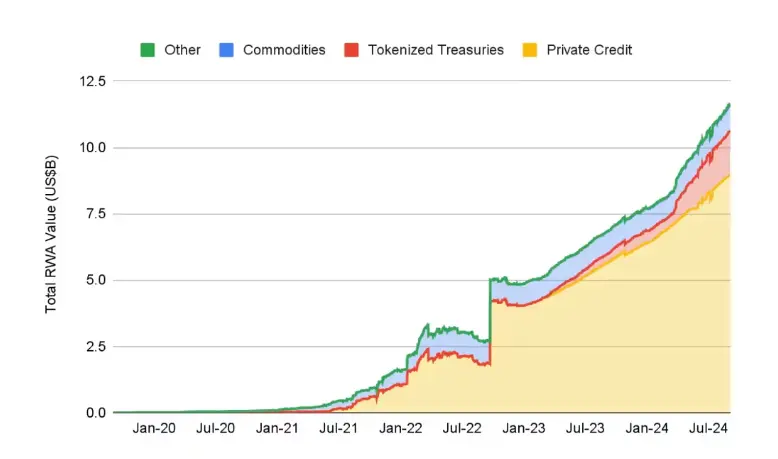
Currencies are also RWAs, so the entire stablecoin market can be considered a massive $200 billion use case. However, excluding the sprawling USD-pegged coin market, the current market capitalization of digitized RWAs hit an unprecedented $12 billion, up from $2.5 billion on September 2023.
RWA Tokenization Steps
The tokenisation of real-world assets encompasses several stages. They include:
-
Off-chain formalization.
-
Information bridging.
-
Blockchain integration.
Off-chain formalization is the first stage, where the underlying RWA’s ownership, legal status, and value are determined. The formalization stage is expected to be centralized and dependent on the issuer, as no viable alternative exists at the moment.
Furthermore, Off-chain formalization is followed by Information Bridging, which is the key tokenization stage. Once the worth and standing of the RWAs are determined, they are converted into digital tokens that also include information regarding the asset’s value and other metadata.
The final stage is the integration phase, in which the token data is incorporated into the blockchain ecosystem. This involves a ground-up decentralized system or other existing programmable blockchain networks like Ethereum, Solana, and others can be used.
Individual issuers will have a ton of responsibility here as they need to be able to manage the supply and demand of these tokens so that investors have the necessary available options.
Balancing Innovation with Regulatory Reality
The technical side of RWA tokenization involves smart contracts, data verification systems (oracles or direct API integration), identity management, compliance mechanisms, and issuing solutions.
While the development of RWA tokenization is in full swing, there are certain technical issues that need to be acknowledged and addressed. They include centralization fears, system complexity, reliability, privacy, and compliance issues.
Regulatory compliance is going to be key here, and without it, RWAs simply cannot function. Other crypto sectors were functional long before the advent of any regulatory body, but with this particular RWA economy, some form of centralization is necessary to be able to function.
Institutional Adoption and Infrastructure
However, the RWA sector is reporting great numbers, and it has the potential to burst into the scene in the near future. The participation of Traditional Finance (TradeFi) channels like banks, funds, and stock exchanges cannot be understated here.
The market value of tokenised U.S. Treasury funds has surpassed $2.2 billion, as indicated in the report. According to a Binance report, BlackRock’s BUIDL tokenised Treasury product is a market leader (market cap exceeding US$500M), and its US spot Bitcoin and Ether are among the most successful financial instruments ever launched on exchange platforms. Franklin Templeton's FBOXX ranks as the second largest tokenised Treasury product, whereas WisdomTree has further diversified with its tokenised equity products and other "Digital Funds."
The integration of institutional private chains with public blockchain subnets could reshape the digital securities landscape by enhancing market accessibility and liquidity for tokenized real-world assets (RWAs). This dual structure offers institutions the security and control of private channels while enabling broader investor access through public subnets, fostering a democratized market model.
Central to this shift are smart contracts, which ensure RWA integrity and compliance by embedding regulatory requirements directly into code. As traditional finance infrastructure converges with blockchain, new market-making strategies are essential to unlock the true potential of tokenized assets, building a more fluid and accessible asset market for the future.
Glenn Tan, CEO of Huros

Additionally, Jahangeer Ansari also mentioned:
The potential impact of RWA tokenization is substantial, with projections suggesting it could disrupt traditional markets on a massive scale. Major financial institutions are already embracing this trend, with some entering the RWA space to tokenize their vast portfolios.
Similarly, leading banks are leveraging tokenization to offer innovative solutions for clients through digital asset platforms. These developments highlight the convergence of institutional DeFi and traditional finance, potentially reshaping fundamental aspects of asset ownership, trading, and collateralization over the coming decade.
Jahangeer Ansari, Head of Investor Relations & BD of FU Capital

For the record, ETFs don’t fall under the specific category of RWA tokenization but they are closely related. They have a centralized register and represent a certain amount of crypto which is a non-physical asset.
Current and Future Use Cases
The use cases of RWAs are expanding beyond expectations—imagine you can co-own a property in the space. That might have never been possible for many who don’t live in fortune without the opportunity presented by RWA.
Among the well-known and established platforms in the RWA tokenising space are Chainlink, which provides oracle services for RWA data verification, and Ondo Finance, which specialises in real-world lending markets. In fact, a plethora of startups and emerging companies now exist.
Rexas is another example, with its ecosystem designed to enable access to the intriguing realm of blockchain and digital assets. Rexas provides essential tools for effective asset management, including the Rexas token builder, which enables the seamless tokenisation of physical assets, and the Rexas Launchpad, a platform that ensures secure and transparent token sales across multiple blockchain networks.
Other tools comprise GenAI, which produces digital art for the NFT market; Rexas Defi, facilitating trading across the network; Rexas Estate; and Rexas Treasury.
The platform utilizes technologies like artificial intelligence to enhance safety. Additionally, Rexas AI Shield facilitates real-time monitoring and assessment of smart contracts, ensuring regulatory compliance while concurrently reducing the probability of fraudulent activities—thereby fostering trust and transparency.
Vikas Pandey presented another use case from another angle. He analyzed the problem he solves with his company as a case study—Shipfinex.
At Shipfinex, we are bringing innovation to the maritime industry by enabling the fractional ownership of ships through blockchain technology. Shipping assets, which have traditionally been expensive and illiquid, can now be tokenized, allowing smaller investors to own a portion of a ship. This approach provides shipowners with new avenues for raising capital while giving investors access to an industry that was previously hard to enter.
He noted that Liquidity is not achieved overnight but over time.
Over time, as more investors and participants enter these markets, the liquidity challenge will naturally improve. Shipfinex is committed to fostering a healthy trading environment by developing a marketplace that encourages active buying and selling of tokenized maritime assets. Additionally, partnerships with key players in the shipping and financial sectors will help create greater trust and engagement in this new form of asset ownership.
Vikas Pandey, Founder of Shipfinex
Wrapping Up
What really stands out to me is the potential for financial inclusion. Having seen how traditional markets operate, I know how difficult it can be for everyday people to build wealth. But with RWA tokens, anyone can start diversifying their portfolio without needing to invest huge sums. It’s a personal passion of mine to see finance become more accessible, and I truly believe this technology is a step toward leveling the playing field for all investors.
Dainis Tka
However, this doesn’t necessarily mean that the RWA ecosystem is without challenges. In the words of Jahangeer Ansari, he mentioned:
While the growth of RWAs in DeFi presents numerous opportunities, it also faces challenges such as regulatory compliance, valuation, and custody solutions. However, the benefits are compelling, including enhanced liquidity, increased asset diversity, and improved transparency through blockchain technology.
Jahangeer Ansari
Vikas Pandey also contributed and spoke about the market infancy nature of the ecosystem.
As much as tokenization enhances liquidity, we recognize that it will take time before these markets become fully liquid. Early on, the liquidity of tokenized assets may still be limited due to the market's infancy and the need to build a robust secondary trading ecosystem.
Vikas Pandey
There has been a forecast regarding the future of the RWA market, as investors' attention has suddenly shifted and even as more companies and startups continue to debut in the ecosystem.
Looking ahead, forecasts suggest that tokenized assets could potentially reach significant market values in optimistic scenarios. This growth trajectory underscores the transformative potential of RWAs in bridging the gap between traditional finance and the decentralized digital economy.
Jahangeer Ansari, Head of Investor Relations & BD of FU Capital





