
AI technology significantly speeds up data theft and passwords breaches. See [1-4]. The recent hack of gmail.com (see [3-4]) puts at risk about 2.5 billion users. Experts recommend to change passwords faster than possible data hacks. For many users, management of frequent passwords changes to multiple accounts/devices/documents/etc is not a simple task.
A simple way to manage frequent changes of multiple passwords or private keys to multiple accounts/wallets/devices/etc is to use dynamical passwords generators (DPGs) with input data equal to the date of change. For example, suppose a user needs to change 20 passwords to 20 online accounts on September 3, 2025. The user enters the date as input data as well as her/his secret key “montecristo555” in a public DPG (dynpass.online) and with a single click generates 20 new and unique strong passwords.
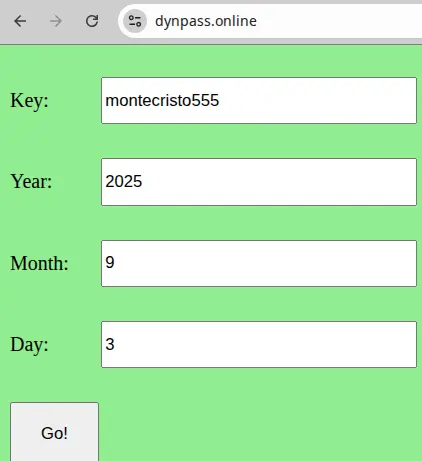
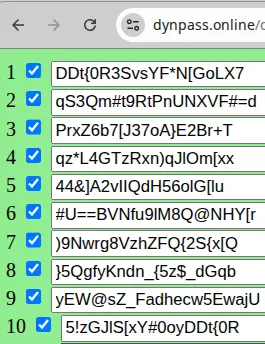
With a private online DPG users can change/create 100 passwords in a single click.
The user can keep all dates, on which she/he changes passwords in a file or paper notebook.
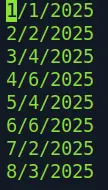
In this way, it is possible to reconstruct all passwords on any date, if it will be required.
All password managers, which keep passwords in encrypted files, have very serious security problems:
Problem 1. They violate the main principle of risk management (do not put all eggs into a single basket).
Problem 2. They have a single point of failure.
Problem 3. They are not ready for the Q-day.
A system design, which violates the main principle of risk management and has a single point of failure is the worst possible design, from a point of view of cyber security. The majority of modern passwords managers has this bad design.
In addition to these three big problems, modern passwords managers have multiple other hidden problems and vulnerabilities in user interfaces, encryptions, data bases with passwords, interactions among elements of the whole system, data base design and implementation, the whole system design and implementation, etc.
The better alternative is to use virtual passwords, managed by dynamical passwords generators (DPGs), which do not have any of these problems, because they do not save passwords in any place and instead generate them on demand, when they are needed.
In addition to high security and convenience, online private DPGs can be accessed from any device connected to internet and users can control their reliability.
Today, all web hosting providers guaranty 99.99% or more of up-time. This means that a probability that a site is down at a particular moment is 1/10^4 or less. By buying a single backup link ($15/year) it is possible to reduce this probability to 1/10^8. By buying two backup links ($30/year) it is possible to reduce this probability to 1/10^12. By buying three backup links ($45/year) it is possible to reduce this probability to 1/10^16. By buying four backup links ($60/year) it is possible to reduce this probability to 1/10^20.
Backup sites are based in different countries and continents. This means that all users, with access to internet, will have access to their private DPGs even in a case when internet on a single continent is down.
If each of 20 generated passwords is used as input into a converter then 20 private keys are generated. See [5].
By using public and private DPGs together, users can create unhackable passwords. See [6].
References:
2. https://www.digitaltrends.com/computing/a-hacker-turned-a-popular-ai-tool-into-a-cybercrime-machine/
4. https://gbhackers.com/gmail-users-reset-passwords/





