
There are many options for offline and online advertising today. The main questions are: which options to use and is paid advertising worth it?
In this post we consider a simple way to determine if it worth to pay for adds given data on prices and efficiencies of the ads.
A simple criteria is the following: if a price for ads is less than a revenue from new customers generated by the ads then it is worth to pay the price, otherwise not.
A number of new customers generated by the adds can be determined as a product of an exposure (how many people will see the ads) and a customer conversion ratio/rate (how many of those who will see the ads will buy products/services). It should be noted that usually, advertisers report action conversion rates, not customer conversion rates. Action conversion rates, for example click rates show ratios of users who took some actions (clicked on the adds or asked for more info) to the total number of users who viewed the ads. Actions conversion rates/ratios always lower than customer conversion rates/ratios.
An average revenue generated by a single customer can be calculated using the customer lifetime value calculator (see [1]). In the first field we enter an average yearly revenue per customer and in the second field we enter an average yearly churn rate of customers. Average churn rates by industries can be found on customergauge.com/blog/average-churn-rate-by-industry.
Let us consider an example.
Example 1. A site with content related to financial services has 10,000 visitors per day. An owner of the site wants $100 per day for an ad. Is it worth to pay for this ad if a customer conversion rate is 0.01% and an average yearly revenue per customer is $40?
For financial services an average churn rate is 19%.
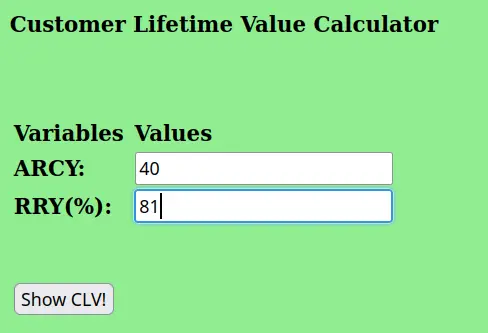
Using the customer lifetime value calculator we find that CLV=$210.53. From 10,000 visitors only one will become a customer (10,000*0.01%=1).
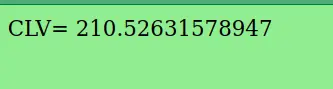
An average revenue generated by a single customer is equal to $210.5 is greater than the cost of the advertisement, therefore it is worth to pay for such ads.
Reference






