
Recent hack of Bybit, where a private key from the cold wallet was used to make fraudulent transactions valued over 1.4 bln. USD, shows that cold wallets are not as secure as it is advertised and believed. Virtual wallets are more secure, because they do not store private keys in any place. It is not possible to hack something if it does not exist in the real world. The only way to hack a private key generated by a virtual wallet is to intercept it when it is used by a user. If the user is careful enough the chance of this interception is very small.
In this post we consider a simple way to combine an online DPG with an offline converter to generate virtual BTC wallets.
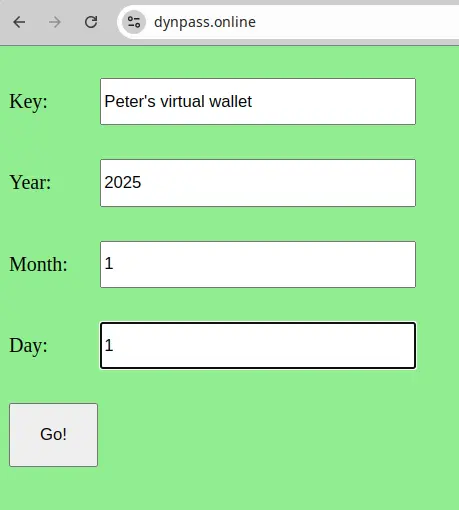
Step 1. Using an online DPG, for example dynpass.online, a user generates 20 output strings from an easy to remember key and date.
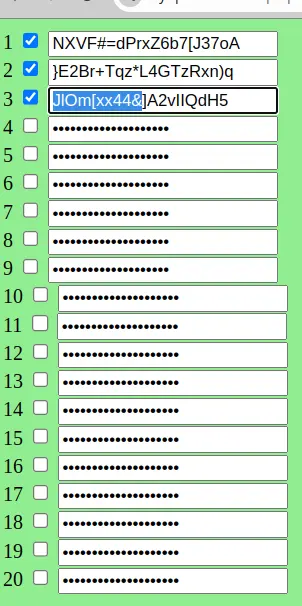
Step 2. From the generated 20 output strings the user creates a virtual key for the converter. For example, using 10 symbols from 1st, 2nd, and 3rd strings and combine them into the virtual key.
Step 3. The user runs an offline converter on an offline computer. After entering the virtual key the user see a mnemonic, seed, public and private keys of the virtual wallet.

The user writes the public key on a paper or in a digital form and gives it to all from whom the user is expected to receive BTCs. After closing the window, which displays the virtual wallet, it does not exist in any place. It can not be hacked, because this is an offline computer, Even if this computer will be stolen by criminals then the criminals will not find the private key, seed, mnemonic on the stolen computer.
If there will be a need to send BTCs then the user can use any tool, for example, such as a full node, lite node, CLI client, software wallet, etc. Those who are not familiar with such tools, can import the virtual wallet into any hot/cold wallet via options such as “import via a private key” or “import/recover via a seed” or “import/recover using a mnemonic”.
After completing the transaction the user has several options. The first option is to delete the imported virtual wallet from the hot/cold wallet to reduce risks of hacking the private key from the hot/cold wallet. The second option is to create a new virtual wallet and send all or most of BTCs to this new wallet/address. For the reason that the private key, seed and mnemonics of the new virtual wallet are not exposed (were not used) they do not exist in the real world and therefore can not be hacked, stolen, damaged, confiscated, etc. In this case, if the hot/cold wallet will be hacked then hackers will not find BTCs which were moved to the new wallet.






