
Since the crypto price collapse which started December 2017, there has been a great deal of talk on bubbles, price corrections, and actual value. Some suggest that Bitcoin is currently seeing the second bubble, which may or may not be getting close to bursting. However, like most economic issues, the truth is more nuanced.
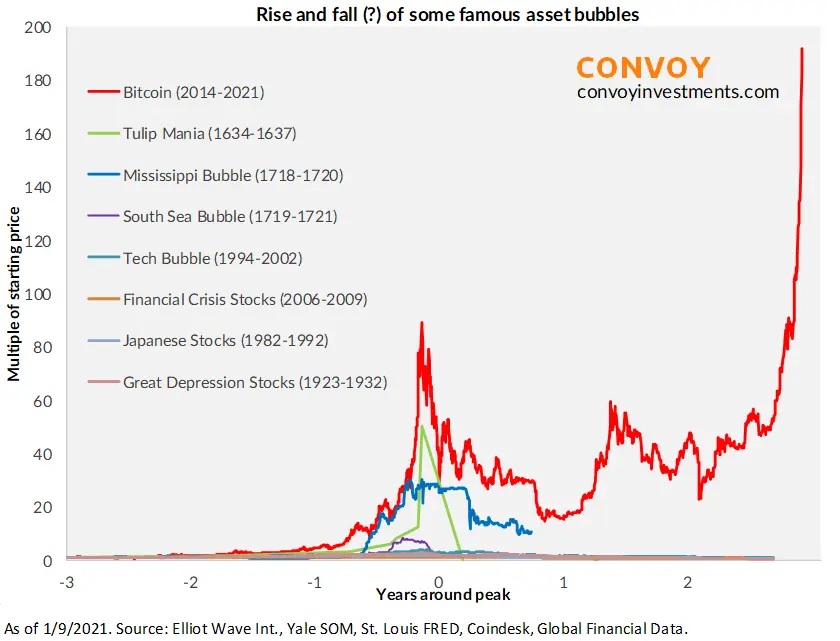
We should first recognize some limitations of Bitcoin. Presently, it is not viable as a currency replacement, since it takes too long to close, has high overhead, and suffers from volatility. Though it is likely to mature with time and technology improvements, is remains a speculative asset. For everyday use, there must be a greater level of stability. And until that is met, it cannot replace fiat, even as it reaches widescale adoption. No one will accept payment for their wage if it could lose half its value the following day.
With that in mind, we must note that the current growth is unsustainable and not organic. Should its trajectory continue through 2021, it would be worth more than the US Dollar economy, which is unwarranted, and would likely be stopped by the US, itself. They are not one for competition, after all.
But, even if Bitcoin is in a bubble, we may not be at the top. As governments print more money, the world economy is in a bubble of its own, with stock prices soaring as the easiest hedge against runaway inflation. There has been close to $18 trillion of negative yielding debt issued, with more on the way. That amount of excess capital is driving many to cryptocurrencies as an inflation-proof asset.
At the heart of it, investors are risk takers. And with the prevalence of stimulus money, and the lackluster appeal of low-yield securities, they will likely look to assets which have higher returns, even if they are seen as dangerous. Cryptocurrencies, despite volatility, serve that exact outlet.
It may well be that Bitcoin is overvalued, but it may well be worth more in comparison to the Dollar as the present and future effects of the economy realize their full effect.






