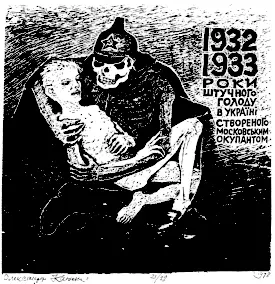
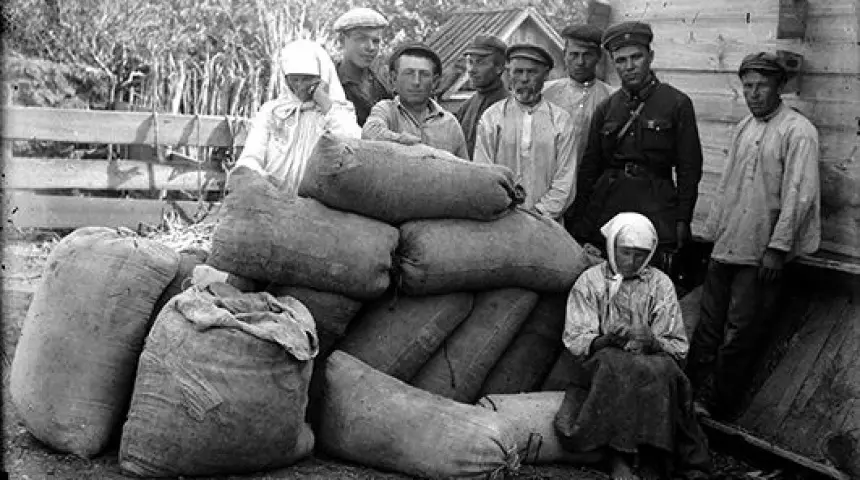
(IMAGE: Oksana Procyk, Leonid Heretz, and James E. Mace, Famine in the Soviet Ukraine 1932-1933: A Memorial Exhibition, Widener Library Harvard University, Harvard University Press, Cambridge Massachusetts, 1986, p. 71)
Stalin's Plan of Forced Collectivization and the Ukrainian Famine of 1932-1933
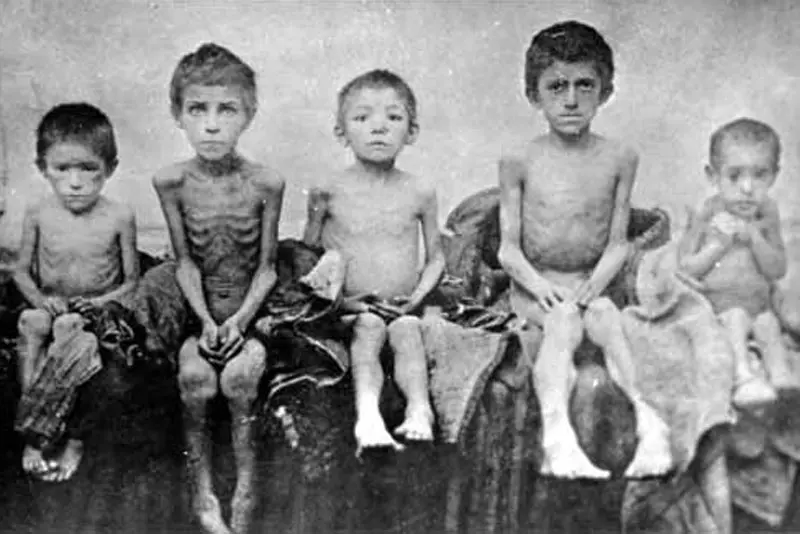
While there is an overwhelming abundance of materials and historical documents concerning the Holocaust and the extermination of over 6 million Jews by Hitler's Nazi Germany, one would be hard pressed to find even a fraction of media and historical records that chronicle the horror of Stalin's "forced collectivization" which resulted in the deaths of over, according to conservative estimates, 6 to 7 million Ukrainian people through starvation. Considered by many historians to be Stalin's most horrifying campaign, "forced collectivization" was the well-organized plan to crush the Ukrainian peasants by massive starvation by confiscating all available food throughout the regions of Ukraine, the northern Caucasus, and the lower Volga river area in 1932 to 1933. The effect of this "artificial" man-made famine was the complete breaking of the peasants' will to resist collectivization of farmland and agricultural products leaving the population politically, socially, and psychologically traumatized. Stalin's plan and the methods by which it was carried out are almost too horrifying to imagine: the execution or deportation of any man, woman, or child taking even the most minute amount of grain in order to stay their hunger, the confiscation of "seed grain" from peasant farmers, and the merciless war waged against anyone who refused to give up their grain resulting in the deaths of millions.
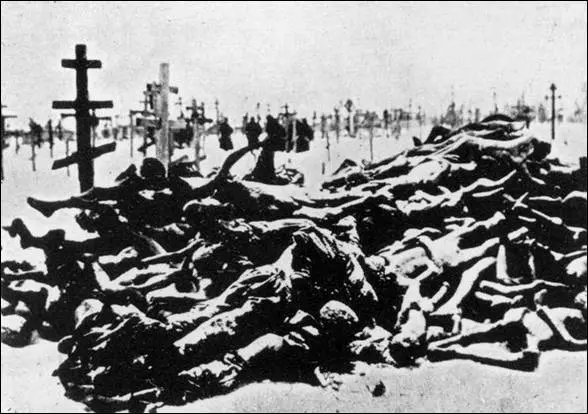
The origins of the famine are rooted in the decision of the Central Committee to completely collectivize peasant holdings of the more important grain-producing regions by, at the very latest, the autumn of 1932. This was a far cry from the original Five Year Plan of collectivizing twenty percent of sown land by the autumn of '32, but all pretense of using less drastic methods such as persuasion or economic pressure were discarded in favor of pure brute force, launching a civil war on rural agricultural areas of serious proportions without any planning or preparation economically and beginning a whole new era of terror of the Stalin regime. (Conquest, 18) Everything became out of control and in just a few weeks since it's implementation, the Party was looking at the disastrous effects of their decision. Robert Conquest, in his book The Great Terror: A Reassessment, writes:
Between January and March 1930, the number of peasant holdings brought into the collective farms increased from 4 million to 14 million. Over half the total peasant households had been collectivized in five months.
The peasants fought against the collectivization at first using any weapons at their disposal, and all the while "... they destroyed their livestock rather than let it fall into the hands of the state." (Conquest, 19) Bertram D. Wolfe, writes in his book Khrushev and Stalin's Ghost:
The peasantry fought for its life using fowling pieces and pitchforks. Uprisings embraced whole regions. Villages were surrounded and laid waste... Districts were stripped of their stocks of grain and seed then cordoned off to die of famine and plague. (Wolfe, 165)
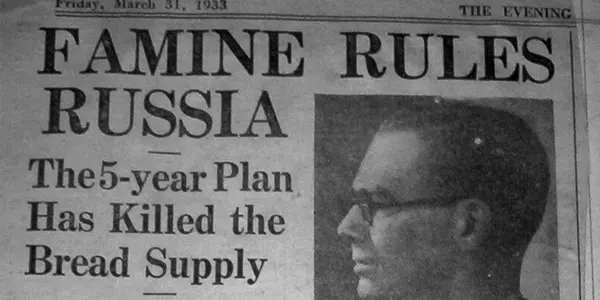
The reaction to the slaughtering of livestock (by the farmers so it would not fall into the hands of the state) and the intentional ruining of the farmland by letting it become overgrown with weeds and grass, was to swiftly punish the farmers who chose to rebel in this manner by execution:
In 1932 the state decreed the death penalty for stealing a bit of coal or grain from a freight train. Then the death penalty was provided for the collectivized farmer who might steal from the fields some of the product of his "collective labor;" then for the willful slaughter of his own cattle; then for letting "the cattle die by neglect." In March 1933, thirty-five officials of the Commissariat of Agriculture were executed after being 'tried' ... for having willfully permitted noxious weeds to grow in the fields. (Wolfe, 169-71)
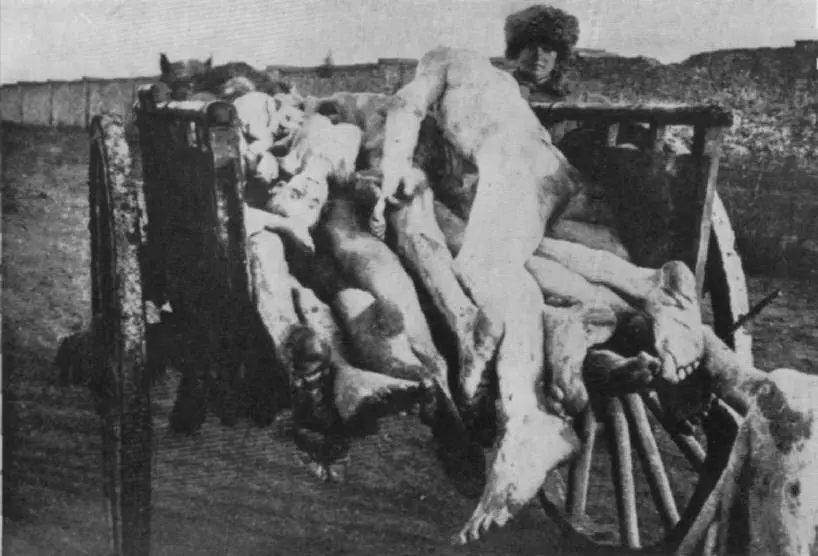
The fields being overrun by weeds and neglect by the Ukrainian peasants in a form of protest is also noted by Maurice Hindus in his book The Great Offensive: "... I never had seen such an abundance of weeds... the sugar beets... were literally submerged in weeds." (Hindus, 154) Stalin, even in the face of such open hostility from the peasants, would not halt his plans for complete collectivization. By well-thought out planning the Party took even more drastic measures and demanded quotas of grain to be met by the farmers that they could not possibly produce. Conquest writes, "There was enough grain, but it was taken away to the last kilogram." (Conquest, 20) Walter Duranty, in his book, USSR: The Story of Soviet Russia, tells of his travels through the famine stricken wasteland of the Ukraine in April 1933 and the recounting of the conditions there by a Red Army brigade commander (General):
The people were almost starving. Their animals were dead. I'll tell you more, there wasn't a cat or dog in the whole village, and that is not a good sign... Instead of two hundred and fifty families there were only seventy-three, and all of them were half-starved. They said, 'Our seed grain was taken away last spring. Comrade Commander, we are soldiers and most of us are Communists. When that order came that our farm must deliver five hundred tons of grain, we held a meeting. Five hundred tons of grain! We needed four hundred tons to sow our fields, and only had six hundred tons. But we gave the grain as ordered.'
'What was the result?" I asked the brigade commander.
"Barren fields" he told me. "Do you know they ate their horses and oxen, such as was left of them? They were starving, do you know that? Their tractors were rusty and useless; and remember, these folks weren't kulaks, weren't class enemies. They were our own people, our soldiers. I was horrified..." (Duranty, 194-95)
Stalin's own personal interpreter, Valentin M. Berezhkov, in his memoirs At Stalin's Side, gives his personal account of the ramifications of collectivization:
... what happened as a result of sweeping collectivization, for example in Kiev, where I saw it all with my own eyes. The entire infrastructure was destroyed. The service sector was disrupted. Artisans, small shop owners, shoemakers, tailors, watchmakers - were all gone. The Contract Market was closed down. Shops in Poldol were demolished... There was nothing left in the city. It was as if a hurricane had swept through it. (Berezhkov, 98)
The amount of peasants who died as a direct result of the artificial famine caused by forced collectivization is considered by many to be even greater than the numbers of Jews who fell to extermination by Hitler's Final Solution. Historian Clarence A. Manning in his book Ukraine Under the Soviets states "It is difficult to estimate accurately the number who perished in the famine, but it was approximately 4,800,000. This is certainly an underestimate, although certain other calculations will place the number between five and six million." (Manning, 101) But taking into account the natural repopulating that would have taken place if not for the great famine, the number of those that died and those that would have been born to the deceased the number would logically be much greater than that conservative estimate. John F. Stewart takes this into account in his estimation of the total number of casualties in his book Tortured but Unconquerable Ukraine:
While no official statistics about this tragedy have been published, there is a document - The Small Soviet Encyclopedia of 1940, in which it is stated that Ukraine had in 1927 a population of 32 millions, and in 1939, only twelve years later, a population of only 28 million. Where had the 4 millions gone to, apart from what should have been the natural increase of another 4 million? (Stewart, 8)
While most historians believe that Stalin's plan of forced collectivization was one of economic reasons, others seem to think that it was to destroy Ukrainian nationalism and hold together the multi-national Soviet Empire. Historian Valentyn Moroz in his paper Nationalism and Genocide: The Origin of the Artificial Famine of 1932-33 in Ukraine writes:
... the murder of seven million Ukrainians in 1933 could not have been motivated by socioeconomic or "class" reasons alone. Conflicts claim millions of victims only in struggles between nations, as in wars, colonial struggles, and so forth, when the national question is paramount. Moscow needed a holocaust. The imposed famine of 1933 and the whole range of repressive mass killings during the 1930's were an expression of the empire's struggle for self-preservation. It was this instinct, and not the economic doctrine of collectivization, which impelled the Kremlin to carry out the horrors of the 1930's. (Moroz, 207)
While one would think that such heinous crimes would not go unnoticed by the United States they apparently did. This is possibly due to the controlling of the press by Moscow in the manner that it only let journalists and newspapers have correspondents in Russia that would either downplay Soviet atrocities or ignore them altogether. (Pipes, 305) Walter Duranty, a correspondent for The New York Times, received favors and luxurious accommodations for skewing and outright lying about the conditions of the Soviet Union. Richard Pipes, in his book A Concise History of the Russian Revolution, states "Duranty... in exchange for a luxurious lifestyle, which included favors of a Russian mistress, turned into an outright apologist for the regime. His dispatches - which distorted Russian realities to the point of denying the Ukrainian famine of 1932-33 which claimed millions of lives - helped create in the United States a climate of opinion friendly to Stalin's Soviet Union, which in 1933 facilitated the granting of diplomatic recognition to that country." (Pipes, 306)
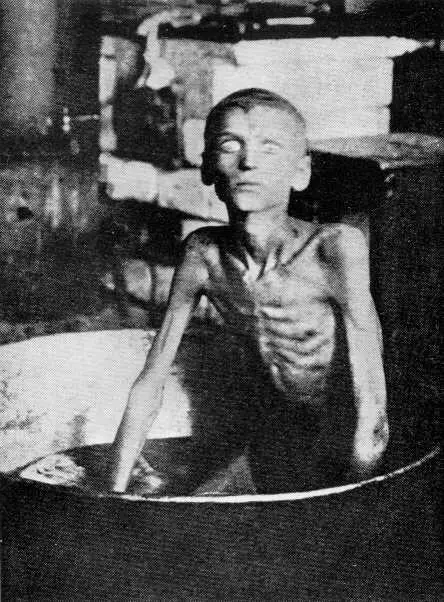
While it is almost incomprehensible the atrocities committed by Stalin and his policy of forced collectivization, it is almost equally damnable that history seems to turn a deaf ear to the plight of those Ukrainian peasants who perished in the famine of 1932-33. While almost everyone with an education greater than a third-grade level within the free world undoubtedly knows about the plight suffered by the Jews in the holocaust of Nazi Germany, barely a fraction of that number - if even that - has any idea of the suffering caused by the holocaust that plagued the Ukrainian region of the Soviet Union during the period of agricultural collectivization. We may never know just how detrimental the famine has been to the culture of this region; for we can only imagine how many productive members of society or great minds that were destroyed by the inhumane policy created by Stalin's Soviet Union before they were able to flourish.
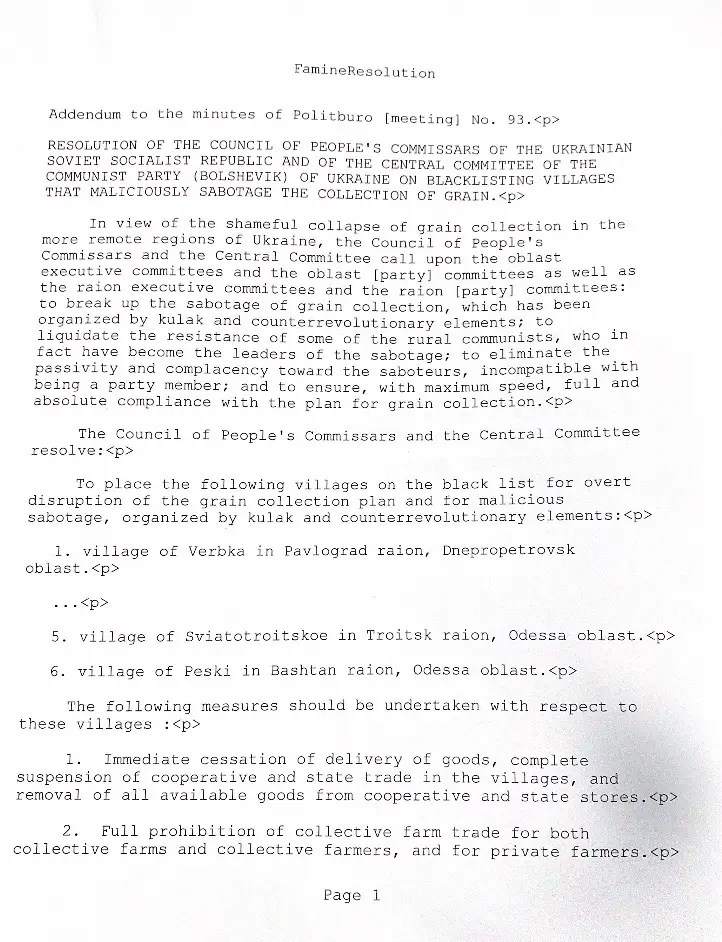
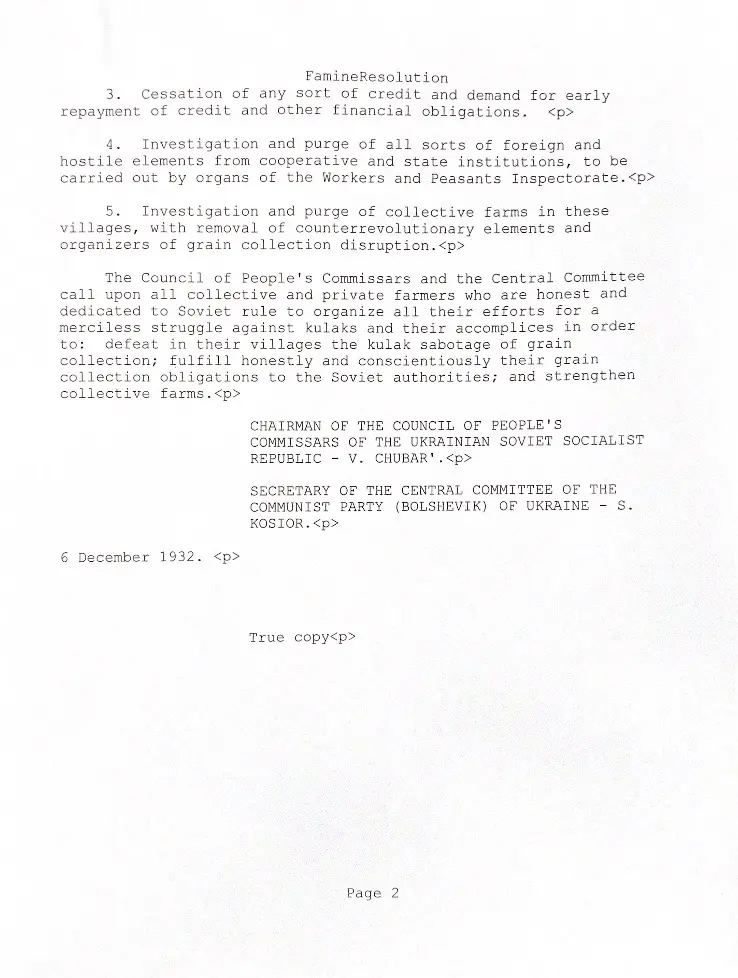
Additional Resource: Addendum to the minutes of Politburo [meeting] No. 93 ~ Famine Resolution
Bibliography:
1. Pipes, Richard. A Concise History of the Russian Revolution
New York : 1995
2. Conquest, Robert. The Great Terror: A Reassessment
New York : Oxford University Press 1990
3. Berezhkov, Valentin M. At Stalin's Side
New York : 1995
4. Wolfe, Bertran D. Khrushev and Stalin's Ghost
Praegar, New York 1957
5. Hindus, Maurice. The Great Offensive
New York : 1933
6. Duranty, Walter. USSR: The Story of Soviet Russia
New York : 1944
7. Stewart, John F. Tortured but Unconquerable Ukraine
Scottish League for European Freedom, 1953
8. Manning, Clarence A. Ukraine Under the Soviets
New York, Bookman Associates, 1953
9. Moroz, Valentyn "Nationalism and Genocide: The Origin of the Artificial Famine of 1932-33 in Ukraine"
The Journal for Historical Review Summer 1986, Volume 6, Number 2
(NOTE: This is a research paper I wrote as an undergraduate student of Philosophy and History at California University of Pennsylvania in July of 2000. This is the first time it has been published besides being on the university's intraweb over 20 years ago.)
Image credits appear below in hyperlink format.