
Before i started on part 2, i want to thank everyone who read, liked, engaged and donated crypto after reading part 1 of my analysis. It was a pleasure and a motivation in getting me to get started on Part 2. Also, the full filing from CDC can be found here.
Before we start: Some Bonus content and context
Days after the lawsuit from crypto.com (CDC), SEC Commissioner Mark Uyeda went on Fox Business and openly criticised the SEC's regulatory approach as a "disaster for the whole industry".
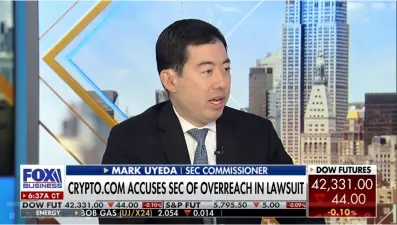
Source: Fox Business
Here are some of the juicer quotes from the Commissioner
"I think our policies and our approach over the last several years have been just really a disaster for the whole industry. We have been sending this 'policy through enforcement,' we've done nothing to provide guidance on it"
"While I won't comment on the specifics of this litigation, what has gone on is part of a broader frustration with the fact that we have not provided interpretive guidance as to what you can and cannot do and if you are involved in some sort of securities offering, how you register, how you get regulated as a broker-dealer, how you get registered as an exchange."
My Interpretation:
It was quite mind blowing to hear Uyeda speak so frankly and directly about the role of the SEC and he basically affirms what we analysed in Part 1. Remember that a key argument that CDC was making is that the SEC themselves are not consistent or clear if crypto assets are considered securities. Whether this is helpful to CDC's lawsuit remains to be seen - but I have a hunch, and I will share more in Part 2.
What is interesting to me is that even within the SEC, there seem to be clear divisions and attitudes towards crypto and this varies with each individual commissioner. (For those who are not familiar with the SEC structure, there are 5 commissioners elected, and of them is the chairman, with a leadership position). While we tend to discuss the SEC as one entity in our analysis, the nuanced reality is that the SEC has its own divisions, stances and alliances. This is why you do see individual commissioners speaking up on their own views (like Mark Uyeda above). I think this may be important because if someone like Mark Uyeda or Hester Pierce (who is very supportive of crypto in the US) is called to testify in CDC's suit against the SEC, I expect them to be a bit more critical of the SEC's regulations (or lack thereof) with respect to cryptocurrencies in the US.
___________________
Part 2: Hold on a SEC!
Part 2 of the analysis focuses on CDC calling the SEC's legitimacy (in the context of this case, and regulating cryptocurrencies) into question. It can be summarised as CDC saying: "Hold on a sec! Who put you in charge?" (I apologise for the puny dad joke folks but when you're reading 48 pages of a legal document, you do what you can to keep yourself entertained.) Without any further adieu, lets examine what CDC has to say
1. The SEC (or Gary Gensler) adopts an inconsistent attitude towards regulating cryptocurrencies
CDC cites 3 situations where the SEC previously admitted that cryptocurrencies are not under their purview
- In para 121-126, CDC cites the SECs approach laid out in the DAO Report, where, the SEC’s then-Director of the Division of Corporation Finance, William Hinman says that there is no issue with crypto exchanges engaging in secondary market sales because "there is no longer any central enterprise being invested in or where the [network token] is sold only to be used to purchase a good or service available through the network on which it was created". If we accept Mr Hinman's words to be true, this blocks the use of the Howey test here because there is no common enterprise IF the tokens are being resold in the secondary market (ie if CDC buys from someone else other than the network issuers and sell to others). CDC has previously stated that the tokens they buy are from the secondary market
- In para 127, CDC cites then-SEC Chair Jay Clayton, who further endorsed Mr Hinman’s views on secondary-market sales of network tokens
- In paras 128-131, CDC cites current SEC Chair Gary Gensler himself
- In May 2021 he testified before Congress that “the [secondary-market] exchanges trading in [network tokens] do not have a regulatory framework . . . at the SEC.”
- In August 2021, Chair Gensler wrote a letter to Senator Elizabeth Warren that echoed this same message, stating that “we need additional authorities to prevent transactions, products, and platforms from falling between the regulatory cracks” and that the “legislative priority should focus on [secondary-market] crypto trading . . . platforms.”
- Lastly, Chair Gensler’s May 2021 testimony before Congress and his call to action in his August 2021 letter acknowledged that Congress has not established a framework for secondary market trading of network tokens or provided the SEC with authority to regulate secondary-market sales of network tokens
Interpretation:
CDC shows that the SEC (since 2021) has consistently admitted that the current laws do not prohibit the sale of secondary market tokens. This seems to have been the approach adopted by most members of the SEC including Chair Gensler (at the start of his chairmanship) as well.
I think it would be fair for most readers at this point to say "but Chrysalis, those comments were from 2021, how do you know the policy has not changed since then?". That's absolutely fair and that is why Mark Uyeda's comments (after CDC has launched the lawsuit) has the potential to be devastating to the SEC's chances in this lawsuit. We have a current SEC Commissioner admitting on TV that "we've done nothing to provide guidance on it". Imagine if this video recording was used in court (or if Mr Uyeda is called to the stand to testify and repeated these exact words AS AN SEC INSIDER).
In my humble opinion, the fractured stances towards crypto within the SEC itself could potentially hold the key to CDC winning the case. Mark Uyeda and Hester Pierce are very pro-crypto and their testimony has the potential to undermine Gary Gensler's case.
2. The SEC (or Gary Gensler) seems to have made up an entirely new term: "Crypto Asset Securities"
Para 134 is extremely enlightening and straightforward:
"Without any new authorities granted to it by Congress or changes to the relevant regulations since Chair Gensler’s 2021 pronouncements, sometime between August 2021 and April 2023, the SEC adopted and began enforcing the de facto Rule that seemingly all network tokens other than bitcoin and ether fit into an entirely new category of financial instrument called Crypto Asset Securities that are subject to the SEC’s direct oversight."
By using this completely made up term, the SEC proceeds to sue cryptocurrency companies (CDC cites the case of Ripple, Coinbase and Binance in the footnotes of para 136 and 137) with little success.
Para 140 gives more clarity to SEC's (or Gary Gensler's) current stance and definition of Crypto Asset Securities.
"From this premise, the SEC claims that all secondary-market sales of these tokens are also securities transactions because obligations running from their issuers to the initial buyers are automatically imputed to every future secondary-market buyer of the tokens. As the SEC puts it, a network token inherently “represents and embodies” its original investment contract."
In Para 142 CDC refutes this stance by stating:
"If a network token “embodies the investment contract” then it can never be sold without this “embodiment” and therefore is all by itself an investment contract—a premise courts have uniformly rejected and the SEC has said it no longer endorses."
Paras 150-175 build on the points made above by quoting 2 SEC commissioners (Uyeda and Pierce) and elaborates on the rulings from previous Binance and Ripple lawsuits. I will not be including the finer details here because much of the content builds on point 2 of this analysis and is basically used to substantiate CDCs argument. Naturally, I do encourage you to read the full CDC filing if you are interested to find out more about the case.
Interpretation:
Gary Gensler takes on a "if im losing the game, imma change the rules" approach in order to sue cryptocurrency companies. In order to drive his agenda forward, he literally creates the term "Crypto Security Assets" and defines it himself AND proceeds to sue companies based on this definition. We know that he has not had any blessing or authority from congress to do so, but lets ignore that for the moment and examine his arguments at face value.
In the definition (para 140) the SEC states that "a network token inherently “represents and embodies” its original investment contract". The SEC is saying that all crypto transactions have this "2 in 1" element of buying and selling the token INCLUSIVE of the original contract obligations with the issuer of the token (eg: if i buy a solana token from CDC, who bought it from coinbase who bought it from Solana, somehow i still have a contract with Solana).
CDCs counter argument is this:
- For a crypto token to have this "2 in 1" feature, the feature of "2 in 1" is essentially a contractual term, making the token a contract itself
- The courts have already rejected the notion that tokens can be contracts (para 142).
- In fact, if you skip down to para 169, which talks about Binance's case vs the SEC, the court states that the Embodiment theory (the 2 in 1 theory) was problematic because it moves away from the Howey test. ( "marks a departure from the Howey framework that leaves the Court, the industry, and future buyers and sellers with no clear differentiating principle between tokens in the marketplace that are securities and tokens that aren’t). This is important because it shows a contradiction in the SEC's argument, the court is saying "DO YOU WANT TO USE THE HOWEY TEST OR NOT?"
- if the SEC uses the Howey test, then the Embodiment theory is not valid (in Part 1, CDC already explained why the Howey test cannot be used in the context of crypto assets)
- If the SEC doesnt use the Howey test, then they would be forced to explain why they are using the Embodiment (2 in 1) theory specifically for crypto assets. In my opinion that would be an uphill climb because it forces the SEC to redefine what a security is, going against decades of legal precedent. It also opens a can of worms for current securities: do we apply the embodiment theory here as well?
- In fact, if you skip down to para 169, which talks about Binance's case vs the SEC, the court states that the Embodiment theory (the 2 in 1 theory) was problematic because it moves away from the Howey test. ( "marks a departure from the Howey framework that leaves the Court, the industry, and future buyers and sellers with no clear differentiating principle between tokens in the marketplace that are securities and tokens that aren’t). This is important because it shows a contradiction in the SEC's argument, the court is saying "DO YOU WANT TO USE THE HOWEY TEST OR NOT?"
In my opinion, the quibbling over whether tokens are contracts or not is too technical and probably can only be addressed by a trained lawyer. All i know here is that Gary Gensler, unhappy with the current rules and established precedents by his predecessors has chosen to create a term of his own definition and is going around suing companies based on this newly created term.
3. The SEC was not authorised by Congress to regulate Secondary Sales of Network Tokens
Paras 176-190 are fairly straightforward. CDC states that congress has not asked the SEC to look into secondary market sales of tokens. In fact, congress is still in the act of contemplating and defining policy:
Para 182
For several years, alongside representatives from the digital asset industry,Congress has been actively contemplating, debating, and advancing legislation to provide a legal framework for network tokens, including registration and a registration process.
In fact, congress seems to lean towards using the CFTC as the regulator for crypto assets:
Para 184 and 185
None of these legislative efforts propose delegating to the SEC the broad authority over secondary-market sales of network tokens or the registration requirements as a consequence of such sales that the SEC has claimed under the Rule. As recently as May 2024, the United States House of Representatives advanced a bill with significant bipartisan support that would grant the CFTC—not the SEC—substantial authority over network tokens. H.R. 4763 (May 22, 2024) (“Financial Innovation and Technology for the 21st Century Act”).
Interpretation
The stance here is pretty clear, the SEC has not received blessing from the US Congress to regulate crypto. Congress is still in the process of making rules and it is more likely that the agency that would be asked to regulate crypto assets is the CFTC.
The rest of the document essentially deals with CDC asking for relief (aka compensation) from the SEC via the courts.
Conclusions and Final Thoughts
Thank you for reading my layman's analysis of the lawsuit. Allow me to summarise what Ive interpreted from it:
- The SEC is vague in the Wells notice, without tellinig CDC what they are being sued for
- The SEC is unable to properly define the problem:
- If BTC and ETH are not securities, why are the tokens listed in the case considered securities?
- The securities do not pass the Howey Test
- The SEC themselves in most precedents say that the sale of secondary market tokens are fine, but something changed under Gary Gensler's leadership and the SEC started to sue cryptocurrency companies. However, Gensler's view is not unanimously agreed on by other commissioners, who are vocal that the SEC is going about this the wrong way
- As part of Gensler's crusade, he has arbitrarily made up terms like "Crypto asset security" and has invented his own definitions as to what constitutes "crypto asset securities" (Embodiment of original contract).
- The problem with that that is that it goes against decades of legal precedent where the Howey Test was used as the sole method to identify securities
- Gensler also (presumably) makes the mistake of using the Howey Test alongside the "Embodiment theory". A silly move, considering that the use of Embodiment Theory undermines the use of Howey Test (and vice versa). This clear contradiction riddled with logical flaws seems to be a repeated theme in Genslers crypto crusade
- Lastly CDC questions if they are even accountable to the SEC. CDC shows how the SEC has not received any powers from congress to regulate cryptocurrencies - a fact that multiple SEC members have confirmed since 2021
CDC lays out a strong case against the SEC, showing the contradictions within their arguments and questioning their authority in the matter. To my untrained eye, they make a great case and im fairly confident they would put up a great fight in court. Im definitely rooting for them as this case has the potential to solidify cryptocurrency legislation in the USA.
I hope you enjoyed reading these articles and found them informative.
Disclaimer: i am not a lawyer, neither am i legally trained. The above article is my interpretation of the lawsuit between CDC and SEC and none of it is financial or legal advice.






