
You may have heard about quantum computers and their revolutionary ability to solve computationally complex problems in an efficient manner. However, you may still not have a grasp about the fundamental concepts that make it all work together. In this series, we will go over the basic ideas underlying a quantum computer. More specifically, we will look at
- Qubits (quantum bits)
- Quantum gates and circuits
- Experimental realizations
Bits
In a classical computer (like the one you're using now), all of the information and computation relies on the fundamental concept of a bit. A classical bit can be described by one of the two states that it is in. Typically, one of the states is labelled 0 and the other is labelled 1. A physical example of a bit can be a coin. We can call the state with heads up 0 and the state with tails up 1. A classical computer works by having a large number of these bits and using them to encode different types of information. Once the information is stored on the bits we can develop algorithms to perform computations we are interested in. We will not go into details about how information is encoded and processed with bits here.
Qubits
A qubit (also called a quantum bit) is the analogous fundamental concept of quantum information and computation. The same way that we can describe a classical bit by its state, we can describe the qubit by the quantum state that it is in. A key difference separating classical and quantum computation is that the quantum state has many more possibilities than just 0 or 1. In fact, the quantum state can be any superposition of the states 0 and 1:

where
 = (psi) is the quantum state of the qubit,
 = is the quantum state corresponding to the classical state 0,
 = is the quantum state corresponding to the classical state 1,
 = (alpha, beta) are complex numbers called probability amplitudes.
In other words, if the qubit is in a state with alpha = 1 and beta = 0, it is in a state that corresponds to the classical state 0. Similarly, if the qubit is in a state with alpha = 0 and beta = 1, it is in a state that corresponds to the classical state 1. However, notice that we can choose arbitrary complex numbers for alpha and beta. The qubit can therefore be in a state of 0 and 1!
A physical example of a quantum bit can be the spin of an electron. The spin of an electron is a quantum mechanical object made up of the two states spin up and spin down. We can label the spin down state

and the spin up state

Measurement
Another key difference between a classical bit and a qubit occurs when performing a measurement of the state. When a classical bit is measured, it remains unchanged. For example, if a coin is in the state heads or 0, when we measure it we will find that the coin is in the state 0. Likewise, if the coin is in the state tails or 1, when we measure it we will find that the coin is in the state 1. A qubit behaves in an unusual way. When a qubit is measured, it can only be found in the state

or

What this means is that we lose information about the state of the qubit by measuring it. For example, if we prepare a qubit in a state with
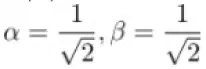
the initial state of the qubit will be:
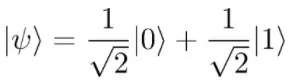
Then, when we measure the qubit we may find that the qubit is in the state  . After this measurement, we will have lost all information about alpha and beta and the new state of the qubit will simply be:
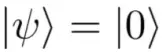
What happened to the information of alpha and beta? Recall that the values alpha and beta are referred to as probability amplitudes. What happens is that alpha and beta are used to determine the result of the measurement. In fact, the result of the measurement gives

with probability

and

with probability

In our previous example this means that the measurement could return
or

each with a 50% probability.
This behavior is what people mean when they say that quantum mechanics is probabilistic in nature. The change of the qubit state after measurement is called wavefunction collapse.
Quantum evolution
As we have seen, we lose a great deal of information when we measure a qubit so why do we care about all of the possible states we have access to by the different possible values of alpha and beta? The answer lies in the nature of quantum evolution. When a quantum mechanical system evolves without interference from the outside world, no measurements occur and no information in the system can be lost. We can therefore develop quantum algorithms to guide this quantum evolution through a quantum computation. The result is that at each step of a quantum algorithm we have full information about the system and only at the very end when we arrive a the result do we measure the system. We will see that if we do this in a clever enough way, the measurement process at the end can reveal more information and harness the power of quantum computation.
Make sure to follow in order to get a notification once the next part in the series becomes available.






