Robinhood generated $1.424 billion in revenue during the third quarter of 2026, marking a 12% increase from the previous year. However, beneath the record performance, the company's latest earnings reveal a significant shift in its business. While cryptocurrency transaction revenue declined 55% to $120 million, prediction-market revenue surged to $173 million, overtaking crypto as a larger contributor to transaction-based revenue.
The contrasting figures highlight how Robinhood's revenue structure is changing. Options, equities, event contracts, and subscription services are becoming increasingly important to the company, while its cryptocurrency business faces a considerable slowdown.
This shift raises an important question about Robinhood's long-term business model: Can the company sustain its growth through a broader financial services ecosystem rather than relying heavily on cryptocurrency trading activity?
Robinhood's Revenue Growth Is Coming From Different Sources
Robinhood's total net revenue reached a record $1.424 billion in Q3 2026, compared with $1.274 billion in the same quarter last year.
Transaction-based revenue remained the largest contributor, generating $867 million, up 19% year over year. Net interest revenue declined 9% to $415 million, while other revenue increased 61% to $142 million.
The revenue breakdown suggests that transaction-based activities are becoming increasingly important to Robinhood's financial performance.
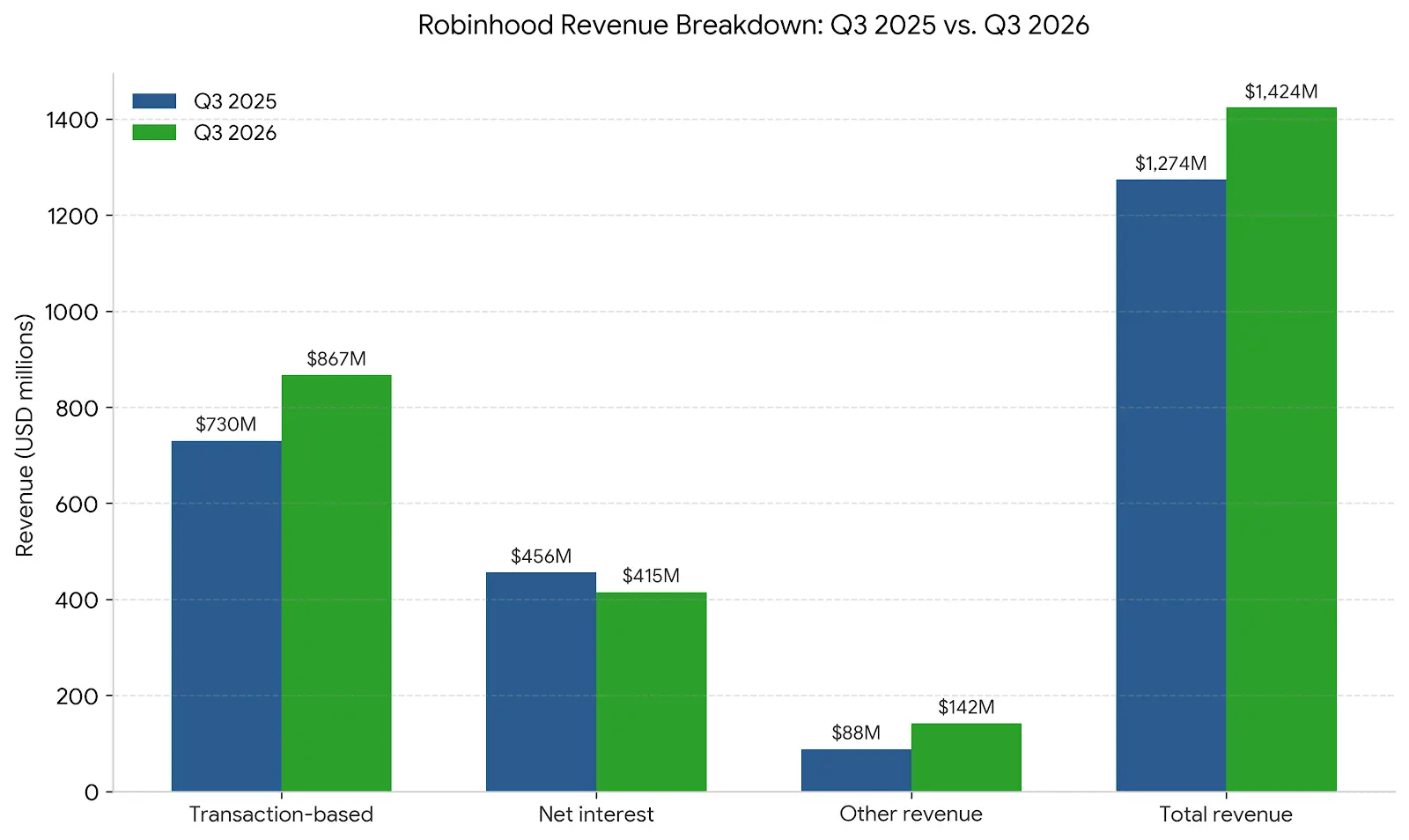
Transaction-based revenue contributed approximately 61% of total revenue, while net interest accounted for around 29%. Other revenue represented approximately 10%.
The change is particularly relevant because Robinhood's transaction-based business includes several products with different growth trajectories. Its performance is no longer explained by cryptocurrency activity alone.
Prediction Markets Overtake Cryptocurrency Revenue
One of the most significant developments in Robinhood's Q3 earnings was the growth of event contracts, which include prediction-market activity.
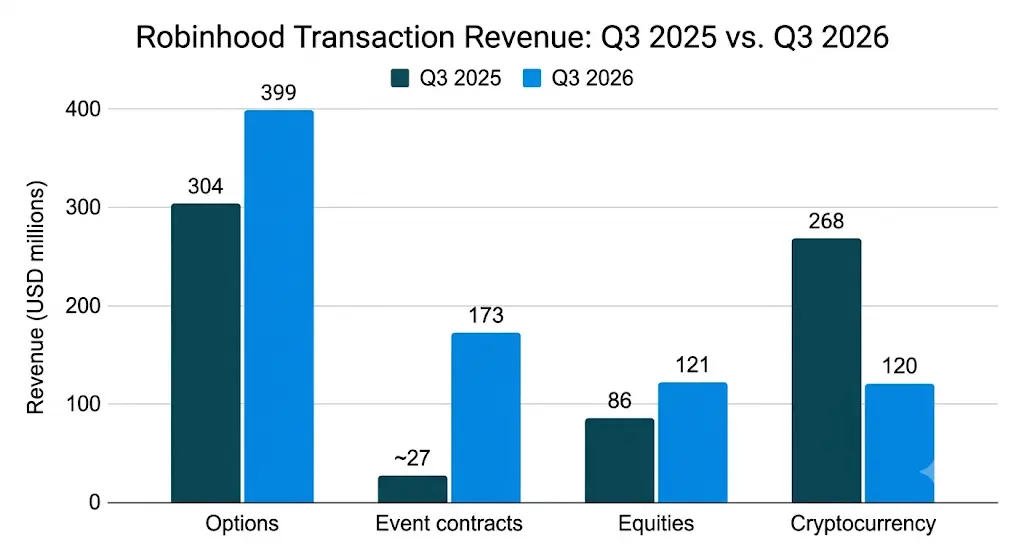
Event contract revenue increased from approximately $27 million in Q3 2025 to $173 million in Q3 2026, representing growth of more than six times.
During the same period, cryptocurrency transaction revenue declined from $268 million to $120 million.
This created a notable reversal in the company's revenue composition.
In Q3 2025, cryptocurrency generated approximately $241 million more revenue than event contracts. By Q3 2026, event contracts generated approximately $53 million more than cryptocurrency.
Event contracts also recorded 16.4 billion contracts traded during the quarter, increasing more than sevenfold year over year.
The revenue figures suggest that prediction markets have become a meaningful
component of Robinhood's transaction business. Their contribution is particularly notable because they expanded while cryptocurrency revenue was contracting.
However, the comparison does not establish that prediction markets will permanently replace crypto as a major growth driver. Their future contribution will depend on sustained customer participation, product adoption, competition, and the economics of operating these markets.
The next few quarters will be important in determining whether this growth represents a lasting change in customer behavior or a period of unusually strong demand.
Options and Equities Provide Additional Growth Support
Robinhood's expansion is not limited to prediction markets.
Options revenue reached $399 million, increasing 31% year over year. Equities revenue climbed 41% to $121 million.
Options accounted for approximately 46% of transaction-based revenue, making them the largest individual category. Event contracts contributed around 20%, while equities and cryptocurrency each represented approximately 14%.
This distribution provides a clearer picture of the company's evolving revenue mix.
Options remain a major source of monetization, while equities and prediction markets are contributing additional growth. Cryptocurrency, which previously generated substantially more revenue than event contracts, has become a smaller contributor.
The development potentially reduces Robinhood's dependence on any single trading category.
However, diversification within transaction-based revenue does not eliminate the risks associated with trading activity. Options, equities, and event contracts are also influenced by customer engagement, market conditions, and trading volumes.
The important question is whether Robinhood can maintain activity across these categories when market volatility and speculative interest decline.
Trading Volumes Reveal Where Customer Activity Is Moving
Robinhood's trading metrics provide additional evidence of the shift taking place across its platform.
Equity notional trading volume reached a record $992 billion, increasing 53% year over year. Options contracts increased 48% to 905 million, while event contracts reached 16.4 billion, representing growth of more than seven times.
Cryptocurrency notional trading volume, in contrast, declined approximately 38% to $50 billion.
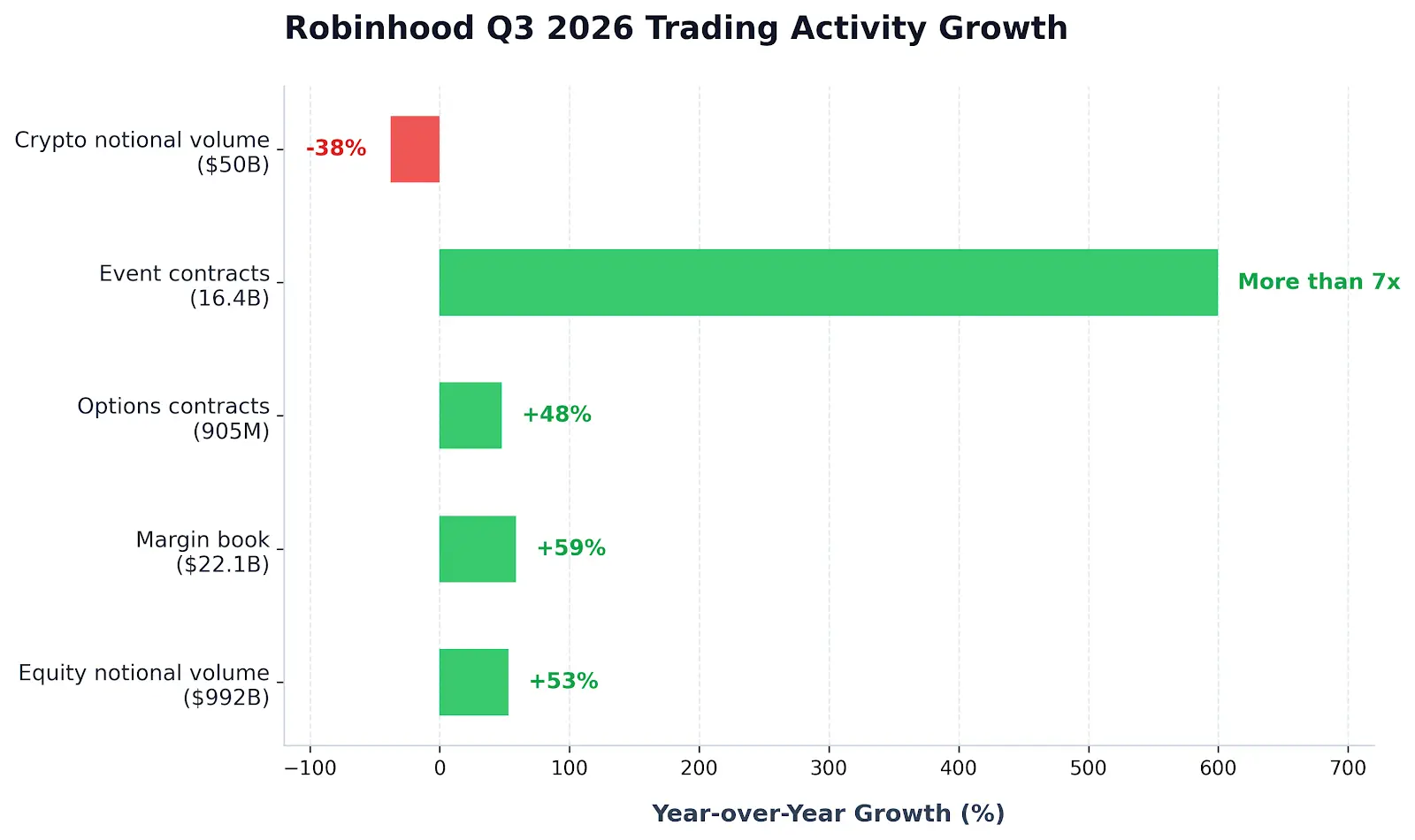
The figures indicate that the decline in cryptocurrency activity did not translate into a broad decline across Robinhood's entire trading platform.
Instead, other categories recorded substantial increases.
This distinction matters when evaluating the company's business model. Higher activity across multiple product categories can create additional revenue opportunities and improve the platform's ability to retain customers with different investment interests.
Nevertheless, trading volume and revenue are not interchangeable. The amount of trading activity does not automatically determine how much money Robinhood earns. Monetization rates, product economics, and operating costs also influence the final results.
Gold Subscribers and Customer Assets Strengthen the Platform
Beyond trading, Robinhood continued to expand its customer base and assets.
Funded customers reached 28.7 million, increasing 7% year over year. Investment accounts climbed 9% to 30.4 million, while total platform assets increased 19% to $396 billion.
The company also attracted $15.7 billion in net deposits during the quarter.
Although quarterly net deposits declined 23% from the $20.4 billion recorded in Q3 2025, the longer-term trend remained stronger. Trailing 12-month net deposits reached $71 billion, representing a 21% growth rate.
This distinction is important because quarterly deposits can fluctuate, while the trailing 12-month figure provides a broader view of customer asset accumulation.
Another important development is the expansion of Robinhood Gold.
Gold subscribers increased 34% year over year to approximately 5.18 million, while the adoption rate climbed from 14.5% to 18%.
The earnings materials also indicate that the average Gold subscriber has approximately four times the assets under custody and around three times the net deposit growth rate of the average funded customer.
These figures suggest that Gold subscribers represent a particularly valuable customer segment.
Higher subscription adoption could help Robinhood deepen customer relationships, encourage greater platform engagement, and expand its revenue sources beyond transaction-based activities.
However, subscriber growth alone does not reveal the profitability of the subscription business. A more detailed breakdown of Gold revenue, servicing costs, and customer retention would help establish its contribution to overall earnings.
Record Adjusted EBITDA Contrasts With Declining Net Income
Despite generating record revenue, Robinhood reported weaker GAAP profitability.
Net income declined 14% year over year to $476 million, compared with $556 million in Q3 2025. Diluted GAAP earnings per share fell 16%, from $0.61 to $0.51.
Adjusted EBITDA, however, increased 9% to a record $808 million, representing an approximately 57% margin.
The difference between adjusted EBITDA and GAAP net income deserves attention.
Robinhood's adjusted profitability improved, but its reported net income declined as expenses increased and other accounting items affected the results.
The company recorded approximately $67 million in unrealized losses, primarily related to mark-to-market changes in Robinhood Ventures Fund I. This represented approximately $0.07 per diluted share.
Operating expenses also increased 16% to $739 million. The company cited credit-loss provisions associated with its growing credit-card business, Trump Accounts, Rothera-related costs, and marketing investments.
The figures suggest that Robinhood is investing in several new growth areas while attempting to maintain operating efficiency.
One positive development was the company's revised full-year 2026 guidance for adjusted operating expenses plus stock-based compensation. Robinhood narrowed the range to 2.675billion–2.75 billion, lowering the upper end by $25 million.
The challenge will be maintaining adjusted earnings growth while controlling the costs and risks associated with its expanding product ecosystem.
HOOD Stock Stabilizes After Q3 Earnings Sell-Off
Robinhood's stock continued to face pressure following its third-quarter 2026 earnings report, although trading showed signs of recovery in early November.
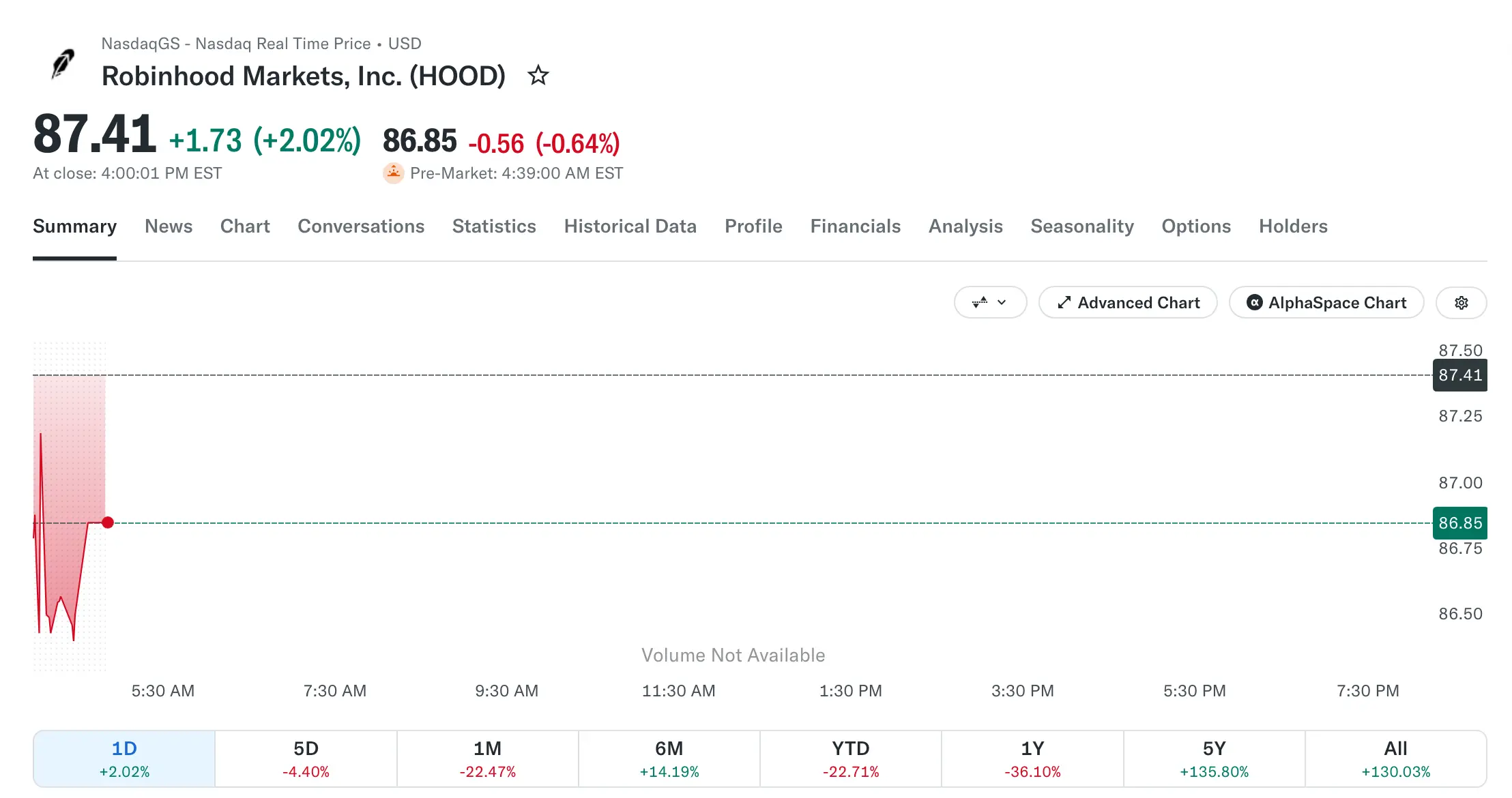
HOOD closed at approximately $94.56 on October 27, before dropping sharply after the earnings announcement. The decline continued through the end of October, with shares reaching a post-earnings low near $82 on October 30.
The stock then staged a modest recovery. It closed at $83.84 on November 2, rose to $85.68 on November 3, and gained another 2.02% to close at $87.41 on November 4.
At the November 4 close, HOOD was still approximately 7.6% below its pre-earnings level. Despite recovering from its late-October low, the stock remained well below the 110–120 range seen in late September and early October.
The broader performance also reflected continued weakness. Based on the supplied market data, HOOD was down approximately 23–25% over one month and 22–24% year to date, while its five-day performance had turned roughly flat to slightly positive.
The mixed Q3 results remain an important part of the market reaction. Record revenue and strong adjusted EBITDA were offset by lower GAAP earnings, declining crypto activity, and higher operating expenses. These factors will remain central to the HOOD Stock Price Prediction as investors assess whether Robinhood can sustain its growth while improving earnings performance.
For now, the early-November rebound suggests that selling pressure has eased somewhat, but the stock has yet to recover its pre-earnings level.
The Next Growth Test: Can Robinhood Make Its Diversification Sustainable?
Robinhood's Q3 results show that its expansion is taking place across several areas of its business.
The company now has 14 business lines generating approximately $100 million or more in annualized revenue. Rothera was added to this group during the quarter.
Its strategic developments also extend beyond trading.
The company is expanding banking services, developing international crypto infrastructure, growing retirement and wealth products, and participating in the Trump Accounts program.
Its banking business reportedly had approximately $5 billion in deposits from more than 350,000 funded customers. Retirement assets under custody reached $36.6 billion, increasing 51% year over year.
These initiatives could help Robinhood become a broader financial services platform rather than relying primarily on retail trading commissions and cryptocurrency-related activity.
However, the diversification strategy also introduces new execution challenges.
Credit products create exposure to credit losses. Prediction markets face questions around sustained participation and regulation. Banking and international expansion require investment and operational execution.
Investors should therefore focus on five areas in upcoming quarters:
Prediction-market revenue: Whether event contracts can sustain their rapid growth and contribute meaningfully to total revenue.
Cryptocurrency activity: Whether crypto revenue stabilizes or continues declining.
Gold adoption: Whether subscriber growth translates into stronger retention, deposits, and recurring revenue.
Credit quality: Whether the expanding credit-card business leads to higher provisions and losses.
Operating leverage: Whether revenue and adjusted EBITDA can continue growing without a disproportionate increase in expenses.
October's early operating commentary was constructive, with more than $13 billion in month-to-date net deposits and strong trading activity. However, the reported deposit figure included an approximately $6 billion Dell family contribution to Trump Accounts. It should therefore not be interpreted entirely as ordinary retail customer deposits.
That distinction will be important when assessing the sustainability of Robinhood's asset growth.
Conclusion: Robinhood's Growth Story Is Moving Beyond Cryptocurrency
Robinhood's Q3 2026 earnings reveal more than a record revenue quarter. They show a changing business model in which prediction markets, options, equities, subscriptions, and other financial services are becoming increasingly important.
The strongest evidence is the reversal between event contracts and cryptocurrency revenue. Event contracts generated $173 million during the quarter, overtaking cryptocurrency revenue, which fell to $120 million.
At the same time, Gold subscriptions expanded 34%, platform assets reached $396 billion, and equity and options trading volumes recorded substantial growth.
These developments indicate that Robinhood is building a broader financial services ecosystem.
But the company still faces important challenges. Declining GAAP net income, rising operating expenses, weaker net interest revenue, and the risks associated with credit expansion remain relevant to its financial outlook.
The central question is whether Robinhood can turn its growing product ecosystem into a more predictable and sustainable earnings model.
Its Q3 results provide evidence of diversification, but continued revenue growth, stronger GAAP profitability, and consistent customer asset accumulation will determine whether that transformation delivers lasting financial value.