
"That was one happy period in my life," he thought, "when I learned to live comfortably in the wilderness." He mused upon it a little more and the thought struck him that this would be a painless way to commence his history, by simply picking out a year not too horrible to dwell upon and write down his recollections. He could put his memories in better order and fill them out later. He rose and collected his notebook and pen, threw a few more pieces of wood on the fire, and lying stretched out at full length on the bare ground in front of his cabin, began to write.
“In the fourth year after the abolition of timekeeping, and nearly everything else, I decided to escape the city and life under the 'new order.' I did this because the chance presented itself, even though I had just gained a promotion that made my life in the new society bearable, perhaps even comfortable. But it was the traveling about and the sense of freedom brought with it that put the idea into my head.
I’d been assigned in the first days of the restructure to the lowest post in the food services group. I spent three bleak years in the basement of a huge cafeteria, washing dishes and preparing food along with a hundred other lost and nameless souls. We worked all the time, except for morning services. The labor was hard. Each night we were shuffled off to a dormitory for what seemed like a few hours of sleep. Then we were rudely roused and forced to another day's work. I thought I would die in these dungeons. I’d given up hope.
But a chance encounter at one of the rare public festivals saved me. An old colleague from university days noticed me as he was passing through the tiers in the temple stadium. He immediately drew me off by the arm, expressed his wonder that I was still alive and offered me a job as a mail-messenger in the Department of Records which he headed. This entitled me to a bicycle, better housing and a green food card.
After months of inner-city deliveries, I was promoted by his nod to the regional bureau. Now I had to personally deliver communications of the highest priority, stamped and sealed in their waxen tablets, between the administrative units of White Oaks and White Sans. I was even sent on occasion to White Sac, and when no convoys were available, I travelled there by bicycle. It was a healthy and pleasant employment. I was often given days of rest between posts, while waiting for return messages.
It was on one of these trips to White Sac that I made my escape. I’d found out from overheard conversations in the department and from deciphering some of the notes I carried that there was a concern in the administration over certain colonies of outlaws to the north in the foothills, and the threat which their numbers posed to the new order. Rumor was that they’d preserved all sorts of contraband and books that could be poisonous to the state. Of course such whispers played and prayed a great deal upon my mind. A seductive hope sprang up that whole colonies on the old plan still existed, needing only more recruits such as myself, before they could rise up and recapture the cities of the new order, one by one, and destroy the despotism.
And so, one crisp morning, with a small supply of food hidden in my mailbag, I rode out a few miles past the western limits of White Sac along the highway and then turned north on an abandoned road into an outlawed zone.
After two days of pedalling through a deserted countryside, I encountered a band of three men walking near the road. After a brief interrogation, in which I expressed my sympathies, they took my bicycle and me up a dirt trail that wound deep into the hills, till we came to a camp in the night, of the rebel tribe.
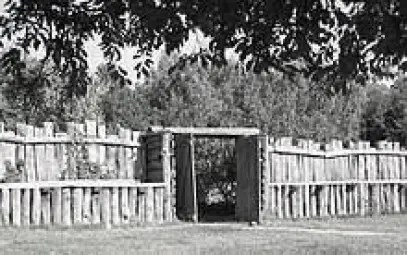
I could see that it was not at all what I had envisioned. Even in the dark the place had a shabby appearance, a few rows of huts surrounded by a palisade of crooked stakes, not eight feet tall. I was led to a low shelter built of sticks and canvass, much like a tepee and told to lie down alongside the huddled mass of humanity at my feet. The setting was sordid, but I still breathed an imaginary air of freedom and rested that night as comfortably as ever, upon pillows of hope.
There were still a few such clans as this living in the countryside back then. Their numbers, to be sure, had been severely diminished over the last four years. There was no law out here and in-fighting and raiding one another over dwindling food supplies had taken a heavy toll. The plague caused even more loss. As in the cities, it still claimed about one in five each year. The population was now less than one-fiftieth of what it had been five years earlier, and on the poorer continents, I was to find, the ratio was far worse. But the few carried on, or tried to, and this camp was an example of the struggle.
In the next few days I was introduced to my new "tribe," for that’s how they thought of themselves. They called themselves the Puma, from the Indians that once inhabited these regions and whose lifestyle they were trying to imitate. If only there had been a few real Pumas among them! Their greatest problem was ignorance. They simply didn’t know enough to live comfortably off the land. Of course it was harder to grow crops these years because of the radiation, and whenever they were about to reap some meager harvest there were the "rovers," ready to pilfer or openly attack, depending on how starved they were.
These were much smaller bands of men, desperate beings, whose only way of life was plunder. In the early days there had been many such bands, living by the gun until their ammunition ran out. Now only the most savage were left, using knives and spears and ambush in place of guns. Some had even descended to the level of brutes. There were rumors of cannibalism. The times were getting worse.
Our tribe consisted of a little over a hundred souls. Only a few years before they had numbered three hundred. But they’d been attacked repeatedly by small groups of robbers from the north, where there were no cities for hundreds of miles. So they’d moved their settlement further east, deep into the foothills of the Sierra Nevada, east of a deserted town once known as Chico.
They were a kind-hearted and humane group. There were women and older children here, about twenty of each, a very humanizing influence. They had preserved a few books, not many because they had to move so often and could only save what they could carry. But rarer still they had among them two portable computers with spare battery packs and hundreds of books on disk. It was their custom in the evenings to read aloud from some these and it wasn’t long before I was a leading participant in these sessions.
These people had come from all walks of life, those who were never rounded up or who had escaped the Church in the first months, sickened by the turn of events, by the transformation of each city into a tyrannical state, brutally marshalling its citizens into work squads, without private possessions or rights, indoctrinating them ceaselessly to a radical faith, and publicly burning anyone for the slightest infraction of Draconian laws.
The first concern of the Puma tribe at this time, which was late winter, was to decide in which direction to move and to do it before the planting season slipped by. Many nights they held meetings to discuss the matter. I was invited to join in these talks. They had no stratification of authority here. Every member was equal and held one vote.
They feared that their whereabouts would soon be discovered by group of some thirty rovers who had come into the region recently. Their scouts had spotted these men the day before they discovered me. This was a serious matter. They were known to have at least several firearms, from shots that were heard. It was the only way such a large group could possibly remain together. There must have been some skilful hunters among them, able to support the little army. It would be suicidal to confront them. A similar such confrontation a year earlier ended with over fifty lives lost. Once a band of such men formed and worked as a unit, there was no adopting them or splitting them. They plundered like pirates. There was no bargaining with them. There was only death.
We talked ourselves down to two options. Our present location was untenable. It had been a poor choice to start with. The soil was too acidic for some crops and the place was not distant enough from the central valley to protect us from those who prowled its fringes. There were rumors of a large tribe on the coast and some of us were for trying to make contact and negotiate a union. It meant moving our tribe back across the valley to some isolated spot in the coastal range and send out scouting parties from there to locate this possible ally.
But it was clearly dangerous, liable to attract the attention of brigands who could trail us till they attacked. And the whole endeavor rested on a rumor. The tribe might no longer exist, or be hostile, in worse plight than ours, more of a burden than a blessing.
The other plan seemed less dangerous only because it was filled with so many unknowns. It was to travel east across the mountains into very remote regions, and find some spot, some home, where we could build a permanent settlement where no one was likely to find us, perhaps in the wilds of Utah or Colorado or New Mexico.
The recent and bloody encounters with rovers finally decided my companions on adopting this course, away with all haste from the likelihood of running into other members of our species. We packed our belongings, sent out scouts to see if the snows had cleared from the passes, and set out, as we discovered, prematurely. We had to wait three weeks in makeshift camps and at cold elevations, while our strength and supplies melted away.
Finally the thaw arrived and we moved on in late May with dangerously lightened loads of food to carry. We made a safe passage into empty regions and breathed a little easier in imagining that we had escaped at least one form of death, the violent kind by a fellow human's hand.






