
Previous Chapter ...

Happy to be home.
Late in September there was a report of a few deaths in Kenya from an unknown disease. An international team of ten doctors was sent, but it was near the border of Kenya and The Democratic Republic of Congo (in no way democratic or even a republic), a constant conflict zone, and they were delayed for weeks. There were all sorts of hemorrhagic fevers in that area, and the rest of the world paid no attention. We were all in a positive glow. The nine-month long lull had now silenced the doomsayers.
But central Africa was always a mystery, with so many people in remote regions, that little reporting went on. It was too dangerous for journalists and the government issued passes meant nothing to the rebel groups, the ADF and Jihadists all fighting each other. That area had never been vaccinated. When boy soldiers swept through towns the fever deaths were thrown into the same communal pits as those shot. And viruses thrived there like rats in the trenches of World War One.
By the time the doctors did arrive, most of the villagers in this one local were very sick. And the doctors' tests did reveal it was linked to COVID and reported back to the WHO in mid-October. One of them also brought it back with him. It had a four-week long latency period, and all our old swabs failed to catch it. But this was kept under wraps as he lay in a hospital tent in Geneva, with the closest monitoring, a circle of experts around him monitoring everything. His fever grew worse and his brain swelled.
Four of the staff caught it next and a small cluster in India and Portugal seemed to have something similar. But this only appeared in a few side columns of medical journals through late-December. It seemed to incubate many weeks before the first symptoms appeared. Everyone had a festive Christmas. So did we.
In January more cases began to appear. People around the globe started catching this fever of encephalitis and in fifty percent of the cases it proved fatal. The mutation was radical, and no one who had the previous vaccines or the mild version seemed immune. The doctors all went to work on a new vaccine. But a panic grew slowly, as the disease spread.
By the end of February there were only a thousand cases worldwide, spread evenly across the globe. By late March there were ten thousand cases, half of them recovering with standard drugs and a week of hospital care.
We were watching the news again each evening, for a full report. With the report of the first cases in New York, we acted quickly, increasing our stocks of everything, food, wine, beer and at Bill's request, a hundred cases of Bourbon, sending Rick alone into town. He made trips all that month, one a day and went as far as Watertown for extra pumps and parts for our machinery. We bought another satellite dish and four more computers in case one broke. There were still no reported cases in these parts (it was early April) and we felt safe. After that we hunkered down.
In May the bad news grew seriously alarming. Hospitals were full again. No vaccine was ready and with the latency undetectable, some doctors guessed the numbers reported only reflected one third of the actual spread. Governors began to panic. Masks and stay at home orders were issued. Then shops and restaurants shut once again, and it only grew worse each day.
Nancy decided to plant a much larger garden now, farm sized, with our extra hands. We had stockpiles of seeds, and she told me a bigger stock of cattle was in order. There was an old farmer some ten miles away with a large farm, who sold us more pigs, chickens and cows. His wife had died of natural causes a year earlier and his few farmhands dispersed with the COVID scare. After that he lost all interest in farming. He thought we were crazy, offering to pay three times the standard price for them. Little did he know money would soon be worthless. But we pulled this off just before that thought came to him, with the Wall Street news a week later, when it collapsed.
I began to pace the floor again, the TV blaring. I became a news addict, switching back to cigarettes. I had Rick bring them in one full truckload, thousands of cartons, almost cleaning out every store, but myself never to run out. I also ordered a hundred more large burlap bags of coffee beans, one hundred and fifty pounds in each from New York city while the money was still good. I could see the day coming when it wouldn’t be available, imported from far away, thinking ahead, the one thing I was good at.
I was plying my brain to guess where all this was going. I recorded details, statistics, rolled them around in my head for new scenarios, jotted them down on pads and drew lines, arrows, between notes at night with Nancy beside me and chatting away by the fire, trying to sketch the map of our future.
I was out in the yard talking to Bill one morning and he mentioned something I'd overlooked. If the working population declined past a certain point, it wouldn't be the necessities of life but the transportation system that would be first to fail. I realized he was right and admired his wisdom and also the fact that with more heads to discuss these matters the better chance we had for surviving this storm. From that evening on we all ate together in the large, unused dining room behind the kitchen. It could easily seat twelve.
Jane and Nancy started cooking together, Rick and Bill and I would sit at the kitchen table, in front of the screen, Bill with his Bourbon and ice, me with a glass of wine and Rick with a beer, to discuss the latest news, while the children romped through the rooms, alive at play.
I don't know exactly what family had lived here long ago but Nancy discovered a small leather handle in the back ceiling of her closet the morning she was emptying it and moving her clothes to my room. When she pulled on it, down came a neatly hidden panel and a fold out ladder which led to a dusty attic full of boxes and stored away furniture. She called me upstairs and with a flashlight we explored.
It stretched the length of the house with a little light from two small, round windows at each end. But the ceiling was the sloped roof, only six feet high in the center and sloping down to nothing at each side, so it could never have been used as a room, except perhaps by children. It was packed almost full of things, only a center aisle left clear. There were dowels of fancy dresses from that Victorian period, boxes of clothes and hats, but others that contained books and pictures, even jewelry, beautiful items, the books mostly female oriented. It must have been a woman's collection and though dusty, in perfect shape and finely bound in leather, with golden-edged pages. There was a stack of magazines over a hundred years old, some of which I brought downstairs to enrich our living room.
I guessed from what I'd heard of the old recluse that this must have been his wife's treasures and that she must have died years earlier. He probably had his house servants pack up all her belongings and store them there, as if the sight of them bothered him.
My agent told me she found this house, after spreading the word, with an out-of-state call from a small-town lawyer. He was leafing through a cabinet of old files and came upon it. This eccentric, recluse millionaire died fifty years ago, a very old man, leaving all his affairs and possessions in the hands of this man’s father, also a lawyer. A short will divided his stocks and bonds between his two children. It mentioned the house in the woods, which no one wanted. No one ever thought to view it, thinking it must be some ruin after all these years of neglect.
But he did have the title and one picture a hundred years old, showing the mansion in its prime. With that they rented a helicopter to view what was left, and much to their surprise it still stood, its roof and windows glistening in the sunlight. There was no place to land and it was so remote he sold it to her on the spot, after one quick arial glance for a million dollars. He was airsick and had never been in a helicopter before, and secretly scared out of his wits. In one way he was out of his wits, as the furniture and books and pictures inside were worth three times that much.
Houses designed long ago by the rich were built to last centuries. After the purchase an engineer was sent in to survey it. He had to land a half mile away. It was solid and intact, almost untouched by time. He took outside pictures and sent them off to her. A day later a construction crew was sent in to clear a landing area. A day later she inspected her purchase, walking not many steps in her dress from the helicopter up the curved staircase to the front door, turning the key with the same coy, silent smile she always wore when she knew she’d bought another treasure for pennies, just like when she first met me. I’m sure some part of her was tingling inside.
Some boxes held old Victorian era toys, dolls and puzzles, dollhouses, wooden trains with tracks and wheels. They must have belonged to the children who'd grown up here and these too he had stashed away. There were so many toys the children were thoroughly spoiled. I brought a few of these down to the living room, two at a time, which kept Eric and Miranda delighted, one with silk dressed dolls, the other with a miniature, hand carved train and village on the living room floor, so we could talk undisturbed. A quick glance at them every fifteen minutes was all the watching they needed, so occupied with their new toys.
I became their year-round Santa Claus, on condition of their good behavior, which they always agreed to with a solemn nod. Then I would hand her another doll and the boy a handful of painted tin soldiers from behind my back. Pretty soon they were sitting on my lap more often than the women, which I didn't mind. I was beginning to like them and tell them bedtime stories after dinner.
But the matter at hand was our concern. It meant our lives, our fate, and every night at dinner that was all that the five of us discussed. We even set up a small table and chairs in the kitchen for the children so they wouldn't interrupt.
At first we decided to see how the pandemic played out, never leaving our compound. Bill suggested we should have some guns ready at hand in case of intruders. He mentioned we might need a castle more than a farm. So we built a heavy wooden gate a hundred feet in front of the house, the one access, crossing the road at a narrow point in the woods, thick with trees, and kept it locked day and night. I even helped construct it, putting my jeans and boots on once again. Several shotguns and rifles, fully loaded, were set up on racks above our three entrances, where the children couldn't get at them, but ready for us to reach up and grab.
By May everything seemed to be melting down. Doctors and Politicians were at a loss, losing face on their T.V. conferences when questions were asked they couldn't answer. The lockdowns were futile. I began watching the news constantly. It was just like the months I wrote my second book, pacing the floor. The others went about their chores by day. But by four they were right beside me in our kitchen, the women starting dinner while listening, the children in the other room playing, and we with a drink in hand, staring at the screen in disbelief.
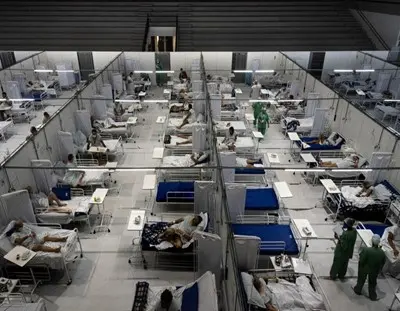
23.May.2024 - General view of UFABC field hospital, in Santo Andre, almost 100% full. covid-o2.jpg
That Summer inflation skyrocketed and markets crashed. My bank accounts became nearly worthless. The banks themselves fell one by one as the economy tanked. I didn't mind that. I was used to living on the cheap. But here we had plenty, luxury even. We were some of the lucky few who exchanged it for all the goods before this crash. But as companies couldn't maintain their work forces, they closed and the vital flow of goods, the whole economy, began to falter. Medical experts were at a loss.
This disease, unlike the earlier waves, had a knack of killing off its victims within months, covering one's body with small, black sores, boils that oozed a puss, just like the accounts I'd read of the Black Plague, dispatching its victims with fevers and headaches of maddening intensity. It had spread around the world in weeks and infected over half the world's population before we knew it. Your contagion didn't appear right away, it creeped through the body slowly, like AIDS, before revealing itself.
The cities were the worst hit. The old and the young disappeared, and the survivors were left to wear themselves away, tending to the invalids, until their own constitutions broke down enough to give access to it. The swiftness of this final wave put most of our best laboratories researching the disease out of commission before they discovered anything. Hospitals were closed when they had no staff left, as doctors and nurses were in the front line of those catching it. Gloves and gowns and masks, and all the precautions they took before proved of little use. To be next to someone sick was to catch it.
At first, like every disease, it assailed those who had survived the last waves, the old, the weak, and the very young. It was an airborne virus and highly contagious. Through our children it spread and raged like a fire through a field of dry grass. The mortality rate among infants that summer was above ninety-five percent. For those under five it was eighty percent, and just as deadly among the old, the weak and the world's malnourished, in whatever mansion or mud hut they lay. There was no news out of Africa.
With the healthiest it took a more diabolical course. The thing came on in waves, like malaria. For most adults the first onslaught was no worse than a bad case of the flu, though it left its signature in one or more black marks on the skin, usually on the chest or torso, but also on the face or neck. And when you saw someone with one of these marks in the street, you were told to give them a wide berth, avoid them like the plague.
The disease was insidious in its recurrences, striking each victim repeatedly, each time harder than the last, soon leaving not sores, but permanent debility.
It announced itself, I was told, by a mild ringing in the ears. Within a few days there would be a noticeable swelling in the neck, discomfort swallowing and a lack of appetite. Then fevers would begin, alternating with cold chills, while the body's defenses struggled against it. Then the patient would be bedridden for days or weeks and often seem to grow well again, with only a few new marks left to show its passing.
But in a month or three months it would come again, in a mild or severe bout, and renew its attack against a weakened frame. The fevers were so intense that they always left some degree of nerve damage, finally rendering each patient crippled or blind and permanently bedridden. It also assailed the brain, and shattered minds in many cases even before it shattered bodies.
These sad particulars resulted in too large a burden on the whole fabric of society, for the healthy had to tend to the sick, and stand in for them at all critical posts. It was a trial for us to even watch these developments on the screen. But that too died as the T.V. stations started going off the air. My computer picked up hundreds of small channels from around the world and in the less affected areas, especially islands. They kept broadcasting.
But two of the main channels were kept running, to inform the masses, or redirect whole groups, whole trades of workers to new tasks. The first task was the burying of the dead. Road crews with bulldozers handled that. The police were re-assigned to move people. They had the guns for that mission. As the populations diminished small towns were abandoned and people were redirected to the coastal cities, where food could be delivered by huge cargo ships, the easiest transport system to maintain.
I thought this was an insane mistake, to crowd people together in the cities. But I guessed the diminishing number of politicians, still in control of things, wanted the people closely herded and under their control to maintain order. The police did whatever they were told and the national guard and finally the military assisted, all troops called home from overseas. But this herding and mingling of people only increased the spread.
When I thought about this mistake, I had Jane and Rick call all the friends they could reach on the internet in these nearby towns and tell them to head to the woods, camp out as long as they could, as distance from others was the only effective barrier. Maybe that way the thing would blow over in a year and they'd survive. And these types were survivors, country folk. Most knew some farming. They all had guns and many could hunt game. Only a few of them agreed and made that choice before the busses arrived.
Throughout the summer we were told by our politicians to keep up hope, bury our dead, and live on to the day when a vaccine and our own indomitable spirit would prevail. Then the president caught ill and died. A much-diminished Congress took over and set up a supposedly temporary system that operated without money. Everyone who could was expected to work and all would be fed and supplied with whatever they needed at designated centers. Those with no family left would receive public care and shelter, mostly near city centers, where they could walk for all their needs.
There were no medicines to alleviate the symptoms, except aspirin and fentanyl, which was now freely distributed at stations to any and all. It was not uncommon to give lethal dosages to those in the final, raving stages of the disease. It was the humane thing to do. Their moans only disheartened those around them. According to our leaders, our greatest challenge was to keep up hope, all pure rhetoric to me.
We watched all these developments throughout the Summer, with a silent dread. But we went about our chores each day, ate our meals and kept busy to keep our minds off the matter. I started minding the children much of the day, being the most useless at farming. I quit the habit of constant news when things got too ugly to watch.
I became a full-time nanny and enjoyed it. Children at this age have the most fascinating minds and imaginations. I learned to converse on their level, catching glimpses of the way they thought. With Eric I’d share my lore of famous battles and generals, all the while lying on the floor setting up his painted soldiers in formations that fit my story. He’d move his men and I mine, the way the battle unfolded. I felt like I was ten years old again, and he was learning history.
With Miranda I’d play card games. We found some decks searching the attic together, the three of us with flashlights. It was an adventure in itself lasting hours with so many unopened boxes. One was a board game and deck with Alice in Wonderland pictures, which she loved, and another like a game of high card, with all sorts of fantastical characters, one trumping another. You shuffled and dealt out five at a time and played your hand to see who would win the most cards, all the while talking with her about all sorts of fragments of her world of interests, like pieces of colored glass collected on a beach, just pebbles to most, but placed in her kaleidoscopic mind making beautiful images with every twist, every new idea that popped into her head, changing the picture entirely, a delight to catch in glimpses as she talked continuously, both to me and to herself. She was a delight to take care of, a little charmer.
I’d never spent time with children before and these two were well behaved. We grew closer each day, forming a deep bond of mutual respect and love. This kept my mind off the future, to some degree.
If you wish to isolate yourself from the world, you have to isolate your mind also. I was thankful the children included me in their fantasy worlds, so different and better than ours.
By late Summer we watched less and less television until the change occurred.
At first, we discussed the idea of forming a bigger clan. This was before Fairfield suffered a forced evacuation, where Rick and Bill still had many friends. When the town caught its first case Rick and Jane told their friends to pack up and disappear into the mountains, live in tents off food supplies and game. Facebook was still abuzz. But like I said, only a few families followed our pleas. Most, as people usually do, put off the decision until it was too late.
Two weeks later the police showed up with buses and told everyone not ill to pack a bag and get in. This all happened in one day. The residents were told the electrical grid was going down in a few days and they had to leave. But they weren't even told a destination. Each person was tested for fever, checked for sores and treated like cattle. But that test didn't catch half of those who were already contagious.
I don’t know by whose authority, but the news programs we watched each evening all of a sudden changed. They became an organ not for news, but for the most inane and rosy human-interest stories that could possibly be dredged up in a crumbling world. While families were dying in hordes and the government slowly disintegrated, with whole regions being depopulated and declared uninhabitable, the news skipped over such statistics to feature stories of people strangely reunited with their pets, or some builder in Idaho still putting up an addition on his house, or the ever-hopeful doctors shaking test-tubes in our faces, promising miracles that were already too late to happen.
The soap operas still captivated mass audiences, even more now, with the number of bedridden. No hint of the disease ever muddied their plots, though the actors seemed to be replaced quite often. The re-runs were the most popular, being impervious to the present gloom; untouched, untainted, never changing things, beyond the pale of death. Game shows were also popular and all the sporting events still able to be drummed up, with teams and leagues combining to make up for their missing players, anything to get our minds off the real disaster.
To turn on the television these days was a grand lesson in human escapism. But one of the forces operating within it, which claimed not to deny, was that of the television evangelists. They still harped away on their old themes of the judgment hour, sin, repentance, and divine wrath. But they also promised hope and a return to a good life if their viewers would repent and join the Church, with a pure heart and obedience to the simple rules the bible commanded.
They were the only ones on the television with a message of hope, facing the problem straight on, and with a plan, though vague at first, of beating this pandemic, while the scientists and doctors interviewed could only report one failure after another.
These popular preachers gained more and more converts with each passing week, despite the death toll continually rising. Then they were joined by the Catholic church, whose bishops started appearing as guests right on their shows, now watched by millions.
The denominations joined and agreed that faith was the only answer for salvation and that all mankind needed to be unified in this time of cataclysm. There could be no more squabbling over petty differences of doctrines and creeds. All the religions had to join together and a simple, unified plan laid out, to appease God.
As they were the only group with a positive response to the pandemic, they gained first viewers and then followers. Their power over the media increased with their viewership. They commanded the ratings, the one thing that the media moguls bowed to, and soon they commanded them. But with all this newfound power they lusted for even more, and their shows slowly spread, like the plague itself, across the prime-time hours.






