
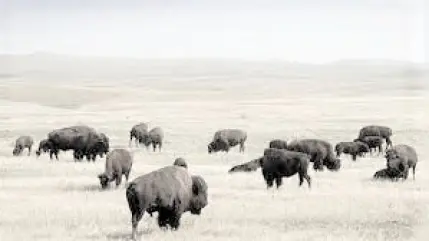
The Bison Return
When the snow had all but melted and we were packing our gear, waiting only for the fresh recruits from the city to resume our work, a high commissioner arrived all the way around the continent by sea with urgent news.
He came by ship from White York with a disturbing report of a deadlock facing the crews that were pushing towards us from the East. Apparently they’d run into a bloody battle the previous fall at the outskirts of a large and supposedly abandoned city by a lake. From what he said I assumed it must have been Buffalo or Detroit. It’d been six years now since the Church had pulled out of that area. They foolishly assumed the region would be deserted, that no one outside their organization could possibly survive so long. They’d just found out that not only people, but armed and organized people, stood in their way.
The principal aim in building the highway was to regain control of this region, a place that they’d early on designated as the land of the Seven Cities. It must have been quite a shock when the highway crews rolled up to the first of these gems, its skyscrapers still gleaming from afar. Our commissioner reported that when they came into the suburbs they met with a barricade and as they climbed over it volleys were fired and more than twenty were killed.
In the next few weeks a hastily formed squad was sent up, armed with all sorts of guns and several artillery pieces. Meanwhile a few priests were sent ahead as negotiators. They waved their white flags and approached the barriers until gunfire sent them running away.
When the artillery arrived the barrier was blasted to pieces from a safe distance, but the armed squad found it prudent to do nothing more. The place with all its tall buildings and underground was far too defensible. They had no idea of the strength of the enemy and finally decided to skirt the city by some twenty miles, to continue building the road with the armed men now a permanent part of their advance crew.
It was at this stage that our commissioner was sent to us, with instructions for us to avoid the large cities in our way and organize a little army in case of attack. When the commissioner arrived, the first thing he did was to thank me for the work I’d done and for a foresight that might have saved the lives of the eastern workers. For this I was awarded the command of a new force on its way, a militia of two hundred men fully equipped, ready to be trained by me and shaped into a regular army.
Our commissioner had to leave soon, but not before he sat down with the engineer and me to plan a new set of tactics for our advance. Every ten to fifteen miles along the highway we would build not only cabins but small stockades, places where we could retreat in case of attack. They would be permanently manned posts helping in the movement of supplies and people.
It would be the task of my men to build these forts, and also become the soldiers who would guard them. Our commissioner left us as quickly as he arrived, telling us he was confident in our abilities and be back by mid-summer to oversee our army and bring word of the location of the eastern crews. He promised to be present and riding on a horse at our sides, on the grand day when our two great highways would meet.
From the moment I accepted this commission of the new recruits, I remember well how I indulged many an hour in imaginary exploits as a general. I had read much as a youth in the military histories of the ancient world. Now the pages of Livy and Xenophon crowded my head. I recalled details of how men were drilled and marched into battle and with this lore I felt ready for the job.
When the men arrived, I realized with frequent sighs what a load of work and expectations had been placed upon me. I was now of a stature pretty much equal to the engineer as the force under me was almost exactly the same size as his own. We decided to integrate our troops and work together as much as possible. I’d need all his help in building stockades and he could well use my men in the heavier aspects of the road work. Pressure was put upon us to make even faster progress than before. The Church was expecting the two highway crews to reach each other by the fall and was putting all its resources towards this goal.
We could see this in the very appearance of the new men sent to us. Many of the workers who’d gone back the winter before had been replaced. The new recruits seemed to be both stronger and younger. The equipment they brought with them, in long supply trains, was also better than before. It was as if the Church had decided to gear up the whole project. Perhaps the unexpected discovery of rebels had struck a fear into the High Council. With a well fortified highway connecting East and West, they would lay the groundwork for the extermination of this unforeseen enemy.
After I reviewed my troops and inspected their uniforms and gear, I had them set up their tents in a field and sit idle for three days, while I made up a staff and a plan. My soldiers were all in their mid-twenties. These were the youngest of the generation that had survived the plague. There was a near absence of youths younger than them and only the first hint of the next generation, babies of the last five years. So these were the ones which the Church decided to trust with guns, though they hardly knew which way to point them.
For some odd reason, the Church didn’t fully trust its older members, however devout, who had experience in either police or military work before the revolution and so they sent none along to help me.
I was given two secretaries by the engineer to handle the requisitions and records of my company. The five scouts I’d trained already were instantly promoted to the rank of lieutenants and ten of the men who’d been taught some marksmanship were picked out to lead squads of twenty apiece and teach them the use of their rifles.
Though we carried guns, the final form of our army resembled a miniature Roman legion, which was the only model I knew. But it worked well enough, in appearance at least, being untested in actual combat, and gave a fine impression that we were well prepared against any danger. We drilled the men daily, especially in target practice and stationed a part of my force each morning ahead of the road crews in interesting formations, to move along with them as they worked on the highway.
But I placed the most care on intelligence. I sent out mounted parties far ahead of our crew and on our flanks. I picked out the best horsemen available and had to learn that art myself. I went out with them daily and taught them all I knew about scouting. By this I formed a select cavalry of some thirty men and we must have made a fine spectacle riding back and forth in three units across the naked Dakota hills. I even equipped these horsemen with spears, but we discarded these later, finding no use for them.
There’s nothing easier than to be a general in time of peace and our exercises and marksmanship improved at a respectable rate. By the late spring several inspectors had arrived from White Seat to review my army and they went back full of praises for me and my aides. Our ranks were orderly and our maneuvers impressive.
By summer we’d reached flatlands, once the farm belt of America. Now they were grasslands dotted with woods and lakes and crisscrossed with streams. In some places we came upon forests of young trees. The rainfall of the last decade along with the exodus of man, was changing the face of the land. In our scouting we came across several herds of buffalo and one of wild horses. There were also large packs of wolves. We never saw them but heard the howling at night.
Finally my scouts reported that there was a large city ahead. Its towers were visible from a great distance. From our calculations the engineer guessed that it was the old city of Saint Paul, the most western of the seven cities. I picked out eight riders and we set off across the prairie straight towards it. We rode all afternoon and by dusk we reached the outskirts. For many miles before the city we must have crossed over what had once been suburbs, devastated by innumerable fires.
The ground was littered with rubble, overgrown with brush and grass except here and there where the hulk of a car or a brick wall still rose a few feet above the leveled waste. We could hardly make out the old streets. Where the grass was thin we could see that the ground was blackened and strewn with the burnt remains of toys and tires and broken plates, a sight all the more ghastly in the fading twilight.
Though we were tired we elected to go into the city that night. Our highway crews were heading straight towards it and we had to determine quickly if it was populated. This was a dangerous mission at any hour but we hoped it would be safer at night when we might escape any ambush in the darkness. We rode up to where the streets were more clear, where buildings were standing, though most of them were gutted. The streets seemed ghostly and were marred with torched vehicles. We saw no lights and heard only the sound of the all-too-loud echo of our horse’s footfalls.
Either the place was deserted or its inhabitants too few or too timid to confront us. After an hour of this nervous prowling we turned around and galloped back out of the city and the suburbs, away from the ruin to camp on a grassy knoll, posting watches for safety.
The next day we entered the city again to bring back precise information. We toured through the streets of tall skyscrapers, gun in hand, and found, in one large plaza, what looked like a newly built and then demolished temple complex. We dismounted and walked in pairs through it and some of the taller structures around.
The temple had been burned, except for the brick walls. But in many of the buildings some levels, especially the basements, had been spared from fire. In these places we found human skeletons behind rude barricades of furniture. They seemed to have died violently. Doors and windows were smashed and every room pillaged for valuables.
I could only guess that the city had suffered some catastrophic fire in the first year of the revolution and that afterwards chaos reigned. Of the people who escaped the fire, gang warfare or in-fighting must have finished them off. We found no signs of recent habitation.
We decided that there was no danger to the place, but that the sight of it was so gloomy we should bypass it. Hard to imagine was the number of people and the years it would take to clean up those ruins. We directed our highway to the south and from a distance of some ten miles, our closest approach, the towers stood out in the daylight. They reminded me of some lone dinosaur, a thing from another era, impervious to time in its skeleton.
On one lone hill in view of these towers, beside a wide river, we built an especially large fortress. There was a narrow bridge nearby which needed some repair. On the other side we found a campsite which looked like it had been used within the last year. From now on I kept most of my soldiers in readiness for battle, surrounding our crews as we pushed ahead as fast as we could towards the crews of the East.
My soldiers were growing nervous in this strange land, months away from their distant home. There were many more abandoned towns in our way and silos and barns and old farm machinery all along the road we were repairing. But we were heartened one morning by the sudden reappearance of our youthful commissioner, wearing a fine white cloak and helmet, accompanied by a bodyguard of forty horsemen. The chief engineer and I were as surprised as anyone at this strange sight.
He jumped off his horse right between us and announced in a loud voice that we were going to war. We retired to a nearby tree to hear the news. He produced a strange map, sketched on a leather skin with white chalk, which indicated that we weren’t far away from the eastern crews. He told us that as soon as we joined up, our orders were to go to war with rebels to the north. The road workers were to be trained and formed into one great army that would reconquer the region for the Church and rid the world of its last outlaws. Then we would proceed to the Capitol and after a glorious parade receive the commendations and gratitude of the Church Fathers themselves.
All this sounded very neat and pleasant until I asked about the strength of the enemy we faced. Of this he had no idea. The eastern crew had met with one fight in only one city. But they’d detoured all the others in their rush to join up with us, so that a bigger campaign could be mounted against the unknown foe.
Our commissioner showed us a charter that nominated him the "Grand Marshall of the Western Army". He assigned me the rank of general and also our engineer. His men were to receive weapons and several hours of training each day, to start immediately. We looked back at him in mute astonishment, not altogether easy with such titles and prospects.
Our leader was younger than us by at least five years. He was tall and slender and handsome, and visibly ambitious. He seemed completely confident of his own powers but also naive and hasty in every way; a dangerous person, I thought, to be leading us into battle.
He was a mass of nervous energy to be sure. From that very first day and all his questions, we had fears he would meddle and alter every system we had carefully designed. But thankfully he didn’t. He’d inspect and dissect my drills and formations, but as long as I could justify them by postulating the types of battles we were likely to face, he would smile and be satisfied until the next hour, when different exercises and new questions entered his mind. He had no more idea than I did of what we’d run into, but I sounded professional and by his nods and silences I slowly gained his respect.
To distract our new leader from these inspections I convinced him to accompany me on a few scouting expeditions. I could tell from his character that he’d enjoy hunting. When we ran across a small herd of buffalo his talk was diverted for days from war to the pleasures of the chase. He sent back his honor guard with the spoils of our hunt and then set out with me alone, to study the art of scouting. He was fascinated with every detail of hunting and living off the land, fishing, skinning animals and making camp. I doubt that twenty students could have troubled me with so many questions. But I played the teacher and grew in his esteem, so much so that I was treated like an advisor from then on in matters far beyond my ken.
A week after our expedition our advance scouts met the eastern road crews, a few days directly to the east of us. We rode out the next morning to meet them and to determine the final link in our highway. It was a memorable occasion, the ‘golden spike’ to be exact. Word was sent back in both directions that the glorious object of the Church had been achieved. Next morning our crews rolled up behind us and a great shout was heard as hundreds of men who had never met ran up to hug their brothers-in-labor, in the middle of a long-neglected field of western Illinois.
last post ...
next post ...






