
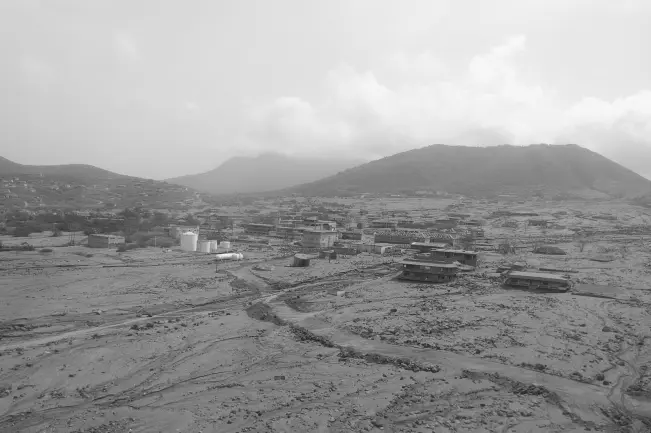
The town deserted
He set out one morning after embracing each of his disciples. He didn't want such an emotional parting, but it happened all the same. He set his course as before, for the coast and the fisherman, with the hope of finding out news of the town before he entered it.
When he reached the coast that evening he found the fisherman's hut deserted and no signs of life there for some time. "Perhaps the old man died," Jonathan thought, "and his son wandered off. Or maybe they drowned in the sea." The boat he’d seen there before was gone.
"This gives me no forewarning," he thought on. "Now I'll have to sneak around the hills and see what I can with my glasses." And that’s exactly what he did.
By noon the next day he was behind the nearest hill, tying his burro to a tree. He climbed the hill, carrying only what he had on his belts, along with his field glasses and staff. When he reached the crest the town spread below him, easy to spy upon.
The most unexpected sight awaited. As he focused his glasses and surveyed the houses, the temple square, the harbor and segments of streets, he perceived no one. The town appeared to be deserted. The midday sun beat down upon the white bricks and tiles and danced in waves of heat, distorting every line, but no other motion was visible.
There were no people or wagons crossing the broad square, no priests loitering about the temple gates. No noise echoed from the streets to reach his ears. From where he was he could see that the sheep which used to dot the pastures to the south were missing. The harbor seemed abandoned, though several small boats still bobbed in its waves. The solitary smokestack in the distance, near the glasshouses, was dormant.
He rose and without further thought proceeded down the hill, staff in hand. The place was indeed deserted, or almost. A white cat darted in front of him across the first street he set foot on. He stopped here and rapped loudly on a door. After a moment he pushed the door open and explored two empty rooms. From what he could piece together, only the clothes and some bedding and utensils were missing, about as much as a family could carry.
"They’d better not be killing them," was his first thought, dreading the idea of some new type of holocaust. He bolted out the door and towards the temple, yelling as he went for anyone there to come out and show themselves. But no one appeared.
The temple he found equally deserted, going through the rooms to no avail. Not much had been removed, including his own bible, and he laughed a moment later at his own vanity when he realized how this fact bothered him at first glance. Then he went to the basements and found them as full as before. This sight cheered him. He could use some of these supplies at the colony, he thought, enough to suffice its needs for years. He decided then and there to head back to the sanctuary and collect his pack train and two of the boys to begin conveying boxes across the hills.
Then another idea struck him. He hurried out towards the harbor where the workshops were. Here he found all sorts of tools and materials and even wagons. Only the animals were missing, but he could use his own burros to drag large loads inland. From here he ran to the glasshouses and found them full of life. This suggested the townspeople couldn’t be more than a month absent, as the watering systems required weekly maintenance. What he wouldn't give for just the smallest of these units in his own colony. “They’d never need to worry about food again, or any weather.” He began examining the structure of one, to see how it might be dismantled.
It was almost dark when he left this inspection and began trudging back through town, to his burro. He was walking along deep in thought, immersed in the problems of transporting large loads over pathless hills.
Whether it was a sound dimly heard, or just chance, he glanced to his right at one of the last houses along the way and noticed the door slightly ajar and some quick motion at eye level behind it.
“Who’s there,” he called out, “show yourself.”
The door opened a little more as he walked up to it and a woman in an obvious state of fear stood there poised as if ready to shut it again in his face.
“What are you doing here,” he said in a gentler voice. “Open the door and let me see you.”
Timidly the woman complied. She had her hood up and a scarf drawn across her face. Only her eyes were visible. From the wrinkles in their corners Jonathan guessed she was in her early forties, or thereabouts.
“Let me in,” he said again, quite close now. “I have some questions for you.”
“Oh, I know who you are. Forgive me Father,” she said, lowering her gaze and moving out of the way.
“Now, now,” said Jonathan, as he stepped into the dim room, “just tell me who you are and where everyone else has gone.”
“The officials came, oh please sit down, I’ve been at a frightful loss.” As she said this she offered him a chair. Just as he sat he noticed a movement in the far corner of the room.
“Who’s there!” he yelled, reaching for his pistol. But before he drew the gun a little girl scurried across the floor to hide in the deep folds of her mother’s robes.
“My daughter,” exclaimed the woman, fearfully.
“Are there any others here?” Jonathan asked, looking at the two. He received no reply. “Come, sit at the table and tell me your story,” he said calmly.
The woman seemed to compose herself and sat across from him placing her daughter on her lap. The girl was a slender child of six or seven, with long, bleached bangs almost hiding her eyes, timid as a mouse. She tried to bury her head in her mother’s arms but kept peeking at Jonathan with sidelong glances.
“If you remember who I am, you know I come from inland,” began Jonathan, “but I find no one here and need to know what happened.”
“They came,” she said, “some two months ago and brought word that we would all have to leave. On the day the great ship came my daughter and I were separated. I came back here and found her but we missed the ship. I’m a widow and have only one child in the world. My husband was purified in the town square the first time you came here.”
It took a minute to put her words together but all of a sudden it came back to him with a shock, as he pictured the fat cleric and his own agency in that poor fellow’s death. It deeply embarrassed him for a moment but he went on to ask her, this time in a much gentler tone of voice, “who were the men that came, and where were all the people taken?”
“High officials.” she went on, “Then there was a fight between our new head priest and another group of priests. Some were burned in the square just like my husband. We were told to pack all the belongings we could carry. Then the ship came to carry us to the Capitol. It’s not forever, they said, just until more holy paint can be brought, then we would be returned. But my daughter, on the day the ship was to leave, lost her cat and went after her. When I realized she was gone I also slipped away and found her here. By the time we returned the ship was sailing away. Now we’re waiting until the others come back.”
Jonathan sat there in silence, wondering at this strange story. He was looking straight at her pretty face and mumbled out, almost unconsciously, “but what if they never return? Then you would die here, alone.”
Only when the woman let out an audible gasp did Jonathan realize the full import of what he’d just said. The daughter also seemed to shudder, as if their worst fears had just been prophesied.
“Don’t fret,” he told her, “I can provide for you until they come back. We have a sanctuary which I’m sure you’ve heard about.”
“O yes!” she added excitedly, “and the miraculous spring and the prize winning youths. We were at the ceremonies. Don’t you remember, Flower.” She looked down at the girl and shifted her around to face Jonathan. “Don’t you remember the great man with his staff who sat beside our old father at the priest’s table and the great games?”
The little girl simply looked at Jonathan curiously. He was again deep in thought, staring down. The woman saw this and remained silent. After several minutes she quietly moved away from the table and pretended to be about housework, straightening out the sheets of a small cot against the wall of that room. The little girl was sitting in the vacated chair, staring across at Jonathan, almost as statue-like, but without the frown upon her face.
Suddenly he started up and looked about and noticed the woman fluffing pillows nearby. “Can I stay here the night? Have you any food?”
“Yes” she replied promptly, “we would be honored by your stay. I have been borrowing from the gardens, enough for dinner. There is so much going to waste there.”
“Thank you,” said Jonathan, “You’re blameless for taking what you need. Pack your bags later tonight and tomorrow we’ll set out for the colony. There you can be with six of your towns folks. They’re married now and have two new babies already. You’ll both be happy there.”
“Oh thank you so much,” she smiled, greatly relieved from her worries. “I’ll make dinner for you.”
That evening Jonathan enjoyed the good meal with this new company, talking of the beauties of the sanctuary they were about to see. Afterwards he sat on the cot the woman had prepared for him. Meanwhile, she became quite talkative and busy, having her daughter clear the table while she began packing up a bundle of things, mentioning each item to Jonathan, though she got little response. Her daughter too was in a glow of helpfulness. He was lost in speculations of what was happening right now to the world. No doubt the church was retracting its boundaries in this hour of desperation.
“If they have less paint,” he thought to himself, “they’ll simply retrench their populations to a few crowded cities. No more parks or white margins. And they’re using their tankers to carry the people away. But that can only go so far. It’s a paint-saving maneuver, no solution. Maybe they plan to re-indoctrinate everyone. They could do that best in a few closed, tightly controlled centers. “The fools” he thought at last, “clenching to power despite a changing world, and moving people like so many gallons of paint. Then again, that’s how they’ve always treated them, like cattle.”






