
Previous Post ...
Book four is completed
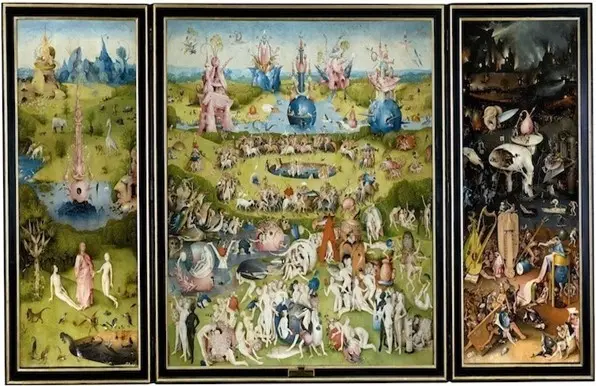
The Garden of Earthly delights. Hieronymus Bosch
The next twelve weeks Nancy was aglow with her work on the farm with her two helpers, Bill and the younger man, Rick. She was happy to see me at work six or seven hours at a steady the pace through each chapter. I was writing quickly, often ten pages a day. She reviewed what I wrote each evening and thought it was all fine, colorful prose. She admired the unexpected details I threw in, the twists and turns of the story line, always about six months ahead of world events and the pandemic. But she looked upon it as pure fiction, another bestseller being born, putting me on track for even more acclaim and money, which we could use to keep improving our little Shangri-La. She saw the first and second part of the triptych, while I was beginning to paint the last.
About a quarter of the way through I realized I couldn't go on just repeating the same. That would be boring. So, I decided I had to ramp things up, the destruction and the terror. This I could do as a natural progression. Up until now in my novel society was in disarray, but things kept running. Serious shifts and sacrifices were made but most kept their heads and at least tried to manage affairs sanely. Now it was time for a horrific turn.
As I said before, sequels are almost formulaic. They follow the grove you're adept at and the sentences just flow. But here I purposely ran the car right off the cliff.
I was trying to describe a future that hadn’t happened yet but so close it was almost like guessing the obvious. There were signs from developing news stories to guide me, but the gloom of this detour took over. I was walking into a dark forest with no trail to follow and no light at the end of it. It only grew deeper and darker.
I could see the hardships piling up, as I imagined them, affecting the whole planet, and slowly overwhelming us. Wave five was just beginning as I began writing. The hospitals were filling up again and deaths doubling every few weeks.
The last wave had been milder in its effects but far more contagious. It was hardly worse than the flu and infected half the world's population. The symptoms were only a runny nose and slight fever, clearing up in a week. We wore masks at first. Then some crazy doctors decided it was a good thing to catch it, being just like a shot that made you immune to the more deadly variants, still lurking in some, those who hadn't died.
And they were sad cases because they suffered all sorts of lasting debility. Most had compromised lungs, a permanent difficulty breathing and the fatigue that came with it. But it also infected the brain with dizziness and disorientation that didn't go away. These people made it out of the hospitals but were semi-invalids, some slowly recuperating over months, others not so lucky.
All this was on the news, happening as I wrote. But this much lighter variant, infecting up to a million people a day in the States alone, and which the doctors called a blessing, was described in my last novel. It set the stage for a recurrence of the more deadly variant, as people who caught the one were a few months later far more susceptible to the other.
It involved describing one failure after another, each inevitable, just like a spiral of dominoes set up with painstaking care on a kitchen table by our adult folly, our industries, all mutually dependent, all going down before our eyes, after the first one is tapped by a little, laughing boy, the virus, laughing as he watches the whole system crumble.
The vaccines themselves became part of the problem, one after another, and each new one advertised as sure to work, and just one more disappointment when it failed as the virus mutated, disheartening everyone. Then it was discovered that over-vaccinated people became transmitters of the disease to the unvaccinated, especially children, worsening a deepening crisis. People began to lose faith in science. Many died from the constantly mutating disease.
There had never been a situation like this before. Each strain had its unique signature. Some were milder in effect but far more contagious, light as the flu. Then other variants would follow, less transmissible, but pick off all those with systems compromised by earlier versions.
Our own behavior wasn’t helping any. The news put people into a panic. False stories, appealing to antivaxxers, were rampant. Then some piece of evidence would come along supporting their theories. Travel was restricted again, airplane flights cancelled, sporting events, the Olympics, and then shutdowns, with many small businesses going broke. But now governments were running out of money to repair these losses and in third world everything just went to hell. People still snuck across borders, hoping their next destination would be better off, but most times it wasn't. There were still trains, ships and trucks, which crisscrossed the globe with goods and people.
Our borders were porous. If one avenue was blocked others were found to get around it. No two countries acted in unison, and some transport industries, airlines and shippers, were worldwide and just too big to shut down. The carriers of each new strain, before symptoms, would slip from one place to the next. Some thought they were fleeing hot spots, but spreading death, creating new hot spots. It seemed like no one was obeying the ever-changing rules.
Some were determined to spend their last days with their loved ones. We were a one world family, without real borders, and our collective house was sick. The age of the ‘Great Wall of China’ was long gone and that never worked. Our own efforts with border guards and useless fences and surveillance by drones seemed just as futile a waste of time, just like all those millions of bricks piled up by millions of slaves. Now it was thousands flooding gates meant to handle a few hundred.
Soldiers deserted their posts when flocks of people pressing against them were infected with the latest strain. We lost hope of containing the thing. It was invisible to the eye and elusive in its dormant states.
It was as if the virus was either smarter than us, or just lucky because of our folly, playing a chess match against our frantic strategies and winning, calmly spreading its control across the board and defeating us as we kept losing the pieces to fight back.
During this third winter things began to look grim as we watched the news. Too many were dying. Facilities for the sick were overwhelmed to the point that people were sent home, to recover or die, told to lock their doors and wait it out. In the poor nations many had no homes with doors.
We thought we were safe in the middle of nowhere, cut off from almost all human contact. But we slowly began to reassess what lay ahead for us.
We didn’t talk about ourselves, just the rest of the world, watching the news, snuggled by our fire. As I sat beside her, I never mentioned my own growing fears. Without a clear picture of the future, it would be premature to upset her with my prognostications, and like the virus itself infect her with worry, which in turn would trouble me even more.
But I was revolving this situation all day long, the myriad possibilities, trying to portray the most likely outcome. I knew it was my own fiction, with invented characters in far off places and I erased hordes on my pages as calmly as an historian records the numbers of fallen in some great battle he never witnessed, even while throwing in some gruesome details to give it color. He’s still the statistician of facts, with the same cold disconnect as an accountant pouring over a spreadsheet. If the numbers tallied up all was good.
We had the satellite computers now and she watched our gains and expenditures like a hawk. But her account grew so fast she insisted on spending her own money on the farm. She was outdoors most of the day, busy with her new animals, learning from Rick how to take care of them. We had fresh eggs and milk. It was winter and the work was easy.
She'd planted a small plot of vegetables, months before. They were all eaten now, and the plot enlarged for the next season.
The two men we kept on, the older carpenter and the other very likeable young man with a truck. He'd grown up on a farm and helped Nancy with her little model. He was polite, soft-spoken and never rude or swearing like the other construction workers on our crew. He lived in the small town with his wife and two young children, made his living as a handyman, a jack-of-all-trades. We always picked him to drive to town for our supplies, to enjoy a brief visit with his wife. The road was easy now with the ruts filled in with gravel.
Bill worked on the fences, and without me knowing it, he was fixing up another building in the woods, out of sight of the house.
My own calm disintegrated as my story went on. But like most men I kept it all inside. If these events really did play out, as the nightly news seemed to suggest they might, the gut feeling that produced my first four novels, turned like a bile in my stomach slowly rising to my throat.
I didn't mind killing off the old and diseased, the foolish antivaxxers in Montana and Texas, the babbling politicians who kept shaking hands, or the hopelessly poor and helpless masses in the third world. I guess I was prejudiced or just cold to such people. The news predicted these would be the first to go. It was obvious, nature's way since the dawn of time.
But now I was describing average parents and their young, educated people who took every precaution dying by the thousands, who'd been the healthiest up to now, people just like Nancy and me. It was disheartening. But it was on the news. It began to turn from a trimming or culling of the weakest, to a world-wide reckoning. I even detailed the birth of this last variant, out of Africa, as a bacterium merging with a virus, so complex now it could do anything.
What was the point, I began to think? It might happen to all of us, and to depict it, this swift attrition of the human race, was not only depressing, but pointless. No one would want to read it, doubly useless, as there would be no one left to read it.
What did our lives matter when most people died? My forecasts of doom and gloom were too sad. I wrote a few more scenarios of cities where the food supply began to fail, of riots and lootings, because this did engage my imagination. I could foresee that the most ruthless sorts, the criminals with guns, would survive for a time while the good people, starving, would leave in hordes, in columns like a death march, ‘a trail of tears’ as the Indians called it, because their destinations were as bad off as what they fled. I was curious about that, history repeated, because I knew the cities would be the first places to drastically melt down, so complex and intricate in their necessities.
One night Nancy, after reading a particularly gruesome scene about mass graves in the parks of downtown Chicago and the mortality rate of those handling the dead at ninety percent, we sat on the couch arm in arm to watch a romance for the fifth time and she said, without turning her head, that my story was growing too dark. I silently agreed.
But my mind raced away like a hamster on a wheel. It flashed upon me that it was just my fiction, whether anyone read it or not, and under my control. So I turned to her a minute later and kissing her on the cheek I replied: “you’re perfectly right, my dear. That’s fine advice. I think so too”.
"I can fix it. For every night there has to be a dawn. I’ll turn it around and give the whole human race new hope and I’ll start on that tomorrow". This made her smile, and she returned my kiss. That sealed the deal. We resumed our movie but went to bed before it was over.
I gave my fiction, after continuous spreads and meltdowns, one great reprieve, a moratorium so to speak, a six-month hiatus where the virus by itself seemed to die down and almost disappear. A new vaccine came out, unlike the others that only lasted a few months. This one seemed to stop it cold, giving mankind a breathing space to regroup and reorganize.
I made this detour at her suggestion, just to be able to keep writing a sustainable plot. And I thanked her every night as my own spirits revived. I was happy again and rose eager to get back to work. I was now saving society. She was just as excited with these pages. Happiness is infectious, just like love.
The strange thing was, something very close to this did occur, just a few months later, as we watched the news. But weeks before that I had the book finished and sent off. My agent, in a clever move, had excerpts of the last chapters printed in the papers, as a preview for the book. It came out just as the lull began and once again had great sales and proved prophetic.
Over thirty percent of the world’s population was now gone. It was mostly the old and the infirm and children, the majority of them in third world countries. A significant slice of the working population of North America had also been erased, putting a strain on every industry. But just like the Black plague, a herd immunity occurred when all the weak were dead and all those who survived were temporarily immune. It seemed to vanish as quickly as it appeared, like a morning fog that burned away at noon, and now bright sunshine was beaming down on all the planet once again.
I couldn’t help dwelling on this, her offhand remark, and how it came to pass. I felt we were one soul in two bodies, and I loved her more than ever. She could see the future as well as I could. Our minds worked on the same plane. But after I finished these four long chapters of reconstruction and rejoicing, the dead buried, our infrastructure patched, everyone fit again and working, reassigned to fill the gaps of those gone, children back in school, I invented an even sunnier world. Empty buildings were torn down to make parks, global warming stopped. Factories were shut down. The air grew cleaner.
The lesson we learned from this pandemic was to recycle everything. It was easy with so much less demand. There was enough food for everyone. There were no more homeless. Those without houses were given the empty ones. We didn’t need new products. Money was minted at a much slower pace, as a worldwide deflation set in. So many buildings were full of what the dead had left behind.
This reorganization started appearing on the news. Steel factories closed and workers reassigned to emptying out abandoned structures. Some smaller towns were abandoned, the remaining few relocated to cities to streamline food distribution. No new cars were built, no appliances or ships or planes. There was a surplus of everything. If anything broke it was replaced from huge warehouses of goods, as the empty houses and garages were gutted.
But this respite was all too short. The world didn’t last another two decades in this much improved state as I predicted. My book came out just as the lull began. But it was just that, a lull and my novel, a dream. A year later hints of a far darker variant hit the fan.
Once again, we made the pilgrimage to New York when the book was to be published. This time we made our trip last a month. It was the end of winter and there was nothing to do on the farm.
New York was in a bustle of life and reconstruction. The theaters, some of them, were alive again. People filled the streets and everyone recognized us. We were invited to dinners by the rich and feted everywhere. So we stayed to enjoy the fame. I knew my series was over and in a year I’d be forgotten. Or at least I thought so.
I spent my days scouring old bookshops, ending up with some forty boxes of fine old volumes to fill the shelves that Bill had made. I wanted a complete collection of famous authors, all the Western classics and I was getting close, everyone in the catalog of the ‘Everyman’s Library’ and several other famous lists of the best thinkers of all ages.
I’m not sure why I went to this trouble, But I liked old bookshops and had a hunch again that it might somehow prove useful, like a backup disk of Western genius. I knew I could download complete libraries of books on hard drives. I bought a dozen of those too for just that purpose. But I liked the old books, the feel of them in your hand, the softness, the smell of the leather, the fine typography, not like some plastic Kindle.
Nancy was equally busy buying items for the farm. We had them all shipped to town for Rick to pick up in almost daily visits.
We returned to find our place much as we left it, with a few unexpected improvements.
My quintet of novels was finished, brought to a close. We were rich, young, with our futures before us, feeling lucky to be alive and with enough money to last us ten lifetimes.
I finally took a well-deserved break from my study. I was at Nancy’s side all day now. I changed from loose fitting pants and white shirts to ragged jeans and a baseball cap, ready to get dirty. The suit I wore in New York, along with Nancy’s finery was put in the back of the closet, on the furthest rung. I thought it would never be worn again and in that I was right. But I also figured that our future here would last a lifetime, one uninterrupted span, with summers in the garden, winters in front of the fireplace, cozy, reading a book, lounging about. In that I was wrong.
Sometimes I'd enter my study, turn the light on for a minute and pick out a book for bedtime reading. Otherwise, it was a dark and empty room, almost scary to walk by, like a ghost. And just like my writing career, I thought, a thing of the past.
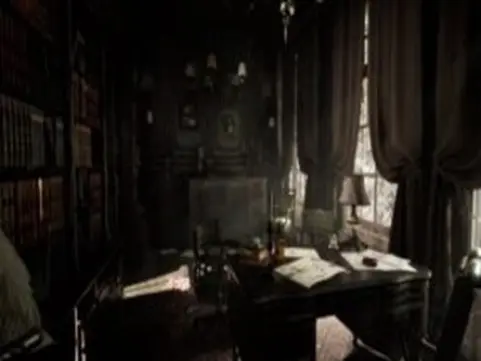
My Study. Unreal Engine U E marketplace 20301.jpg






