
In the fall of 1967 my father was again promoted and transferred, this time to San Francisco, to be assistant manager of their very large machine shop there. He flew out and purchased a house, while my mother and me packed up. The plan was for a moving company to take the big load of furniture and for us to drive in our Peugeot station wagon, (he loved that car) with a few suitcases, seeing the sights across the country. My sister Paddy was in her second year at William Smith, the local college for girls, and stayed in Geneva. So I was the only child, indulged and spoiled as such.
It was the last day of October. We were packed but my parents didn’t want me to miss Halloween, so the plan was I would trick or treat with my friends that evening and we would set out when it was over, drive a few hours, stay at some motel and begin our journey in earnest the next day. That night I almost died. We set out and were about five minutes into our journey, making a right onto the main street of Geneva to head out of town, when we were struck by a drunk driver almost square in the rear, our car going about fifteen miles per hour to his eighty. The back of our car was crushed like a collapsed accordion by the force of the blow. His car careened off, crossed the street and went through the front of a house before stopping. Of course he didn’t have a scratch, being drunk.
My mother and father in the front seat were unhurt except for a few cuts. I was in the back seat behind my mother and a puppy beagle in my lap. The dog somehow flew into her lap without getting hurt. But my seat was pressed against hers. If it hadn’t been for the structural integrity of the car (a Peugeot is almost as solidly built as a Volvo), and all the suitcases in the back buffering the blow, I would have been crushed to death. As it was, they pulled me out of the window fully conscious. I sat down on the curb and only felt a mild chest pain at first. But as the seconds rolled by, with an ambulance on its way, my breathing became more and more difficult. My chest was swelling up. As they got there I couldn’t breathe at all. I remember them laying me in a stretcher and putting the mask of oxygen on my face. It felt like a miracle and was the most delicious breath of air I ever experienced, cool and pure and lifesaving.
I was in an oxygen tent in the hospital for four days, with ice packs on my chest to take the swelling down. The bruises repaired and I was released. But that accident, I think, left a lasting scar and weakness on my lungs. With no car we continued our trip by train.
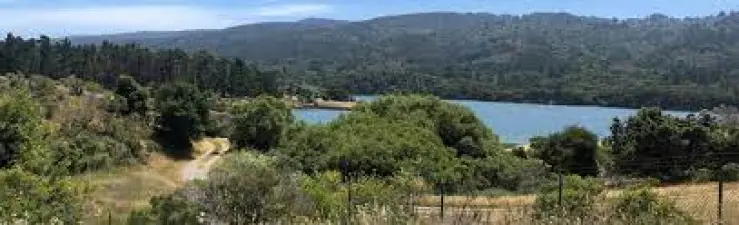
We moved into a new house in Belmont, in a new subdivision of this small town and once again on the very outskirts of the town, all the land behind the steep hillside of our back yard being designated game preserve watershed land where no houses could be built, and a mile beyond that the Crystal Springs water reservoir, a long skinny lake in a fault line, the water supply for San Francisco, so well fenced and patrolled constantly by trucks and boats and helicopters no one could even get near it. But it was such a beautiful lake we had to explore it.
My father seemed to have a propensity for living on the very edge of town and this gave me the repeated pleasure to step out our back door and hike for miles, a habit I began to love. My childhood hikes of a half-mile now turned into half-day long treks with my teenaged friends.
Our new address, Hallmark drive, had only ten finished and inhabited houses when we moved in. It was the first street down a steep hill to a whole new development that would expand and fill many still empty streets, winding into the hills towards town, a huge community. Over the next four years hundreds of houses were built, the developer starting them a few at a time as his finances permitted. But on our short stretch of street I again found three boys to befriend. Two were a year younger than me, Brad and Jim, and one my age, David. He was in my classes as we started high school. We entered the science fair that year and won second prize, on rocks and rock collecting, using my collection. He made the displays as he was an indoor type, scared to hike outdoors for fear of poison oak. My two other new friends were rascals, and the outdoors was our element. They were poor in school, ignoring homework and books, unlike me. But we became a pack of wildlings on weekends and explored every inch of the empty hills and ravines around us, no brush too thick to stop us, coming home covered in dirt and thorns, cuts and poison oak rashes.
Being well off and middle class, our parents bought us just about everything we asked for, right away. For outdoor toys we had bicycles, unicycles at one point, which the three of rode around on, a spectacle to all the neighbors. We had B.B. guns, then pellet guns, shooting at birds, and minibikes for the dirt trails. By fifteen we infiltrated the Crystal Springs reservoir, swimming in it, chased by hordes of rangers when they spotted us, only once getting caught, and getting out of that fix when six of them finally trapped us one day and threatened us with a court appearance and the nearby youth detention center, which I bluffed our way out of by angrily telling the ranger in charge, a fat fellow, that my dad was so high up in San Francisco politics that he could have him fired. The ruse worked and they let us go with a warning, not even taking our names. But they told us if were ever caught again, they’d remember us and we’d be in deep trouble.
We were back inside the reservoir within a month, undeterred, since that’s what we loved to do, hike and explore new places. This first acclimatized me to breaking the law. I never went out of my way to do it. I just took no notice of it when it was in my way. A year later, smoking pot and trying out acid with my buddies, I took no notice of laws. We were discreet, but never deterred by the threat of penalties. In dealing with people I was scrupulously honest, fair and kind. But laws that forbid one to do something to oneself or go to some lake with a fence around it I totally ignored. My body was my own and the Earth was my home.
We set up tree hammocks, costing only a few dollars at the army surplus store, ones with mosquito netting and sunshades, on one Oak tree so hidden in the hills no other roving band of boys ever found it. We knew this because besides the hammocks we left all kinds of personal items there, on little shelves we built beside them, each of us claiming one large branch of the tree. It was our secret, personal retreat for several years. I later wrote a poem about it.
The Oak Tree
Under the ancient limbs of an oak tree
Where nature spread a verdant panoply,
I crouched and plied my little store of wit
To bless the mossy carpet with a name,
For something with a name is not the same
And brings rewards to those that cherish it.
I made up spirits and I gave them power
To whisper from the branches of the tree,
And laying there through many a summer hour
I listened as they echoed back to me.
Life thrilled and thinking thrived within that bower,
The sunlight through the leaves a sight to see,
Where all alone I loosed my teeming mind
Treading the paths that only children find.
The oak trees in this area were a truly amazing sight. The hilltops were bare and grassy, green a few months in Spring but generally a golden brown. The valleys, if they had a creek, were thick with small trees and bushes, green most of the year. But on a few hillsides, half-way down, an oak tree would establish itself and over the course of a century expand into a dome with its own ecosystem underneath, with ferns and moss gathered around its trunk, enjoying the constant shade, and Spanish moss hanging like tinsel from its branches. It made a shady hollow and when one entered, the earth seemed to quiet to a hush, almost like an old church, and a little bit of awe and calm came with it.
We smoked the Spanish moss that grew on the trees. It had a pleasant aromatic flavor. We tried smoking a fern once and it nearly choked Brad, taking the first slight puff. You can’t smoke ferns. We made campfires and bay leaf tea, made a raft for a pond we found. It was the Tom Sawyer life of freedom and adventure. By six each night I was home for dinner.
My parents had a set routine. Dinner was always exactly at six, almost to the minute. The C.B.S. nightly news with Walter Cronkite was turned on in the other room, low volume, which we could see over the banister of the dining room, eating and talking about our day’s events, my parents sipping a glass of wine to the excellent meals she prepared, having learned the art of many fine dishes while in France. I remember one evening in particular. My father was never one to mention politics much or world events, but on this night Walter was describing a particularly bad day in Vietnam. My father’s back was to the T.V. but as Walter talked on and my father caught his drift he turned around and started watching avidly. It was a massacre of natives, maybe the My Lai, but for once in my life I saw him blush and say to himself in a pathetic tone: “Oh my god.”






