
It's high time, I think, to look back a few more years and relate what I have been putting off in this narrative, that is, a brief history of the fall, and the first causes that brought on our revolution.
It was a horrible time for the human race, with desperation driving our train, disease the cargo, and death the terminal. I lived through that era in part because I distanced myself from its horror, playing the historian and watching its collapse like some distant spectator, remarking the numbers, not the names and faces of those falling all around me.
For some odd reason, which doctors never could explain, the plague didn’t touch me, or about one-in-a-hundred of my fellow beings. No matter how closely we ministered to our dying friends, no matter how tightly we clasped their scarecrow frames, kissed their foreheads and even wished out loud to share their fate, we never got sick. Perhaps it was an attitude, feeding upon a strange remoteness like my own, that bid us see this thing through to its end.
But I need to go back a few years before the plague to explain the birth of our religion; the first chance incidents that made the change in our collective mind and led us to smother civilization under a blanket of white.
The founder of our universal faith, our figurehead, father and even messiah, the first who perceived the holy light and showed us the straight and narrow path, was actually a very troubled and unhappy man in this world, a media mogul, who was gone before he had any certain knowledge of the revolution he would spark from his tomb.
His name was Herbert Luke. He was orphaned at an early age and had a hard and miserable childhood in some war-torn corner of Europe. But he was clever young man and ravenously hungry to succeed. So he came to America, and starting out as a simple technician, rose in the jungle of television networks to control an empire of media, not only behind the scenes, but across its front pages, combating and creating endless scandals. Like his papers he thrived upon public notice, and dished up his personal life, his wives, his affairs and his children, to fuel the fire. He made himself the focus of public attention, in some ways like one wretched player described by a Roman historian, "king of Bithynia, and of all the human vices."
Yet he also created a myth about himself that seemed to help him transcend his troubles. He was a brilliant self-promoter, chameleon-like in character. One thing never changed amidst all the changes; he was always the center of attention. He ran through lifestyles faster than other people went through wardrobes, and with as little effort. In early old age, with the greater part of his friends and family gone but his own energies undiminished, he began giving away large slices of his empire to charities and funds of his own conceiving, and became, among other things, a world-renowned patron of the arts.
But this passion too gave way to a new one when he conceived himself to be not the promoter but the creator of great art. In everything that he looked upon in life, long enough to consider, be it fair or foul, his one response was: "I could do a better job myself." So he took up oils and began painting huge canvases, which were unveiled as media events, usually with the opening of some new museum or public concourse.
His tireless shifting and disaffection with the present made each of these semi-annual events entirely different from the ones before, and he had such a knack of tickling the world into a frenzy of pre-show curiosity, that each new "revelation", as he styled it, was met with more acclaim than the last.
The paid critics at these ceremonies were happy to concur, and the lists of celebrities that attended them added such a spotlight of fame, that it took weeks for the fanfare to die down. Along with the myriad articles and posters and replicas and books, came the television shows and debates on the merits of the latest work, telling us how it bested all previous, a new miracle of art from the hand of a master, a true seer.
Some of his paintings weren’t bad. He could imitate the style of a Rembrandt or a Picasso fairly well, always adding a few elements of his own to make the piece unique. But I must say that after five or six of these "events" I personally was beginning to grow tired of the shows, mostly glitter and parade. I would tune in briefly to see what strange, new school he’d adopted, spelling death to every other school for the time being. His health was now deteriorating, and he was growing more reclusive and stranger in his ways, showing himself only at each unveiling, which made them all the more anticipated for his rare appearance.
But he still limped on and was constantly shuffled about within a maze of well-guarded retreats. Only the thirst for fame, "that last infirmity of a noble mind," still burned strong within the weary limbs, and so his media-machine built up one last bubble of excitement. There would be one more show, and the picture to be unveiled, incomparably greater than any that had come before it, depicting, rumor had it, the agonies and the triumph of a man facing his own demise, the last word in art, its final resolution.
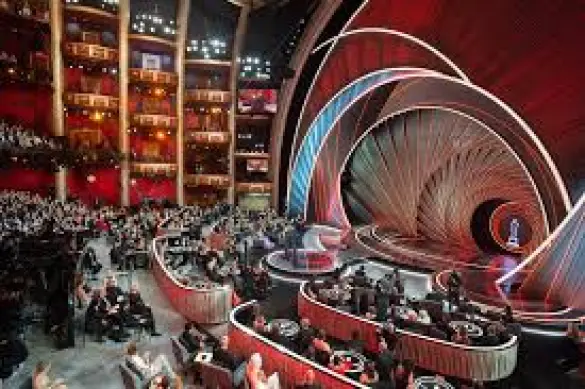
After months of hype, the show didn't happen, or rather, it didn't happen according to plan. The date was set. The invitations were sent out. The hall was readied. On the long-awaited evening blocks around the World Trade Center were sealed off as the celebrities began to arrive, and viewers the world over tuned in to a show that preempted everything else.
It had been Luke's habit at the last few shows to arrive late, just as the show commenced, keeping his whereabouts shrouded in secrecy from all but a few. The show began without him or the canvass, but a dramatic entrance was expected any moment. No one could forget the strange spectacle that was aired that night.
It was the prelude to an unforgettable week.
The hall filled to overflowing with the elite of the media and glamour world. An orchestra played and the cameras panned the large room repeatedly just to show how many superstars were there. But the curtains never parted. Minutes ticked by and the general mood changed slowly from good humor and patience and idle chatting to one of growing annoyance. Then worry set in, taxing the abilities of the announcers to keep talking. Finally, after two hours of waiting, the audience began to disperse. But even in that slow exodus something happened and suddenly people rushed to the doors, as if a bomb threat had been announced. There were just a few injuries, but the show ended on that freak note, disturbing and disappointing everyone.
Two days later came the first reports of a strange, new disease spreading out of Africa. The world, of course, was still preoccupied with the mysterious non-appearance of Herbert Luke. A search was undertaken, and rumors of various plots and counter plots and cover-ups and even death ran rampant. But the decisive evidence of his body couldn’t be found. More rampant still was the disease, which quickly spread through six continents and put out of our minds, I thought forever, the story of Luke.
last post ...
next post ...






