
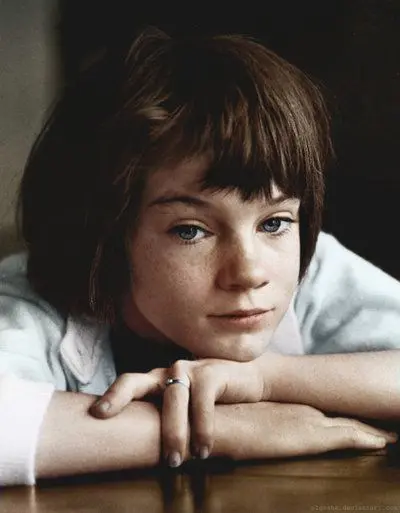
Scout, olgasha.deviantart.com
CHAPTER TWO
I leaned back in my chair and began wondering about what I’d just done. Was it an act of recklessness? No, I thought to myself, I don’t have a history of that. My character tends towards the timid. Stupidity? I know I’m not above it, but there’s got to be a more precise word. Despair? Maybe that’s it. The way my life was going any radical change could only be an improvement. But I didn’t think of that. I didn’t think anything. It must have been an act of pure folly. I went to the upper library and a shelf of favorite books, taking down an old, Latin edition of Erasmus’ “Praise of Folly,” a book I’d read several times, but which now piqued my interest with added relevancy. I returned to the office and began reading.
After twelve pages or so I began to feel a sort of glow, dim at first but growing in pleasantness until it enveloped my whole body in a blanket of warmth and happiness. The word ‘beatitude’ sprang to mind. I kept on reading with greater relish. The ironies and double entendres in this essay were amazing. I thought I could see dozens of them, so rich was the consciousness that composed it. Never before did I perceive so many levels of his sharp wit, so many innuendos, so many sly references to people and customs and historical events.
I read the book through, got up, went to the kitchen and drank a glass of milk. Returning to the library, with my appetite now whetted, I took down a collection of Samuel Johnson’s Rambler essays and dove in, reading nonstop until the midnight chime of the hallway clock brought me back to this world. I went to bed, my head teeming with images and thoughts, so many parallels, so many portraits like threads coming together, harmonizing, weaving in my mind a rich tapestry, the tapestry of life.
After an hour or so in this reverie, I chose sleep, and sleep I found. It was a night of lucid dreaming which seemed to capture my entire childhood and schooldays in perfect order. It seemed to answer questions deep in my subconscious, fill in gaps like missing pieces in a jigsaw puzzle, questions I never asked or knew existed. It was completing itself in some way.
I awoke at nine in the morning feeling restored and better rested than I had in a long time. In the bathroom, after a refreshing shower, I noticed two things, the minor cut in my hand, from a mishap a few days earlier was entirely gone. Also gone were blemishes dating back much further than that, a scar on my knee, from a fall when I was nine, and the black mole on my neck, which I was always conscious of, and which made me shy since it first appeared my second year of college. How could the skin repair itself so perfectly after all these years and in a single night? I gazed in the mirror at my face. The skin was perfect, the slightest freckles on my cheeks had vanished. My eyelashes were darker and my iris’ seemed to have a glow to them, a lighter shade of brown tending toward maroon. I looked younger by several years and could honestly call myself handsome. Even my hair seemed thicker and lustrous.
With these discoveries I quickly dressed and hurried downstairs to the kitchen, to make myself breakfast. Though my appetite was keen, to say the least, I noticed that I moderated my intake quite a bit. I fried a single egg and noticed the unbelievably pleasant scent while it was cooking. A half glass of orange juice and half a toasted muffin completed the meal. But every bite and sip were pure nirvana. I could feel the morsels sliding down my throat into my stomach. The tastes of every bite were tingling and mingling and lingering in my mouth with the juice, a confluence of pleasures. I usually drank coffee in the morning, but this day I resisted it. I had no need. I was brimming with energy.
“I’m going to lose a little weight,” I said to myself, knowing my pudginess, “and eat smarter.”
As I was tidying up the table, my mind drifted back to the readings of the night before. The pages flashed before my eyes as I stood at the sink washing the dishes. Every word, every sentence was there in my mind’s eye in perfect order. And I could access everything I’d read immediately. It was all there, a perfect index in sleek clarity, legions of ideas and allusions and examples primed for cross reference, ready to marshal and use for any mental endeavor I chose to undertake.
This drove me back to the library. I had to organize it, pour over every title, every shelf of that amazing collection and comprehend the entirety of it. I started by just reading the names of the books and the tables of contents, moving some around to better groupings, arranging them alphabetically by author. I finished almost a quarter of the first-floor library when hunger called me back to the kitchen for another Spartan meal, then right back to the task at hand. I wanted to know every book there and where it was, how well it was written, its level of sophistication, its utility to me.
In the midst of this dusty reorganization, late in the afternoon, I happened across a folio of Robert Burton’s ‘Anatomy of Melancholy.’ As I read the synopsis of the first partition I was blown away. It was a marvel of condensation and an architectural wonder. Why aren’t all books described and delineated so perfectly? Within ten pages he comprised the whole opus so perfectly, so succinctly, you saw it all, you knew where everything was and which exact page to leaf, to flick and find it. And now another thought, with its myriad implications and ramifications bowled me over. I could know what I didn’t know, that is, I could see the progress of my knowledge on every subject and at the same time the size, the span, the dimensions of the subject itself, and then see exactly what I had left to acquire, what gaps there were, to build a complete house of knowledge.
Burton and Bacon and Johnson saw all of this with stunning clarity. We think we’re clever in our improvements and advancements and gadgets in this late age. But I can tell you this, men long before us, and women too, were wiser than we are. This is what I loved so much about certain old books; there was so much to learn from them.
It was time for dinner. I took out a pasta dish that Naomi had brought over and as I was heating it, savoring the aromas drifting up, I remembered how my father, a wine connoisseur, would sometimes talk at the table on how much the right grape could compliment any dish, amplify the flavors, often pouring my mother and I a glass to prove his assertions. I would dismiss his oratory as a vinous flight of fancy, sip and agree, but I never developed the habit.
In fact, I hadn’t even visited the rather extensive wine cellar in the basement since he’d passed away. It was a dim and musty room so stamped with his character, (it was his second passion after books) that I was a little in awe of entering it as if his ghost might still appear. But this night I conquered my fears, descended the steps and went in, quickly pulling three dusty bottles off the nearest rack and closing the door. These would last me a month, I thought. I didn’t want to revisit that place too often.
I uncorked one bottle, poured myself a third of glass and took a sip with my first bite of pasta. The experience was amazing. All of those ridiculous adjectives they used to describe wine, a taste of oak, a hint of blackberry, flowery, full, silken, earthy bouquets, which I assumed were mere hype to help sell an overpriced item, were now real to my palate. I opened the next bottle of another year to see if there was a difference and there was, and to me, the medley of flavors was elegantly altered. I didn’t want to drink more of the wine for its baser effects so I stopped there, thinking a half glass would add great relish to my nightly repast. I left the three bottles sitting on the kitchen counter.
After dinner, I cleaned the kitchen and laid down, still half dressed, on my large poster bed, on gray silk sheets. I’d been reading so much all day I just wanted to meditate, review all that had happened in the last twenty-four hours and sum it up. I was happy, which was good. I was healthy, by leaps and bounds healthier than the day before, which was even better. I was sound of mind and body, young, affluent, and now that all blemishes were gone, handsome. The world was an open door to me, inviting me to a feast of joys and opportunities. I revelled in the thoughts of possible futures, of success and fame, honors received and speeches delivered in front of admiring audiences. I entertained this imaginary dream until one sentence, like a splash of cold water, put a sudden stop to it. It was a sobering line spoken from beyond the grave, from an ancient book, tumbling me down from my fluffy clouds: “from those to whom much is given, much will be required.”
I’d read it long ago as a quote from the bible and though I was not religious, it struck a deep chord, like some eternal truth or universal rule no one could escape. So I began to think of what good I might do, who I could help, but I knew so few people. Only Naomi came to mind, and I resolved then and there to do all that was humanly possible to help her. In this saintly frame of mind, I fell asleep.
It was bright sunbeams that woke me through the parted curtains, sunshine now two days absent, and a delight to feel on my face. I rose and breakfasted and just had to get out into the fresh air. It was Friday and almost a week. I went to the safe and took out the envelope of wafers hoping to give them back to Jaime and tell him the exciting news. I stuck it in my wallet along with a few hundred dollars and went out the back door, thinking to drive to his apartment and buy him some fancy lunch. His five-day trip should have just ended, and I could catch him before he set off for Yosemite. But as I stood in the driveway, admiring the foliage, with the breeze and the chirping birds, I decided to walk all the way, even though it was over three miles. My body was urging me to exercise.
So I set out, whistling down the winding streets of the large houses above the campus of Berkeley where all the rich people lived, stopping to admire a garden or smell a flower, saying ‘hello’ to middle-aged people in their front yards I’d never met. I crossed through the lawns and lanes of the campus, now almost deserted for summer, and then on down Telegraph avenue happy as a lark. I was just reaching the corner of Dwight Way when out of the blue, almost bumping into me turning the corner, steps Jane, holding a little girl of about ten in her hand and on the other side of that girl, another woman, beautiful and dark-haired, holding her other hand.
“My God, Roland, after all these years, what a surprise.”
She let go of the girl and gave me a warm hug.
“This is Mary. I live with her. And this is her daughter, Scout. But how about you? How’ve you been doing? You look fantastic.”
“Yes, I am doing fine, great in fact. It’s so nice to see you again. I’ve often thought of you. Are you back in town? What are you up to right now, are you busy, could you join me for breakfast?”
Jane looked at Mary with a questioning gaze.
“We’re kind of tight on funds right now.” She said reluctantly.
“No, no, I’ve got all kinds of money. It’s my treat. There’s a decent place just up the street. Let’s go and catch up.”
“Well I am famished” Mary said, glancing at me and then Jane. The little girl was gazing at me curiously, and as I looked down at her, I could see that there was something amiss in her eyes. Both Jane and Mary noticed this interchange and Mary spoke up. “She has severe autism. She’s my dear child. I hope you don’t mind.”
“No, not at all.” I stammered. “Let’s go eat.”
The place right up the street was a popular gay and lesbian eatery, famous for breakfasts. It was already crowded, but we were soon shown to a booth. Mary told Scout to scoot in first, to the inside and sat across from her so that Jane and I could talk to each other face to face. We ordered overflowing meals, juice and coffee, Mary asking for pancakes for Scout as she sat quietly beside me, sometimes looking up at my face but most often looking down, playing with her fingers and saying nothing. When the food came, we ate with gusto, Jane and I getting into a long overdue conversation about the last four years of our lives between bites. Only Scout wasn’t eating, pushing around pieces of pancake in a soup of syrup with her fork, nibbling at one now and then.
Jane explained to me that she and Mary had been roommates for over a year, meeting in L.A., after her father died, at a small community college where she finished a degree in clothing design. She now worked at a vintage clothing shop in Berkeley, part-time, and did seamstress work on the side. Mary had been working at a local pastry shop; her daughter enrolled in a special needs school. But with her daughter’s frequent fits and trips to the hospital she’d been laid off for absenteeism, so they were having a hard time making the rent.
That very morning they were on a mission to find another apartment when they ran into me. But as Mary described it sadly, with their finances and job histories and the burden of a sick, speechless, autistic child, their prospects were not rosy.
“Let’s make a day of it.” I said. “Forget about everything and let’s go to the beach. It sounds like you two need a break. It’s a beautiful day and we shouldn’t pass up this opportunity. You only live once. Do you have a car?”
“Yes, it’s just a block away” said Mary. “But we have no bathing suits.”
“I can fix all that” I said. “There’s a shop just up the avenue where we can purchase them, put them on in the dressing rooms and be all set when we get there. We can buy towels and parasols and sunscreen too. We’ll drive to San Francisco first. I know a great deli on the Embarcadero where we can get lunch. After that, it’s over the Golden Gate to Marin and Point Reyes where the beaches are waiting.”
As the words came out, I was surprised at what a salesman I was and wondered why I was even saying these extemporary thoughts. It was like an overflowing of happiness. But the suggestion seemed to catch as Mary stared at Jane, both their mouths half open in disbelief and then slowly nodding in unison and agreement. Even Scout seemed to perk up and agree, looking up at me with a faint smile.






