
Humans design computers and computers carry out what we call algorithms, complex calculations factoring in as many variants and possibilities as we can imagine. We allow them to trade for us in microseconds. We give them ever greater influence over our decision making, in ever wider aspects of our lives. Such is our future.
But there is one word in this functional development that we should not disregard. It is the crux of the matter and will determine the direction and the outcome of our fate, as calculated by these 'algorithms'. The word is 'imagine'.
In the movie "Limitless" the protagonist sees patterns in a wider context than others and makes a killing on Wall Street.
In the movie "The Queen's Gambit" the girl becomes a grand master because she can see possibilities of combinations of moves others can't. A cynical reporter asks her if she has 'apophenia' an ability to see patterns in random things, (which others can't). Another word for it is 'pareidolia', the ability to make shapes or pictures out of randomness.
Because it's a rarity such people are considered abnormal, possibly insane. But I consider both talents simply the functioning of a powerful imagination, and I know this from the poetry that I've read, where it shines in imagery, in parallels where no one else ever connected the dots, which once clearly expressed, are obvious to us, a new and beautiful addition to our intelligence.
Arthur Rimbaud is a shining example. In a plain cupboard of objects he sees tomes of history. In his shoe string a lyre. The Atlantic ocean is a puddle for a boy's paper boat. In vowels he see's specific colors, turning black and white pages into Technicolor. Why did it take the poets of Paris (except for Paul Verlaine) twenty years to all of a sudden realize this mastery of thought?
Why did Evariste Galois, who died at the age of twenty write down his formulation of group theory in algebra in a manuscript of sixty pages, the night before he was shot in a duel and no one was able to make heads or tales of it for another fifteen years, sitting on the desks of the best mathematicians in France. But when they did decipher it mathematics took a huge leap forward in progress, the Galois theory being the key to a multitude of new fields.
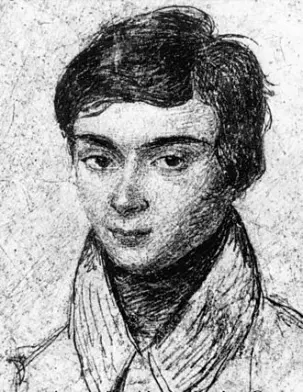
Evarist Galois
There are infinite more examples I could quote from every age of poetry that give us unforgettable images which add to our own 'apophenia', which serve to broaden our vistas, our consciousness of this world, its possibilities of connections.
It's like a spider's web, that grows ever wider and more complex and intricate in subtleties, and our own vision better, sharper, as we see each thing in a new and brighter perspective, magnified and enhanced.
Here's a few words from a poor anonymous poet of the early middle ages, in love, describing the joys of sex with his lass in a grassy field, now done and tired and and taking a break, about to fall asleep, their minds drifting into a dreamy fog: "oculi nantes in palpebrarum rate""the eyes swimming on the rafts of the eyelids".
Eyelids do sort of float on the watery surface of the eye, but the image is unforgettable to anyone with sensibility.
Here's one more from an unknown schoolboy asked to translate the passage in the bible of Jesus turning water into wine, into Latin verse:
"Vidit et erubuit lympha pudica Deum".
In English: "The virgin waters saw the face of God and blushed", so perfect an image it was copied down thousands of times. Too bad the boy was forgotten.
Algorithms will never reach such heights of fancy, such complex connections. Yet they are there. They do exist. And that's my problem with them.
If they remain simple and mundane, if their creators don't put in the imaginative factors that that give them flight, then we fall into their simple, or crude categories and are pigeonholed as such.
I know we progress as humans in consciousness. I'd hate to see machines retard that progress.
I was walking my dog the other day when the question struck me: "does my dog have any conception of aging or death, like we do, or is that consciousness beyond his ken, and people just 'disappear' for no known reason"?
This immediately suggested another question to me. "What aspects of our reality, our lives, are just a tad bit beyond our perception, unperceived by us, invisible to our eyes, too complex for our faculties to understand, but yet there, a part of us, awaiting discovery. Someone might soon catch a glimpse and then explain it to everyone, opening up an obvious whole new world, (as Galois did with group theory) raising us to a new level, just as we're a level above dogs.
I hope we never let computers get in the way of our own enlightenment.

My dog, Leeloo






