
RekTimes Weekly Markets
6 May 2022: With interest rates now rising significantly in the United States and markets beginning to decline, there is a strong probability that a global recession is at the doorstep. This becomes pretty clear when analyzing key economic metrics despite the reportedly low unemployment rate in the US.
Our main point of emphasis this week - the Federal Reserve cannot control external economic factors. Raising interest rates will not stop inflation in both the energy and food sectors.
Therefore, companies are looking at higher costs while low to middle income families will experience a debt squeeze. Less disposable income leads to less demand. Less demand AND higher costs for corporations will lead to cost cutting and/or economic growth reduction.
The following newsletter will explore these ideas in depth for the global economy and the cryptocurrency market:

Global Economy
As inflation continues to run historically high in both established and emerging economies, action is now being taken by many central banks - the United States now included - to control inflation and enter a period of tight monetary policy.
Governments have been stuck between a rock & a hard place for some time now - trapped between extreme inflation and a deflationary economic correction. With the Federal Reserve announcing a rate hike of 0.5% and coming rate hikes that would bring interest rates to ~3%, global markets are now facing extreme pressure.

Interest Rate Increases
Raising interest rates makes borrowing more expensive and less favorable. Additionally, certain debts become more expensive to service. This is especially true for the United States, who must service more than $30 Trillion in debt. These debt costs will continue to eat up the budget of governments like the US.

Corporations and start-ups relying on debt to grow now have increased expenses that must be priced in. This is primarily affecting assets like tech stocks, which have been absolutely pummeled in recent weeks.
For example, here are the returns on assets since Fall 2021:
- Amazon (AMZN): -39%
- Apple (AAPL): -14%
- Netflix (NFLX): -74%
- Meta Platforms (FB): -46%
- Ethereum (ETH): -44%
- Bitcoin (BTC): -47%
Now let's focus on debt like credit cards. Americans had a record level of CC debt in 2019, just prior to the Covid-19 Pandemic. Following the pandemic, outstanding credit card debt fell significantly. This is directly correlated with the massive release of government stimulus in response to the pandemic.
In just Q4 2021 alone, Americans added $52 Billion in CC debt, raising the total balance from $804 Billion to $856 Billion. What happened? Stimulus money ran out and incomes simply have not adjusted fast enough to the huge increase in inflation. All of that debt just got more expensive.

To add to the pile, Americans had already been getting massively squeezed in the housing market, with rent price increases of greater than 30% in some cities and a housing market that has EXCEEDED the 2008 housing bubble in terms of price/median income ratio. Anyone that was waiting for a house now must service that mortgage with the highest rates seen in years. Everyone that overbought will lose that home equity if prices correct.

Impacts to Employment
Americans are now feeling the heat from multiple sectors. This eats into both savings and disposable income considerably. For corporations, to offset expense increases and maintain margins, cost cutting must come from somewhere. The most obvious area in which to accomplish this is by cutting labor costs.
Despite wage increases and a growing labor market that has favored the job seekers, falling disposable income combined with rising costs will lead to lower demand for goods & services. This naturally presents itself as an opportunity for companies to conduct layoffs and cut costs. Therefore, unemployment should rise and productivity (namely Real GDP) should fall.
Inflation Will Remain Persistent
The last point to consider here is the macro-economic factors that central banks have absolutely no control over. With Russia and Ukraine locked into a war, both energy costs and food costs are expected to increase substantially. Russia and Ukraine are both producers and have subsequently halted these operations. Additionally, costs of the war are eating into the budgets of outside nations. For instance, the United States is spending billions on support for Ukraine.
Per research conducted by the World Bank, energy prices are estimated to rise over 50% during the course of 2022. Wheat prices are forecast to go up over 40% while the prices of precious metals are expected to increase ~16%.
Commodity markets themselves are being squeezed tremendously as supply shocks that have resulted from both Covid and the Russo-Ukraine War continue to impact the markets over time.
The Death Spiral
There is an emerging negative feedback loop within the global economy. As inflation continues to impact global markets, costs in many vital asset classes are expected to rise. Additionally, interest rates hikes makes borrowing more expensive. Demand will slow and growth will slow.
Falling demand and higher costs ultimately leads to a cool-off in the labor market through less hirings and more layoffs. Productivity falls, cash flow slows down, and the cycle feeds on itself. This is the makings of a global recession.
Further Reading - In the Know
-
Higher Interest Rates Will Raise Interest Costs On The National Debt (PGPF)
-
Household Debt and Credit Report - Q4 2021 (Federal Reserve)
- Commodity Markets Outlook (World Bank)
- World Economic Outlook APR 2022 (IMF)

Crypto-Economy & Markets
The cryptocurrency market entered a new leg down over the past week, with many assets breaking through key support levels.
Market sentiment has remained in a status of ' Extreme Fear'.
The full Fear & Greed Index chart is shown below:

Total Market
The Total Crypto Market is now down 45% off the all time high established in Q4 2021.
With the latest leg down, the market is firmly under the 50MA. The 200MA is ~50% down from current levels at ~$850 Billion.
The Crypto Total Market Cap is shown below:

Bitcoin
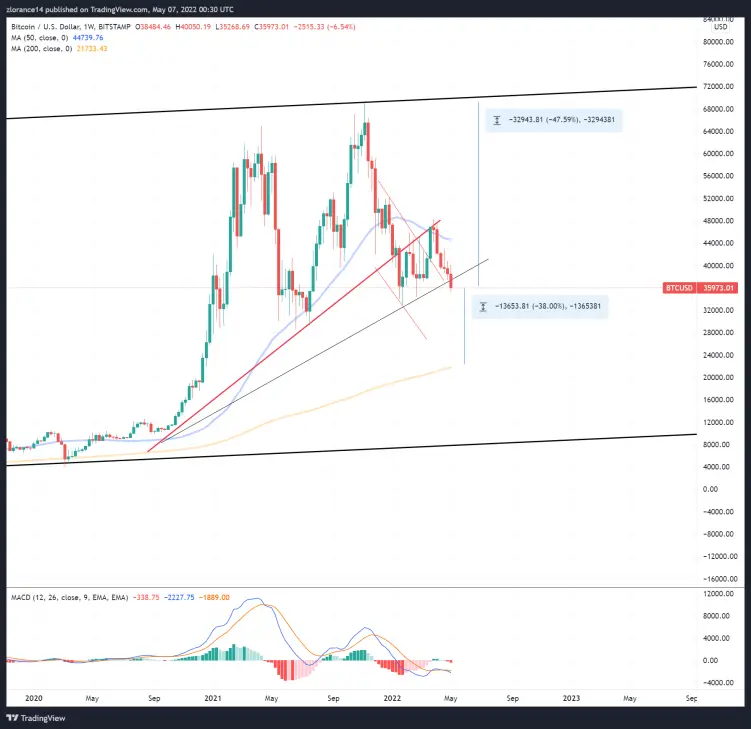
Bitcoin has officially broken through critical support at ~$37,000 and should be expected to trend lower long term. This latest breakdown correlates with declining demand.
Bitcoin is down ~47% and could potentially fall another 38% to the 200MA stationed around ~$20,000.
The Bitcoin/USD Weekly chart is shown below:
Alt Coins
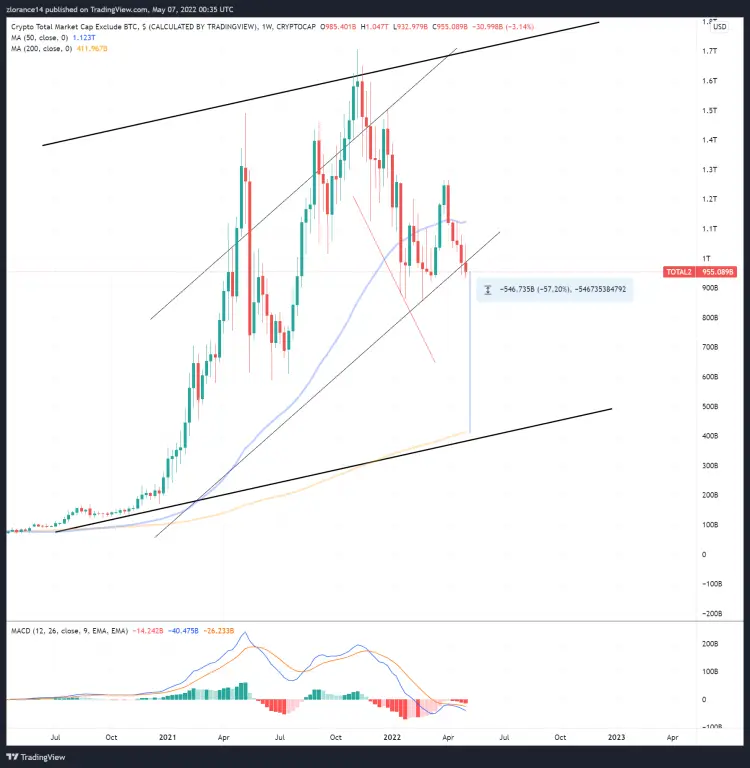
Ethereum and altcoins are also trending lower, albeit at a lagging pace to Bitcoin.
Ethereum still has a support level at $2500, but the Total Altcoin Market has broken through critical support and looks to trend lower to its 200MA at roughly $400 Billion.
The Total Altcoin Market Cap is shown below:

Markets Summary
The Total Crypto Market, led by Bitcoin, looks to be heading for lower lows as both digital assets and stocks are being sold off in a frenzy driven by higher interest rates. Based on a combination of economic factors, it appears to strongly favor a coming world recession.
The major entrance made by investors, venture capitalists, and hedge funds fueled a massive amount of growth within the cryptoeconomy, spurring tons of new projects and assisting others in achieving high valuations. Those same VCs that led the early investment rounds of many projects still have the ability to take much more profit and dump on later investors.
As cash dries up and economic pressures rise, cryptocurrencies as a speculative, high-risk asset class should expect to see increased pain.
Of course, the greater amount of pain will be felt in the general populace as the pressures of a recession continue to build. How governments will respond in the short to medium term is unknown. What can be suggested now is to prepare for a period of probable stagflation or, at the very least, a deflationary environment in the general economy.
Please keep in mind this is not financial advice, but merely observations and free analysis. We cannot predict the future, but are confident in the long term technicals & fundamentals.
Coming RekTimes Articles:
- Article on El Salvador
- RekTimes Weekly Markets 1.32
Long Term Projects
- Investigation on MOBI
- Research report on Ampleforth Stablecoin
- Q2 Summary Report

If you enjoyed this article, be sure to follow this page to be notified of our weekly postings
Use the QR codes below to tip in USD/BTC or send a tip through CoinTr.ee



Moose & Marsha Handcrafted Goods