17 June 2021: The United States is heading towards economic disaster. U.S. Total Public Debt has exploded over $27 trillion USD while GDP has lagged behind that growth. Additionally, the Federal Reserve has had to increased money printing, evident by examining the money supply, to consequently cover the massive deficit that the US has been operating on for years, especially to cover the COVID-19 stimulus packages that were used for economic relief.
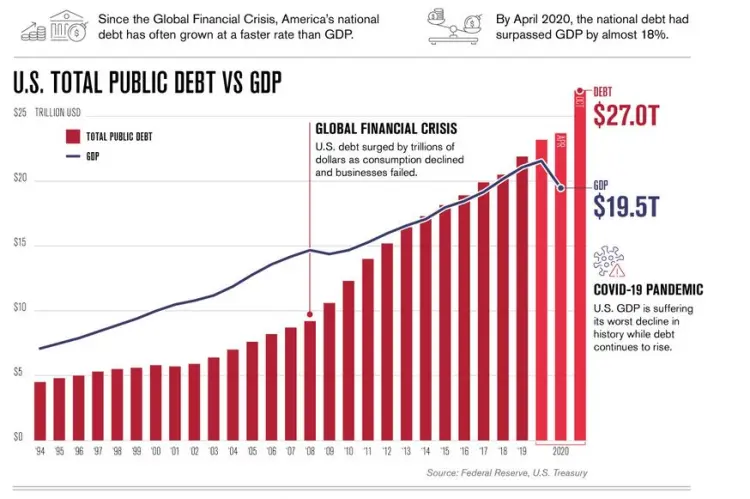
This article will explore how the current US economic trajectory is on a path for total disaster and how Bitcoin & cryptocurrencies could actually help change that.

The United States has a Debt Problem
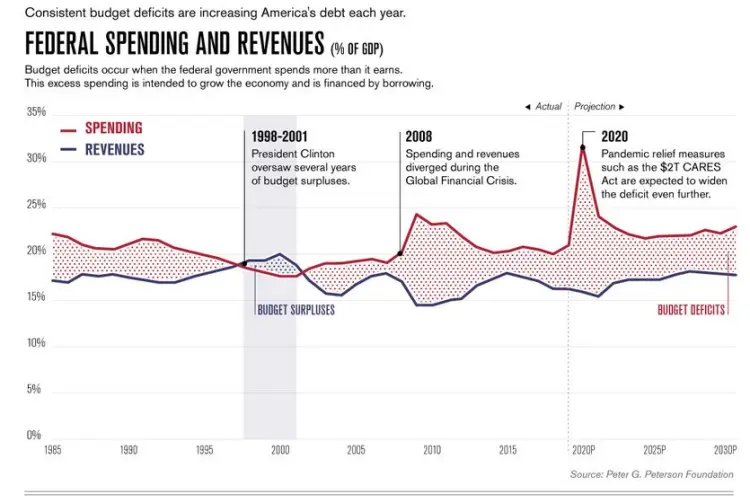
The last surplus that the US Government had was during the Clinton Administration from 1998 up to 2001. Since then, the United States has operated on a budget deficit with some significantly bad periods of spending, including the 2008 financial crisis and the 2020 pandemic.
Currently, federal spending is outpacing federal revenues by approximately $900 billion USD per year. This means that at this current pace, the US will add another $8.1 trillion USD to the total debt, not including increasing interest costs, any additional stimulus, or additional spending for climate change, infrastructure, and other key issues.
Federal Spending
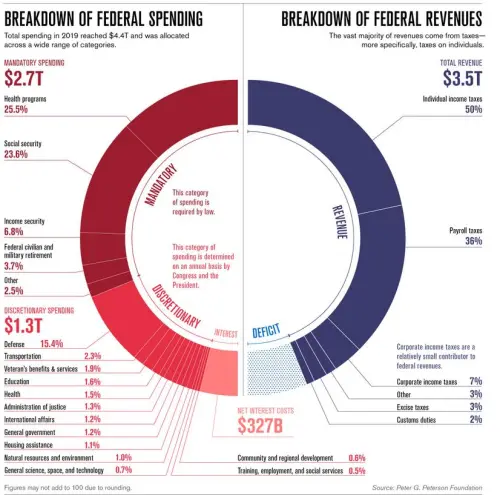
The United States spends an estimated $4.4 trillion USD each year. This is broken down across multiple spending categories. The United States spends around 25.5% of its budget on health programs despite having the most expensive healthcare system in the developed world. Americans actively spend much more than their peers in other nations for the same treatment. For example, Americans pay nearly 10 times more for a standard unit of insulin. The average cost for insulin in the United States in 2018 was estimated at $98.70 USD compared to the sampling average of 32 foreign countries where the cost was estimated at only $8.81 USD.
In addition to healthcare spending, 23.7% is spent on social security, 15.4% is spent on defense, and just 2.3% & 1.5% is spent on transportation & education respectively. Only 1% is spent on the environment.
The U.S. has to pay an estimated $327 billion USD each year just on the interest to cover the debt payments the country has already built up. This number will grow significantly as the US continues to operate at a deficit and if interest rates go up.
Federal Revenues
The United States brings in about $3.5 trillion USD in revenue each year. Of this $3.5 trillion, around 50% of it currently comes from income taxes on the individual level, 36% comes from payroll taxes, 7% from corporate taxes, and the rest spread out over smaller categories.
The 7% of revenue coming from corporate taxes should actually be higher, but the US is losing billions of dollars from this revenue source each year through companies finding ways to avoid paying taxes they owe. For example, 55 major corporations in the US did not pay federal income taxes in 2020, including the likes of FedEx, Nike, Salesforce, and more.
To reiterate, the average annual deficit for the United States is approximately $900 billion USD each year.

Shrinking Demand for US Dollars, Larger Burdens on Americans
To cover rising expenses and increasing interest payments each year, the US Government has two options. The first option is to either cut spending or increase income. The US could increase income in the form of higher taxes, both individual and corporate. The other side of that coin is to subsequently cut expenses, such as military spending.
The other option that the US Government has is to simply print more money, and that is exactly what they have been doing. The Federal Reserve has printed nearly 40% of the total outstanding money supply in the past 18 months.
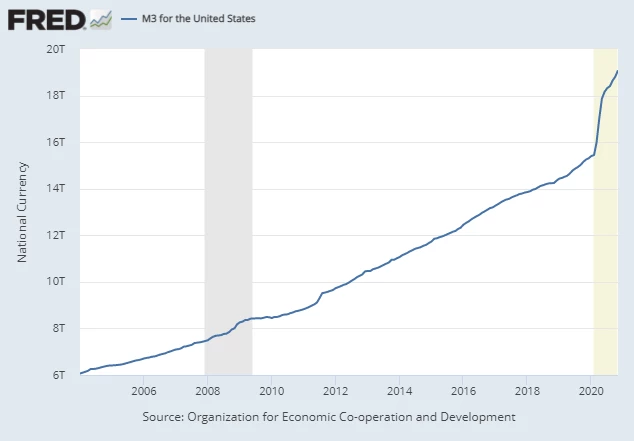
In the chart above, the massive increase in outstanding US Dollars can be observed above. The money supply was significantly increased in the yellow bar on the right. This massive expansion of USD has brought on the fears of rising inflation which has, so far, been evident. Inflation has reached 5% in the month of May and is expected to increase this month in June. If you want to learn more about inflation, check out this article.
It should be noted that the Federal Reserve has discontinued the money supply charts like the one seen above.
This massive expansion in the money supply has also been met with a shrinking demand for US Dollars abroad. Countries are trading in their USD for other currencies and assets. The USD as a share of the global reserve currencies has hit its lowest point in 25 years, dropping to under 60% of the total global reserve currency currently in circulation.
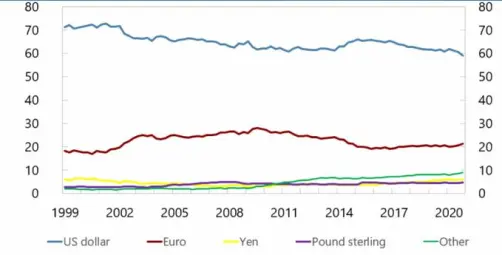
This means that all of those USD are slowly going to fall into American markets, meaning Americans will be footing the bill of rising costs due to a devaluing of the USD.
In addition to a rapidly expanded money supply, wages for most Americans have not budged in decades. When accounting for inflation, wages have actually been decreasing in the United States despite productivity being the highest it has ever been.
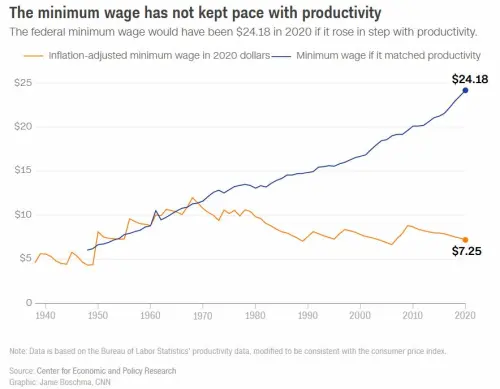
This means, Americans are working harder and harder for less and less money. With rising costs of living, Americans are seeing their standard of living decrease over time. Food, housing, medical expenses, higher education, and more are becoming more expensive each passing year.
The Negative Economic Feedback Loop
To summarize, increasing deficits each year are prompting the US Government to cover bigger and bigger deficits with more debt. Without cutting costs or increasing revenues, they are forced to borrow more money from the Federal Reserve. So, with increasing debt comes increasing interest costs which is increasing the deficit for the next year even more, which prompts more borrowing, and so on.
Even if the US Government can manage to get back to a breakeven budget, it will have no money to combat the incoming costs of climate change, no money to rebuild crumbling American infrastructure, and no money for the next economic recession - without more borrowing.
This borrowing is increasing the money supply, which is increasing inflation and subsequently costs. Costs are being passed down to American families who have less and less purchasing power each time around. This is where the visible negative feedback loop is becoming apparent.
In an economy that only thrives on consumption, what happens when the majority of people you rely on to spend money to support GDP don't have any money left to spend?
The only factor keeping the US economic machine turning right now is strength in the US Dollar, which is statistically declining on a global scale. If the rest of the world is losing confidence in the USD, the only ones left footing the bill of devaluation is Americans themselves.
The companies operating in America won't fail, they will simply sell their products and services to those that can afford them - and it won't be Americans. The United States will get outbid for goods by foreign countries utilizing stronger currencies.
Due to the 'America First' policy by former President Trump, the United States is actively being left out of major trade agreement all over the world. For example, the United States has been left out of the new Regional Comprehensive Partnership Agreement (RCEP) that includes countries like China, Japan, Korea, and more. This agreement is valued at over 30% of the global economy.

The Case for Bitcoin in America
America has an opportunity to turn around this current economic trajectory. The United States should be the first major nation in the world to make Bitcoin legal tender. There are obvious merits and rewards in being first. Bitcoin has a fixed supply of 21 million coins - ever. If the United States chooses to be the first major country to adopt Bitcoin as legal tender, just by holding Bitcoin on their balance sheets, the United States could actively begin paying back the massive $27 trillion USD in debt it currently holds as other countries also buy into Bitcoin.
Smaller nations such as El Salvador, Panama, and Nigeria already understand this. The major losers when it comes to cryptocurrencies will be the ones who are the latest to join the party. Currently, Bitcoin is only valued at less than 2% of the world's money. The countries who adopt the technology first will be paying the cheapest cost to integrate it into their economies and balance sheets. As Bitcoin expands and captures more of the global money supply, that cost will increase exponentially until adoption is complete.
Summary
Would Bitcoin be a fix-all for America? Absolutely not. The evidence is abundantly clear, however, that the current economic path for the United States does not have a positive outlook and different solutions should be explored. The negative loop that has been created cannot be ignored. Simply expanding the money supply to cover the debt is unsustainable over the long term and will bring about nasty negative consequences to Americans. Bitcoin offers a solution out of that loop. While additional problems will persist, Bitcoin at least would offer the United States a secondary legal tender with a positive economic future to help mitigate the damage being done by devaluing the US dollar. The United States needs Bitcoin.
REKTimes is a rebrand of the former blog, Crypto.Think
Check out this link for a chance to win our $100 in Bitcoin giveaway! - REKTimes Bitcoin Giveaway