
Token economics (or tokenomics) is the study of the new type of economy that is defined as the design of a particular ecosystem in a blockchain environment. Every ecosystem is composed of several elements and the token functions as the central element of this new type of economy. A token is a digital asset that can belong to different categories: utility/security and fungible/non-fungible, etc.
Utility or Security Token
The utility token is a cryptocurrency used to offer access to products and/or services on a platform. Security token derives its value from an external and tangible asset, and offers to the token holders a wide range of rights (entitlement to a share of profits, interest on a debt, ownership or equity in a legal entity, and so on). Given the different regulatory frameworks applicable, the line between these two categories of tokens is thin, so it can be problematic in tokenomics. The actual regulatory framework is not very clear about the criteria for qualifying a token as a security or a utility token, but there are guidelines that allow the blockchain entrepreneurs to create tokens legally. In this article "Blockchain Real Estate Projects Developed Til December 2019" published here, I talk about some use cases in different jurisdictions.
Fungible or Non-fungible
Depending on the scope of the project, a token might be fungible or non-fungible. Fungible tokens are interchangeable and are divided into smaller token units. Non-fungible tokens are non-interchangeable and cannot be divided. In a tokenomics analysis, the choice between a fungible or non-fungible token will entirely depend on the used case study.
The Blockchain Ecosystem
Why Blockchain?
In decentralized or centralized applications or in smart contracts, blockchain can provide functions other than making payments and, in such applications the units are not coins, but tokens or digital assets. Blockchain offers a number of exceptional features: removing intermediaries, reducing fees, recording public documents, verifying identity, preventing fraud, enforcing regulations and protocols, providing transparency, creating privacy, and more.
However, even if it has a number of remarkable use cases, before it can become widely adopted, the blockchain must fix its user experience problem, because the most of users do not really care about blockchain—they just want something that works. In order to improve user experience, the development teams aim to make blockchain accessible to everyone, easy to understand and user friendly, and their main question must always be:
 What leads the USER to Come, Stay & Interact (UCSI) with Your Token?
Experienced Teams will consider UCSI as being the core of token economics and this guides them to create a system based on user’s experience (UX), having well-calculated number of tokens emitted and a balanced allocation of tokens, with a steady and sustainable long-term plan, and by creating adequate mechanism for the functionality of the blockchain, platforms and wallets.
Token-flow
In addition to the UCSI question, while designing an ecosystem and doing tokenomics analysis, developers ask the following questions:
- What are the values that the Token project is trying to promote?
- What are the sources of input (injection) and output (rewards) of tokens?
- How can we build a sustainable and stable ecosystem in the long-term?
Architecture: Dual or Simple
In order to choose between a simple and a dual token architecture, you must consider several criteria: interest of users and investors, cost of development, the goal of the project and the purpose of the token. For example, you can design the structure of the project to be suitable for a Security Token class, with an Asset Token subclass. This simple token structure will fit precisely with the goal pursued by many Security Token Offering (STO) projects.
Stabilization Mechanism
It is important for us to manage the threats linked to crowdinvesting business model that can have a negative impact on the token economics. For example, proposing too high bonuses to early bird investors can lead to risky situations where a single investor can have a critical influence. To avoid this, we create a token backed by a physical stable real estate asset, which has a real cost and cannot be manipulated by a real estate mogul or a financial institution, etc. Most Security Tokens are not volatile cryptocurrencies, bonds or stocks, as they are backed by real assets.
Monetary Policy
A monetary policy consists of measures that are taken in order to create stability for the token, as it is very important to build a core strategy in order to maintain a safe value for the potential token holders. As shown in the above paragraph the Security Token backed by a tangible asset isn’t a monetary asset, and do not have significant implications for monetary policy and is not effectively competing against cash and deposits. But, bonds, futures and other intangible asset, that aren’t backed by a physical asset, could have implications for monetary policy. Correctly defining while designing your Token it is very important here.
Security Token Offerings (STOs)
Security/Asset tokens are cryptographic digital assets to which a right is attached, and could include shares, bonds, futures, physical property, debt contract, intellectual property rights, etc. A security token is a digital contract that denotes a share of ownership in some asset of value. Holding the token would give the right to some percent of an apartment, a house, or equity in a business, etc.
A security token is the digital equivalent of a stock certificate, updated and secured for the 21st century that performs equally in functionality as a traditional security; the difference is that it confirms ownership through blockchain transactions.
Considered by the community as an Investment Contract, similar to that of traditional financial instruments, security tokens offer a number of financial rights to investors, such as: revenues through favourable price movements; profit dividends; income shares; interest paid to participants, etc.
The Security Token Investment Model
The primary reason to tokenize an asset is to improve its liquidity, which correlates strongly with the asset’s trading volume. Stocks and bonds are liquid, whereas cars, real estate, collectibles and jewellery lack high volume secondary market trading activity and liquidity. A permanent trading market improves price discovery, minimizes price volatility, and reduces risks. In addition, a token backed by private asset, augmented with protocols that add dividend, interest or share of profit functionalities, brings this previously illiquid asset class into the Passive Income Class of Investment (PICI), and presents a new type of real estate asset, the Fractional Property Ownership (FPO).
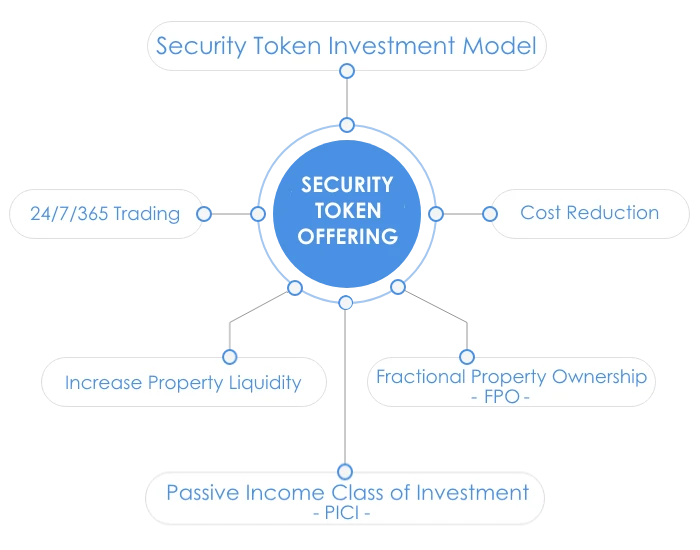
(Image source: ReitisCapital.com)
Let’s look at the upside for tokenizing securities in contrast to old formats:
- Public view of the capital table — every stakeholder has an address on own blockchain. Each address contains a number or a fraction number of security tokens. On-chain, these tokens are the representation of ownership (not the actual ownership). We call this on-chain representation display, for investors to know how many investors and tokens are on the platform.
- Access to liquidity — currently, the majority of investors who purchase securities in a private enterprise do not have liquidity until the company is sold, goes public or is dissolved. This may be good for rich investors, but a capital lockup of 7+ years is not acceptable by normal people. Through tokenization, securities are traded on Exchanges, in small amounts.
- Automation and price reduction — the technology has eliminated the broker, the floor trader, the assistant, the attorney and many others. Using tokenized securities, the costs for issuing and trading securities goes down very much.
- Lower cost dividend/interest distribution — imagine this scenario: an investor you could get a €1000 dividend from a company but gets charged €100-€150 for the processing; with the blockchain that charge is less than 10 cents! This is a significant improvement.
The downside is that using digital tools and products are lack of knowledge yet, so we need intensive training for the majority of people who do not have the knowledge to do it in the right way. Educational programs are long-term and must include imperative training courses for young and old generations.
The Real Estate Investment Tokenization Model
In real estate industry, tokens can represent ownership in the underlying asset, equity in a legal structure that owns the asset, an interest in a lending contract, a debt secured by the real estate, a stream of income based on cash flows from the asset, and the list goes on.
Accordingly, SECURITY TOKEN backed by REAL ESTATE could represent the value of a number of SQUARE METERS of an APARTMENT.
Why would a real estate owner decide to tokenize?
- Tokenization creates liquidity – the investment pool for tokens is truly global. Anyone that meets capital requirements and has an internet connection can invest.
- Lower investor barriers – the barriers for investor entry will likely be lowered as real estate assets become more liquid.
- Programmable securities – tokens can be allocated and managed through smart contracts that would automatically enact important processes, e.g. automated interest or dividend payout through smart contracts, which would reduce costs.
- Security and immutability – cryptographic encryption protects the assets and blockchains tracking the tokens are append-only, meaning everything that has happened in the past is public to anyone who might want to look, including the regulators.
Glossary:
Token economics (or tokenomics) is the study of the new type of economy that is defined as the design of a particular ecosystem in a blockchain environment.
Security/Asset Tokens are cryptographic digital assets to which a right is attached, and could include shares, bonds, futures, physical property, debt contract, intellectual property rights, etc. A security token is a digital contract that denotes a share of ownership in some asset of value. Holding the token would give the right to some percent of an apartment, a house, or equity in a business.
Security Token Offerings (STOs) are security tokens offered through Exchanges.
Utility token is a cryptocurrency used to offer access to products and/or services on a platform.
This is not an investment advice! Before investing in any markets be aware about the risks involved.






