
Real World Assets
Bringing real-world assets (RWA) onto the blockchain is an emerging trend in DeFi which will have a lasting effect on the field. Bridging RWA with the DeFi industry and tokenizing those RWA will create a value worth trillions of dollars. RWA have the potential to change the future of financing. In 2021, Societe Generale, a large multinational financial services company, raised $30 million using its AAA rated bonds. (AAA or triple-A is the highest credit rating issued by rating agencies.)
It worked in the following way. An investment arm of SocGen called SG-Forge accepted the ownership of OFH bonds from SocGen. Then, it used those bonds as collateral to MakerDAO to mint DAI which was converted to fiat. The fiat funds were transferred to SocGen.
This example shows how RWA and DeFi in general can change finance by working with traditional finance actors. It has the potential to free otherwise illiquid assets leading to better capital efficiency.
What are real-world assets?
RWA can be but are not limited to real estate, loans or mortgages, contracts, carbon credits, tangible assets of high value, such as jets and yachts. Any physical or non-physical asset that can be represented on-chain and that has a cash flow can be regarded as RWA.
But why is there a need for transporting RWA to DeFi? There are many reasons among which the intermediation costs are one of the most important ones. Financing costs are still unreasonably high in many parts of the world because currently the system depends on and is operated by middlemen, e.g. investment banks, brokers, and rating agencies.
Liquidity is another big issue in many financial markets. Lots of physical or financial assets , however valuable, lack liquidity, thus are not tradable and are not available to most investors. Tokenization of these assets will bring higher liquidity to traditional financial markets and DeFi.
Bridging RWA to DeFi will also benefit business owners in emerging economies where borrowing foreign capital may be difficult due to inaccessibility to financial markets.
The primary use case of the RWA space is using these assets to borrow a loan, typically issued in stablecoins. Once the collateral of the borrower is assessed by the protocol, the total value of the loan available to the borrower is calculated. The debt then is represented in the form of NFTs which are sold to lenders. So, at the end of the RWA tokenization process, lenders get RWA-backed NFTs for which they pay stablecoins, and the borrower receives those stablecoins.
Florence Finance
One of the latest protocols in the space of RWAs is Florence Finance whose target is small and medium enterprises, or SME lending. Its Twitter profile states that Florence Finance is “the leading Euro-denominated RWA project”. Florence Finance solves two problems at once. First, it provides an uncorrelated source of income of crypto users, the so-called real yield. Second, it addresses the funding problem of SME which exists across many countries, both developed and developing ones. To achieve these targets Florence Finance works with SME lenders to get diversified SME credit exposure.
How it works?
Below is the chart explaining how the protocol works.
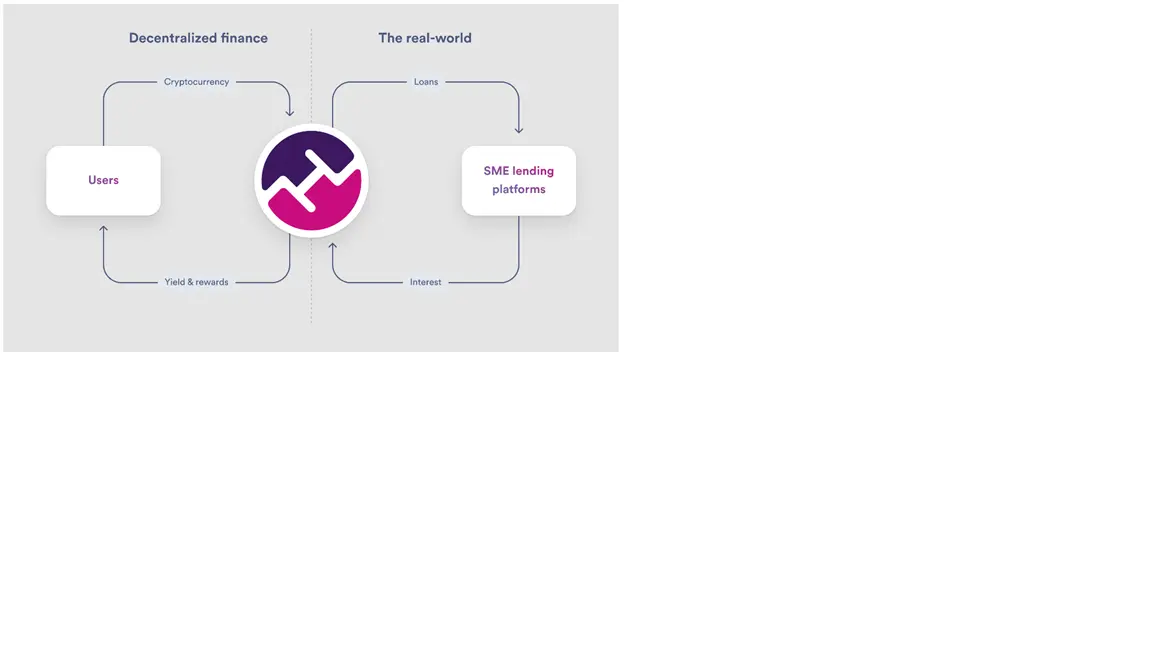
Users provide liquidity with stablecoins to the protocol for which they receive receipt tokens called FLR or Loan Vault Tokens. The collected funds are directed SME lending platforms or Delegates. Delegates lend the funds to SMEs. Note that SMEs are administered not by Florence Finance but by Delegates. Florence Finance doesn’t directly work with SMEs, i.e., it doesn’t lend funds to them but to the SME lending platforms. That’s why the loans and interest are paid back to Delegates which then distribute them to the protocol users.
At the moment of this writing, there are two ways you can earn yield with Florence Finance:
- Staking the protocol’s native token, FLR in the staking pool and in turn receive Medici (MDC) token.
- Putting your stablecoins into use in a Florence Finance Loan Vault.
Let’s see Loan Vaults work. To earn yield through a Loan Vault, a user should buy Florin token (FLR), Florence Finance’s native currency. It can be purchased on a decentralized exchange (DEX) with a stablecoin, such as USDC or EURS. FLR is backed 1:1 by the principal amount of outstanding loans and accrued interest. Once a user supplies FLR tokens into a Loan Vault, he will receive Loan Vault Tokens (LVT). Interest is accrued from the moment you provide liquidity to the Vault. When you withdraw your funds from the Vault, you’ll get back both the principal amount and interest accrued in the form of FLR tokens.
Though it is a good idea to commit at least part of your funds to earn real yield, there are some risks which shouldn’t be dismissed. First, there is credit risk. There is no guarantee that one or several counterparties will honor their obligations; in private credit you stand to lose all your money. There is also smart contract risk.






