
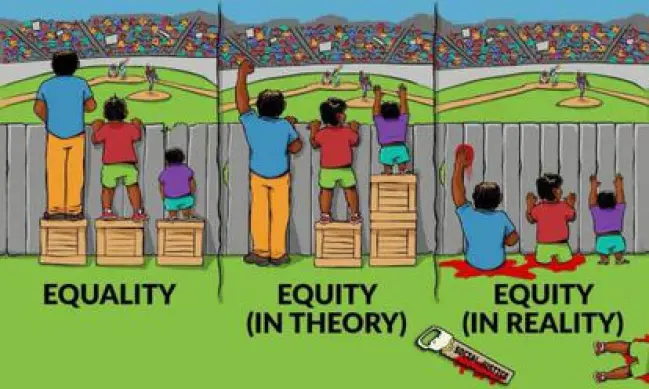
The origin of the word equality, in Latin, Roman, is "aequalitatem" or, depending on the meaning "aequalitas". In the language of the Roman empire, Latin, the placement of words, including their order, intonation, and what follows, or what comes before, determines how the situation is viewed.
Generally speaking, the formation of a language determines how people who use that language envision social mechanisms. In Anglo-Saxon languages, even those that have Celtic at the root, it is only possible to understand, in oral expression, the passage of ideas, starting from the final point. With adjectives coming before the intention of the verb and the subject. Also the collective, or the honor of what goes before, comes before the individual. The surname always comes before, in general usage, the first name. Translating: your family, your clan, comes before your name. Historical edges of ancestral cultures.
In Latin, Mediterranean or Iberian languages, there is the use of the name, the formality of the subject + verb + predicate. This demonstrates the action, long before the sentence ends. The very use, for example, of symbology, in this case the interrogation or exclamation, in Spanish, already warning of what the phrase is, denotes the intention.
If we observe pictographic oriental writings, that is, those that use drawings to convey ideas, it is noted that the relation of the whole, in the abstraction of the idea, defines as many possibilities as the interlocutor's experience. That way, unless you're immersed in the conversation, you won't have an understanding of the whole.
In sub-Saharan cultures, with fast writing, the idea is the speed for saving energy in writing. In this case, both in language and in writing, it is verified that simple inflections determine the intention. If necessary, ancestry shows that the economy of gestures and mouth opening determine survival in arid lands.
In other words, in speech and writing, there are cultural issues, survival, honor, ancestry of each people and, of course, the junctions between peoples.
Therefore, equality, as in Latin, will depend on what is understood socially, legally and culturally as equivalent.
Equivalence, or equality, cannot be observed just because things have the same weight and measure. the maxim of equality, normally, in these present times, is the physical and mental adaptability to accept the different so that the different can move independently and without obstacles in all aspects of society.
The concept of accessibility comes from there: to give equal conditions through the midfication of space to free those who depend on accessibility.
In the case of human "races", wrong taxonomic concept, since biologically there is only homo sapiens, divided ethnically, anthropologically and taxonomically by language, regionality and skin pigmentation characteristics, they do not interfere at all in human biological functions and social among humans.
For example, three identical pens, of the same brand, without revealing their ink color, undoubtedly have the same function: writing. Color alone is the means by which writing will be drawn. But the writing, the result of writing with the pen, happened regardless of the color emitted!
Likewise are the humans. All without exception, stand of power of all mental and physical faculties and under the same conditions, do the same things.
Equality, therefore, is restricted only to the capacities with which each individual can contribute to the social environment in which they are inserted.
The struggle for equality, therefore, in the social environment, is much more linked to the historical and moral conditions of each people, the way each regional society sees the other, or how it understands the male-female relationships within the social context.
Certain differences are largely linked to moral, ethical, ancestral or historical concepts of events that determined the behavior of this or that society.
As these conditions permeate all aspects of human life, they also permeate the digital world in difference and equality.
At the beginning of the digital age, the asexual freedom of avatars and profiles, still unheard of without social networks, allowed gender equality by not knowing who was on the other end of the line.
In fact, this also happens today, to a lesser extent. However, while in the real aspect, attacks are limited, in the digital world they are hordes.
In cryptocurrencies it is no different.
The different cryptocurrencies have strengths and weaknesses, depending on the mining logic and driving policy. The tokens have strength or not depending on the cause and propagation means used and propagation strategies demanded.
Anyway, this logic is essentially linked to social engineering.
Remarkably, referral and reward programs are very similar to ponzi schemes. Those who have more references earn more and sustain themselves by being closer to the top of the pyramid and those at the bottom almost never manage to gain.
Equality, in this case, does not exist. The gains depend on, precisely, the differentiation between those at the top and those at the bottom.
The DefI also use this technique.
So, while in the real world there is a struggle for ethnic and gender equality, in cryptocurrencies there are often unequal explorations based on the lack or lack of knowledge, ingenuity and the hopelessness of others.
In the digital world, cruelty lies in the lack of a global vision of the financial system. Inequalities, instead of being taken care of and offered accessibility, are used to take advantage.
Taking care of others keeps the system healthy. If at almost every moment there is deception for its own good, if the other is only meant to be exploited, soon the whole system will collapse, because the poison will be a justification for strict regulations.
Few won, many lost, and that was reflected in the system. It happened in the past, it will happen cyclically.
A reflection remains: the investor, on average, is at what point on this line?
For better or for worse are you, individually, contributing to the cryptocurrency system not becoming a "cash-for-all" system?
If, on the one hand, cryptocurrencies have been changing lives around the world, on the other hand, other people have been destroying other lives out of greed.
Which side would we be on?






