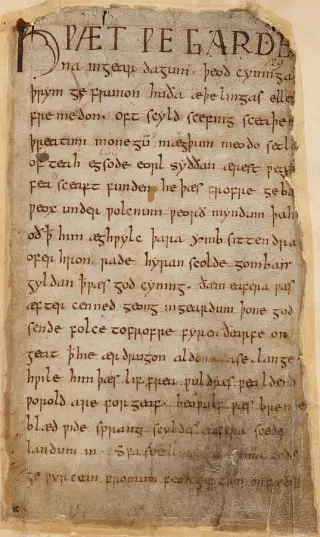
The tale of Beowulf, written in Old English, between the years 700 to 1000 AD, tells the adventures of this warrior, from the time of conqueror to the end as king. Written almost like a synthetic poem, it is more like a tale that can be set to music than, in fact, a poem.

In short, for those who have never read or heard of this tale, it describes the adventures of a group of Vikings that sailed the northern seas until their fearless commander, Beowulf, decides to land and settle to seize the laurels of their victories: after all , nothing more than being in the lands of those who were saved, being showered with gold, women and fame.

The story, to put it in context, takes place in Scandinavia not Christianized at all, from the sixth century (there are even signs of disdain for the God who had brought there in front of Thor). At that time King Hrothgar of the Danes (or of Danes) asked Beowulf a hero of the geats to hunt Grendel. Grendel wants the mead in Heorot.

Beowulf kills him, Grendel's mother madly attacks and is defeated. The combat ended, full of gold, mead and foodstuffs, Beowulf returns to Geatland (Götaland in modern Sweden) and becomes king of the Geats. For fifty years he rules these lands with justice and strength, defending the borders and spreading the legend of a just, loyal and hospitable king.

After this time, Beowulf, already old, comes across a hungry dragon for gold (detail: the dragon destroys everything around him because someone in the kingdom stole a piece of gold from him). The dragon accumulates and accumulates and accumulates (no, not a coincidence with R.R Tolkien's Lord of the Rings books). Beowulf goes to the dragon's lair and in a deadly fight, almost defeats the dragon. In fact, who defeats it is Wiglaf, his faithful squire, who remains with Beowulf, after the mortal wound that the king took from the dragon, impaling the dragon. The king makes Wiglaf his heir and occupant of the throne, for the servant was loyal, just and maintained the same fighting spirit and justice as the king himself.

After his death, his court cremate his body and erected a tower on a promontory in his memory.

It would not be just a legend if, in fact, there were no tombs and inscriptions in the lands under siege.

This tale is as important in Anglo-Saxon culture as in Norse, as it brings a normal human being, just carrying sword, armor and magic shield as something ethereal. But in itself, as in the fight with Grendel's mother, he is naked for the fight, defeating the mythical monster.

In other words, it wasn't a god who killed and resolved the issues, it was a man. Almost the same way as Arthur in England. Of course, Bwowulf is the maintenance of non-Christian beliefs and Arthur embraces Christian beliefs.

Either way, both occur between 600 to 700 after Christ and extol human deeds, even if initially for glory, but later assuming the responsibilities that come with the office of King and protector: with justice, loyalty and strength.

In the case of the dragon comes the realization: the dragon only wanted what was his. That was stolen! Of course, the dragon's emotional response isn't justifiable.

Beowulf tries to mediate first, which has no effect, using force secondarily. Scholars take into account that this dragon should already exist in the kingdom, during the reign of Beowulf and, were it not for the act of theft, would remain there after the natural death of the king.

The dragon is normally attributed in literature to magical beings, possessing great strength and very old, living two or three to five human generations. But they are also literary symbols of greed, avarice, cruelty and introspection...in the best example of "don't mess with me, I don't mess with you!" and the neighbor to turn around.

The bitcoin case reveals the dragon that exists in crypto traders: most felt robbed and left destroying everything around them. They began to apply in meaningless things and value, bringing down the market even more. Venturing into risky tokens and losing more.

Like the dragon, spitting fire and turning everything around him into scorched earth, in that typical mixture of frustrated greed, anger and greed.

Worse, in the financial market there is always Beowulf that kills the dragon, that kills the accumulated power, demonstrating that everything has a limit.

Sometimes we are the dragon, sometimes we are Beowulf. We are almost never Wiglaf.

But Wigraf, having been humbled, spared honor and meager wealth during a long life as a squire, defending and holding himself apart, patiently succeeded in the kingdom and due recognition.

So when should we be the dragon, Beowulf or Wiglaf.

I believe, at this moment when the dragon and Beowulf are killing each other in the magical world of cryptocurrencies, that we should be Wiglaf...that with no magic weapon, just normal shield and armor, he impaled the dragon after the final fight, taking all the booty of Beowulf and the dragon.

How many fights until you find this booty?

Understanding yourself is a fundamental component of operating cryptocurrencies!!!!


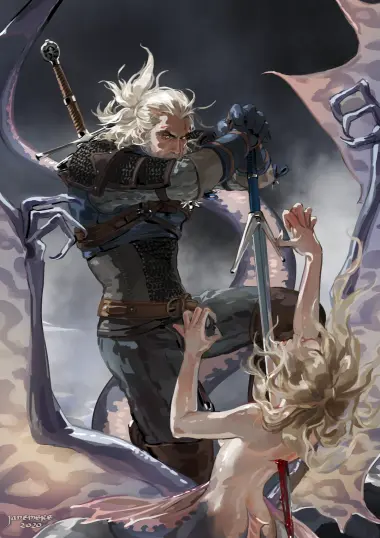
And, YES, the first picture is the Witcher: Gerald - that go talk later! And R.R Tolkien wrote about Beowulf too!






