
I have been waiting a few days for the dust to settle on this one before finally posting on the subject. It has been just over a week (12 June 2026) since the SpaceX IPO (Initial Public Offer) saw shares being sold (reportedly at US$135 each) and ownership becoming a matter of public interest. This is a significant step as it marks a turning point for both Elon Musk’s personal empire and the trajectory of future space exploration.
Yesterday I posted as to why it is important that we leave our home planet and expand into the universe.
Back to the SpaceX IPO, the offering isn’t just a financial event; it has reshaped how SpaceX will be funded, governed, and judged, and it signals a new phase in Musk’s long‑term Mars and AI ambitions.
Let's start with Elon Musk.
I suppose the question is, and has always been, a question of whether Elon Musk is a visionary or the ultimate Bond villain. On the one hand he has driven technologies forwards (and continues to do so) for the benefit of mankind; I don't think I am alone in being impressed when I first saw one of his rockets return to earth and land vertically and ready for reuse). On the other hand, given his awkward public persona, the whole thing does smell a lot of megalomania and his life seems to be the exemplar proof that wealth = power and greater wealth = greater power. While initially invited into the White House to head up the aptly named DOGE (Department of Government Efficiency) he was soon driven out because Trump's ego was even bigger than his. This must have really stung because Elon Musk's role was significant in getting the big orange baboon (re)elected in the first place.
First and foremost Elon Musk has retained his roles as CEO, CTO, and Chairman of SpaceX even after going public. This means despite a wider ownership of SpaceX he has ensured that he remains firmly at the centre of all strategic decisions. The S‑1 filing shows SpaceX has evolved into a technology conglomerate spanning rockets, satellites, and AI, all under Musk’s direct control. The IPO also saw his personal wealth soar and he became the world's first trillionaire (my spellchecker didn't even like that word) as a result of the sell off.
Elon Musk has now built for himself a massive interconnected empire which centred around him being the key asset, with investor confidence very much being focused on him and his performance. The interconnection comes through the whole (you could call it cross-pollinating) network, which now shares capital, talent, and infrastructure. His entire ecosystem, that features rockets, satellites, AI, and even the merged xAI division and let's not forget Tesla may well share some crossover technologies that can be utilised to drive his programme forwards.
However, bringing SpaceX into the public domain does mean that as well as there being more capital available there is greater scrutiny of the business. SpaceX will now be subject to regulatory oversight, quarterly earnings pressure and investor expectations tied to Musk’s execution. This is the price he has to pay to unlock the massive capital needed for Starship, Starlink, and AI expansion.
Now moving on to the big picture, the main driver. Elon Musk as to many visionaries, sees our future in the stars and that means space exploration. You might recall what I wrote yesterday about the doom of the Earth and how we should respond.
The late great Stephen Hawking warned that humanity must establish colonies on other planets as a "backup plan" to avoid extinction. He famously stated that keeping our species entirely on one planet is like putting "all our eggs in one basket" and urged humanity to spread out into the cosmos. Hawking suggested back in 2010 that we have a few hundred years and by 2017 he had reduced that timeline to 100 to 600 years and stated that this is the tipping point where we will eventually be lost without off-world bases. To be honest when I was checking this I did recall something about him saying if we don't leave in the next 100 years then we never will and thus that was the basis of my search. The results as you can see were just a bit :) different.
The process is already underway and there is a sequential strategy to how it works and so all of these test launches are not just random events. To summarise the premise that it works on is based on the following principles; Starlink (Elon's Musk's satellite-based internet service) generates cash which is then used to fund the Starship programme. The name is rather unimaginative and sounds like it comes from a children's book, but it is fit for purpose. With a constant stream of income Starship can focus on slashing launch costs, which will then in turn lower costs and expand the space economy. These expanded markets with then fund Mars, Lunar, and AI ambitions. This sequence - logical and simple - was explicitly described in Reuters’ analysis of the IPO. At this point, and I don't know the figures, I don't know if Starlink is a big enough business to be able to act as a catalyst for such ambition and especially given that Elon Musk's companies are notorious for making losses.
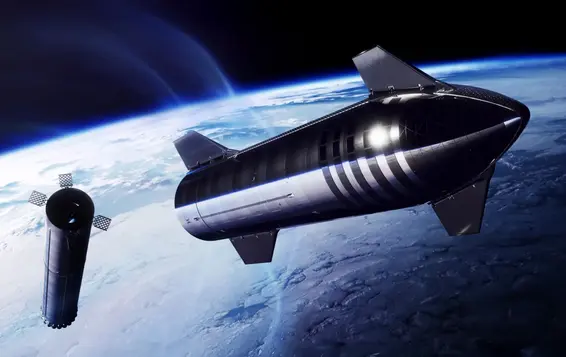
However, if all goes to plan, Starship (see image above) will provide the ships and infrastructure so that it will become the workhorse in supporting a whole lot of "space stuff". The video that accompanied the IPO touts visions of Mars missions, Lunar cargo transport, asteroid mining and orbital data centres to name a few. I think a bit like with Jeff Bezos (who didn't turn a profit for a very long time at Amazon), it is all about getting the infrastructure right and then focussing on profitability. Assuming launch costs can be reduced there is a case for establishing space-based businesses.
More importantly, from a visionary perspective, we shouldn't think of the IPO as a series of side projects being sold as a part of the investment pitch, rather we should think about it as being just a first step with a view to accelerating a multi‑planetary future.
All this requires ongoing funding and, despite my scepticism, Starlink has already become a significant financial engine in itself (my concern is whether it will be big enough for the vision, not whether it is big) and it alone generates over half of SpaceX’s revenue (~$11B last year). Public capital could be used to increase, global coverage (I have begun to see adverts during my browsing in recent times), land more governmental and military contracts and grow into previously unexplored areas of aviation and maritime expansion. Any growth will strengthen the cash flow needed for deep‑space missions and for me this is the potential Achilles Heel of the project. It all revolves around getting enough funding.
All of this development is going hand in hand with the growth of AI and with SpaceX merging with xAI, AI has become a core part of the IPO story and this can be illustrated by the fact that. 60% of 2025 capital spending went to AI (~$20B). Even so with development being at a fairly early stage, it has sustained heavy losses that count in the billions. This merger has also brought Grok and other related AI products into play, but they have also become a part of SpaceX’s risk profile.
The bottom line is that the IPO isn’t just about rockets, it’s about taking a chance on Musk’s ability to fuse space infrastructure + AI compute + global connectivity into a unified platform. All of this comes with great risk of course and the most notable ones are related to ongoing financing. I have already stated that Elon's Musk's companies are notorious for making huge losses (which does raise questions concerning where his personal wealth is coming from (I don't want to say emb****ment). SpaceX have released figures that show that in the Q1 2026 lost $US4.28B, which is an eightfold increase year on year and that cumulative losses, since inception, now amount to $US37B cumulative losses since inception.
With such alarming figures it shows that investors must believe in Musk’s long‑term execution rather than traditional fundamentals. To think otherwise would be the same as investing in a Ponzi or buying snake oil.
Aside from the financial side of things, SpaceX faces possible legal costs of ~$530M in expected legal costs due to litigation that came about as a result of absorbing Musk’s AI and social media companies.
When it comes down to it, deliverables are ALWAYS what matters. Simply can they deliver, this is true of all businesses whatever their size, complexity and compostion. With SpaceX now being part rocket company, part satellite internet provider and part AI venture and analysts have warned that the valuation ($1.75–$2T) is based on the assumption Musk can execute - that is deliver - across all fronts.
What is exciting, assuming that he does actually deliver is that space will become a public‑market industry, rather than a costly domain only available to the governments of rich economies. While this has shifted in recent years with companies such as Virgin Galactic (Richard Branson), Blue Origin (Jeff Bezos) as well as SpaceX is a move away from traditional governmental dominance of space. This is a trend that is likely to continue and even more so if SpaceX's vision comes to be. As the vision unfolds, as well as accelerating private‑sector space competition, SpaceX is likely to set valuation benchmarks for future space companies and a byproduct could be the pressure that it would naturally exert on NASA and world governments to collaborate more with commercial players.
That aside, let's remember what it is really about.
Mars and beyond is finally becoming more plausible. Public capital can (and should) be used to push the sequence mentioned earlier, above all with an end goal of upscaling Starship production, building lunar infrastructure and developing AI‑driven autonomous space operations. We can then realistically look at Mars colonisation and then beyond. One interesting thing that comes to mind is the often said adage that the step from modern airliner to space is nowhere near as big as the step from the ground to the altitude that the airliner themselves reach. Whether it is 6 miles high or 100 miles high the environment is just as hostile. Getting off the surface safely and efficiently has always been the most costly part of space exploration. Please note I am not suggesting it is as simple as building a more powerful aeroplane, other factors need to be considered in design such as dealing with weightlessness and reentry. Ideally, Starships will be built on the Moon (which has quarter of the gravity and therefore less resources are needed to achieve escape velocity) with components being shuttled there and later from that stepping stone, production should move on to a place where essential minerals can be mined. For example, Mars is red because of the heavy presence of iron (admittedly in the form of rust) and if this could be utilised efficiently it will save a lot of costs and remove the need to bring it from Earth.
So, to conclude, the SpaceX IPO is a massive accelerant. It gives Musk unprecedented capital to pursue Mars, Starship, and AI‑driven space systems, but it also exposes SpaceX to public‑market pressure and scrutiny. The future of space exploration will now be shaped not only by engineering breakthroughs but by investor confidence in Musk’s ability to execute an extraordinarily ambitious, interconnected vision.
I hope he succeeds and that all of that concentrated power is ultimately benign.
And on that note, as always stay safe and well my friends.





