
For a body of water that has thwarted empires, the English Channel - la Manche in French - is shockingly shallow. It was violently carved when a catastrophic megaflood shattered a chalk dam. Its average depth is only about 63 meters (207 feet), shallowing out significantly toward the Strait of Dover, which reaches depths of just 45 meters (148 feet). The exception is a steep underwater valley known as Hurd's Deep, which plunges to 174 meters (571 feet) in the western part of the Channel.
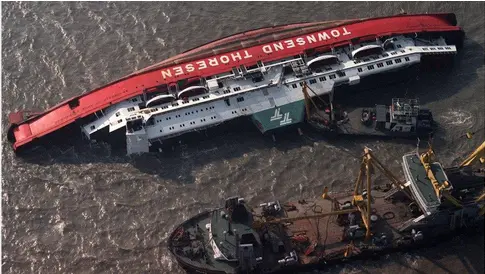
Some of you may recall when the Herald of Free Enterprise "sank". Such was the shallowness of the water that it simply keeled over onto its side with one side left protruding above the water line. Even so it was still a massive tragedy that saw 193 souls perish.
Hundreds of thousands of years ago, Britain was connected to continental Europe by a continuous chalk ridge known as the Weald-Artois anticline. North of this ridge, a massive glacial lake formed, fed by melting ice sheets and major European rivers like the Rhine and Thames.
Around 450,000 years ago, this proglacial lake overtopped the chalk dam. The resulting waterfalls carved deep plunge pools into the rock, eventually causing the entire ridge to fail. The breach unleashed an enormous volume of water that scoured the bedrock and carved the Strait of Dover. A second megaflood roughly 160,000 years ago widened the breach. When global sea levels rose at the end of the last ice age, the sea filled the valley, separating Britain from the continent.
The seafloor left behind by these floods is characterized by giant underwater sand waves—some up to 20 meters high—that continuously shift with the powerful tidal currents. Beneath the seabed, engineers took advantage of a stable, waterproof layer of chalk marl to bore the Channel Tunnel, ensuring the crossing stays completely dry despite the ocean above.
The Channel's deepest point, Hurd's Deep, has a darker history. Because it offered deep water in an otherwise shallow sea, it was utilized as a dumping ground. Following both World Wars, the British government discarded massive quantities of conventional and chemical munitions into the trench, along with low-level radioactive waste in the mid-20th century. It is also the resting place of thousands of shipwrecks, including the Royal Navy submarine HMS Affray, which sank there in 1951.
As always stay safe and well my friends.






