
Today I am going to try to break down and simplify the way that legitimate crypto investments diverge from Ponzi schemes—and where they sometimes dangerously overlap.
There are many similarities between Ponzi Schemes and Crypto Investments and indeed some crypto ventures can look like Ponzi schemes, especially to the untrained eye. To summarise, both -
Promise High Returns Both often advertise outsized profits. A key look out is that Ponzi schemes guarantee them; shady crypto projects imply them.
Complex or Opaque Mechanisms Ponzi schemes hide how money is made. Some crypto platforms use jargon-heavy whitepapers or vague “AI trading bots” to obscure their actual operations.
Referral Incentives Both may reward users for recruiting others. In Ponzi schemes, this is essential to survival. In crypto, it’s often a marketing tactic—but can be abused. In fact Ponzis fail when the pyramid bottoms out.
Early Payouts Build Trust and increase vulnerablity. Remember fattening the pig, which I referred to yesterday. Ponzi schemes pay early investors with new money. Some crypto scams mimic this by showing fake dashboards or allowing small withdrawals early on. If you wish to play them at their own game take the early payout (remember to consider time as an investment too) and then "get the hell out of Dodge..."
Greed is often an investor's undoing.
In terms of differences it is actually easier to present it in a table format and then you can compare side by side.
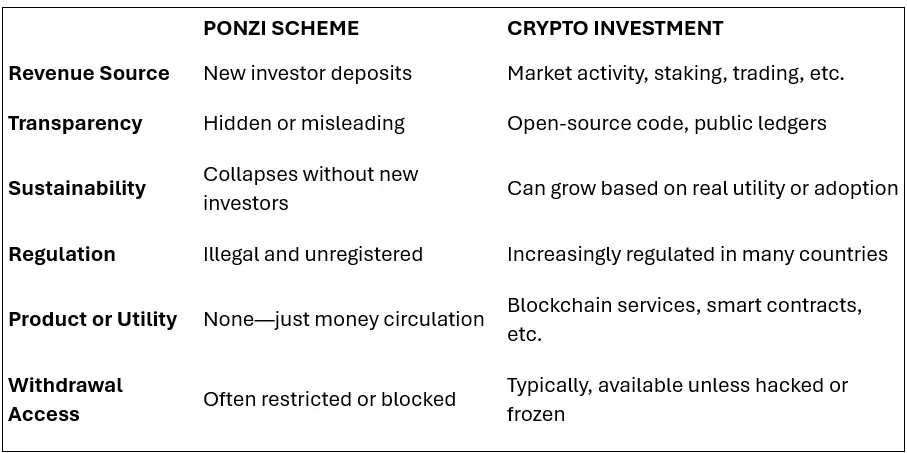
I would like to draw your attention particularly to the first and the last points as the key red flags. In a Ponzi there are no tradable assets the money just moves up the pyramid (as I already said, but it needs repeating), whereas with Crypto an asset is actually held even if it may fluctuate or even lose value. I am holding a whole lot of ALGO and missed an opportunity to get out when I could earlier in the year and the value is poor, but I am still holding the ALGO, they have not disappeared.
What does blur the lines is that some schemes use crypto to run Ponzi operations. For example, Amir Capital in Kazakhstan posed as a crypto investment fund, promising 5–10% monthly returns. It paid early investors with new deposits and eventually froze withdrawals. These scams exploit crypto’s anonymity and lack of global regulation.
The lesson is to be careful where you keep your crypto. One other point of concern I have is the amount of money that is spent on sponsorship by crypto companies and where that money is sourced from. This smells fishy to me. I am surprised that the F1 drivers aren't crashing into crypto. com signs on their way round - there are so many. TEZOs are emblazened all over the Mercedes team and they were even the shirt sponsor for Manchester United. And this is from an underperforming asset that's hype was that it is at least a $2 token Currently it is running at somewhere between a third and a quarter of that.
What do you think?
So when it comes down to it crypto is a powerful tool—but it’s not immune to abuse. The key difference is that real crypto investments are based on transparent, decentralized technology, while Ponzi schemes rely on deception and constant recruitment. If you ever see “guaranteed returns” with no clear business model, run. Additionally if you are going into a crypto asset ensure that you read the white paper, those that have a real world application are more likely to hang around.
Be cautious of meme coins that are particularly prone to being pumped and dumped by whales, unless you a discerning enough to be able to hold on to the whale's tail.
As always stay safe and well my friends.






