
I was 31 when I moved to Poland and ever since then I have struggled with learning the language and coming to grips with the nuances of all of the vocabulary and grammar. The vocab in itself is not so bad, because just like any other language there are specific words for different things and you get to the stage where you either know them or you don't. Word acquisition is not the problem, the problem is how those words are used grammatically.
Upon arrival I probably knew several words / phrases that I am going to try to recall here. I had picked them up during my first visit to Poland a decade or so earlier. Please forgive my inability to use Polish special characters as my keyboard is not set up that way.
Dzien dobry - Good Morning / Good Day (literally)
Bardzo dobrze - Very Good
Tak / Nie - Yes / No
Dziekuje - Thank You.
Dobranoc - Good Night
... and that was about it.
So now I set about living and working in Poland and my first few years, when I was literally the only English person in the town, was a real learning curve for me, because it really was sink or swim. I managed to get to the level where I could get by, but any attempt to deviate from the root word was just guess work, or - all to frequently fallible - instinct and the concepts were beyond me. I distinctly remember one student (of English) who I was working with having to figure out exactly the right Polish forms for herself in almost a sing-songy voice (Komo? Czym? Kim? Czego? Czelmo?... or something like that) and I often sat and wondered if it was so difficult for the Poles no wonder why I have problems.
Sometimes I understood why there was greater complexity, but then the language would throw me a curveball. For example (and in fairness the first part of what I am going to say, the Polish makes more sense than in English) take the simple word YOU. I even understand why there can be four different forms of such a simple word:
YOU will be late (subject / singular)
I will meet YOU at work (object / singular)
YOU are all very welcome (subject / plural)
"I am talking to YOU" said the teacher (object / plural)
Please take may word for it, but even here you can see the ambiguity in the plural forms, because without context it could be either singular or plural. The Americans have an excellent workaround when they use Y'all even if it sounds a bit awkward but the bottom line is that it does work. I think after yesterday's post I needed to balance it off a bit!
I always try to be fair.
So having four words for YOU in Polish makes sense, and it makes so much sense that the pronoun can even be dropped (eg ty jestes - sorry for lack of Polish characters - simply becomes jestes), but then they have to throw in another word just to confuse things.
I love you is "Kocham cie" and I miss you is "Tesknie za toba". Where the hell did toba come from? I have asked many Polish people over the years, the difference between the root tobie and ciebie and have never once had a satisfactory answer. It is a completely different and seemingly irrelevant word from my point of view and yet it is necessary in any attempt to master Polish.
More to the point, the levels of complexity go beyond that. For some reason plurals change from five into another form. We might have singular and plural as the standard, irregular plurals (eg man, woman - men, women) and singular plurals (sheep - not sheeps) but we don't suddenly change after four for some inexplicable reason.
When you add that to the sheer complexity of the language you begin to understand how complicated it is. Take a simple word, tomato. In English it can be changed to tomatoes, "tomatoey" and even "tomatoish" (the spell checker hates them and they do look a bit weird anyway). Check this out for the Polish:
That is 28 different ways to use the simple word tomato!
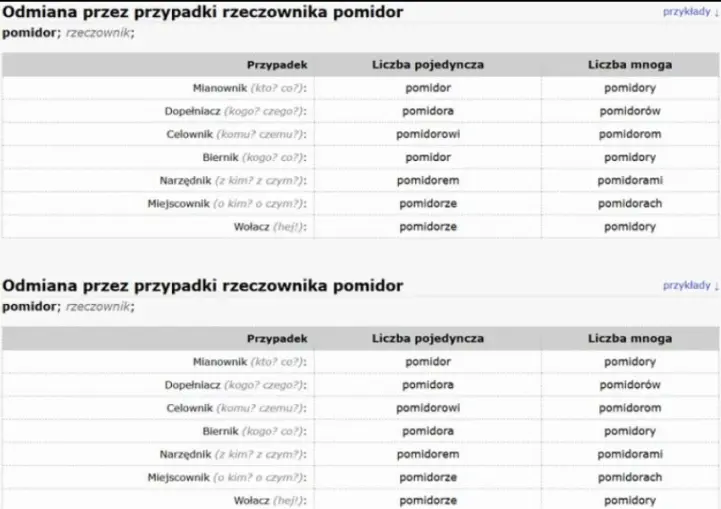
And that is just one word!
My day to day communication is more than functional and, in terms of an academic score, I came in at a reasonable level conversationally (B1+), but a total disaster grammatically during an assessment I did a few years ago.
Who is usually Kto, but sometimes it becomes Kim, and blood can either be Krew or Krwi. I have just looked it up to verify the spelling of Krwi and AI (co-pilot) gave me the table shown in the graphic below, which, assuming it is accurate (see what I write later about -owy / -kowy), is actually pretty good, but I would have to learn every single form to attain fluency and I would have to repeat this for every single word!
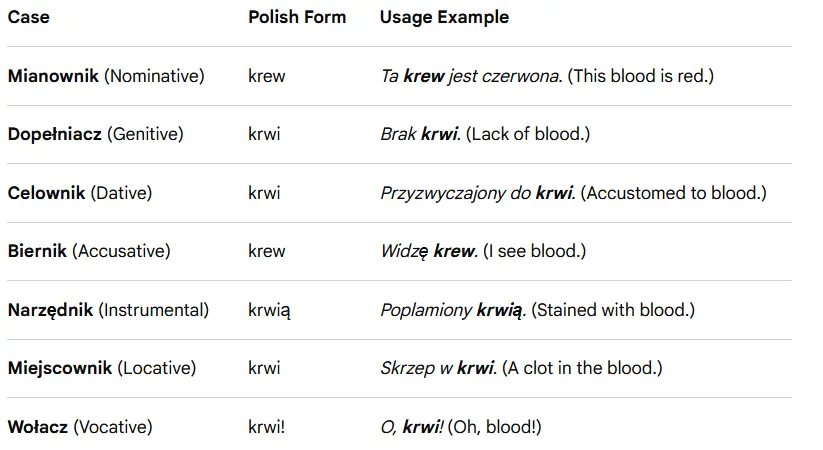
Most people understand when I say Krew, even if it is the wrong form! And just like the different forms of tomato, blood has limited forms even though the verb is irregular (bleed, bled, bled). In addition to the verb, we can have the base form blood (noun), bloody (adjective) and at a stretch bloodily (adverb - but not a particularly easy word to use contextually). Please note, blooded / blooding are regular conversions of the verb to blood, but just like bloodily, they are rarely used and only in a specific context.
Trying to get my head around Polish is frustrating and this is no more obvious than it is with Mama_Rah's family. Mama_Rah is, of course, so fluent that I sometimes forget she is not English. Her mum and dad don't speak English, nor does her brother. To make it clear from the outset, as we have chosen Poland as our home, I have no expectations that they should learn English.
One of the most unusual things that is a common occurrence is that while my Polish works almost everywhere else (and yes I know it could be a lot better) it does not work with the family. My passive skills are generally very reasonable (I understand almost everything I hear) even if my productive skills (speaking etc) are considerably weaker, but when it comes to my Polish family all of that seems to go out of the window. In fairness, conversing with my mother-in-law is probably the best, as she does slow down a bit and use more straightforward phrases. Mama_Rah speaks so fast that she sounds like a wasp on steroids.
So, to use the previous example, if I use Krew instead of Krwi when talking to most people, they figure it out, but if I get it wrong it is simply not understandable to my Polish family. An early example of this occurred one time when I was visiting and had to return home by train the next day. Mama_Rah's mum asked me what time my train was. In English I would say "about 12." and so I tried to replicate this and I cannot remember exactly which way round I did it but the difference was to do with cardinal (1, 2, 3 etc) and ordinal (1st, 2nd, 3rd) numbers. I think I used the ordinal form instead of the cardinal form as I followed the English convention which would have been wrong. This is called first language interference. An easy illustration of this is that in Polish a person will say, if I were to directly translate it, "I have 25 years" (mam 25 lat), but in English we would say "I am 25 years old".
Back to the train time, the difference between 12 (dwanaście - "dva-nash-chi") and 12th (dwunasty - "dvoo-nast-ee") in Polish is very slight, but the root word is easily recognisable and so it would be natural to figure it out, even if I use the wrong form - just like with Krew and Krwi! It is obvious, even from my phonetic simplification of the pronunciation that the difference, while marked, is not significant enough to throw somebody off the overall understanding of what I was trying to communicate.
And then, obviously to me, the context provides a lot of additional support. I was asked for the time of the train so some kind of number was always going to be the answer.
I think there are also a couple of things that work against me.
Firstly, because Mama_Rah's English is at such a high level, her English is held up as an exemplar and a mirror with the expectation that my Polish should be able to match hers; and especially after living here for so long. Having taught English for more than 30 years, I do believe there has to be an element of talent to learning languages effectively. That aside, you might argue that hard work should suffice. However, I have had none of Mama_Rah's advantages nor do I have her natural talent:
- She learnt English in high school - Polish wasn't an option for me (nor Albanian which would have been the two most useful languages the way my life has worked out).
- She then spent seven years studying English full-time - when would I get the opportunity, especially now the kids have arrived?
- She has worked in an Anglophone environment since at least 2008 - and probably even earlier. My environment is English-dominated. My students work with me because of my English.
- Our domestic language at home is English (and this might be one thing that can change), but realistically whenever we try, Mama_Rah gives up before me... and her reasons do make sense. Why would she want to have pre-intermediate conversations with me? She speaks Polish with the kids and I speak in English; and frankly I shouldn't speak Polish with them because they will pick up my accent and my mistakes.
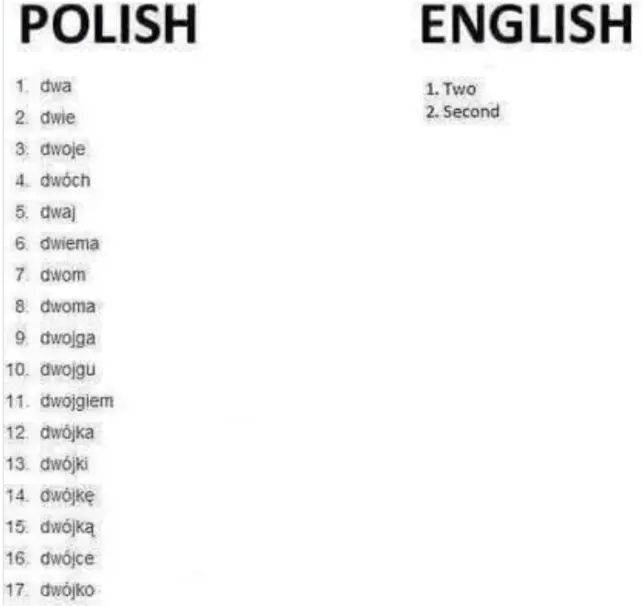
And while English has its undoubted quirks (especially spelling!), it is nowhere near as difficult as Polish. You may have been bamboozled by tomato and blood, but that is easy when compared to two / second, as follows.
There is also the issue of culture which is probably the biggest single challenge. Recently, I have heard my mother-in-law and Mama_Rah use Older_Rah's name with -owy and -kowy on the end. A quick AI search seemed to suggest this was an adjective form, which is difficult enough as an English speaker to grasp anyway, because the closest I can equate is Tom's toy - the possessive). However, when I asked, Mama_Rah just laughed and said there was no such thing. I was somewhat taken aback and it shows that AI isn't always right. She did proffer up the correct forms, which have actually stuck. Even so, I was still surprised (and I am not joking) when literally five minutes later she said "___owy", but then when I challenged her about it she said it was a slip of the tongue.
The second cultural element is one of mentality.
I do have the will, even if I lack the talent (and frankly the time), but when I first met Mama_Rah, one of the things she said to me was that her dad told her that I absolutely should NOT expect him to learn English. As I have already made clear, I do not have an issue with this, I have chosen to live in Poland after all. However, the subtext of the message from him seems to be "He has to communicate on my terms". To illustrate this, I have only once heard him use one English word ("black") in 18 years. When it comes to Mama_Rah's mum, she does have a grasp of some basic phrases which she occasionally uses, but they are so simple that I know them in Polish anyway (for example "I don't know" - "Nie wiem". However, for the boys' benefit, he might have to learn some phrases; both boys like the kind of toy cars that you drag backwards on the floor and then release so they drive forwards. Mama_Rah and I simply call them "pull backs", but if grandad doesn't understand then he is stuck. Similarly, if Younger_Rah wants picking up he says "Up! Up! Up! and doesn't use the Polish - although his outstretched arms are usually more than enough to communicate his wishes.
Again there is no expectation on my side but there is a bit of a feeling of "my way or the highway". I guess what I am looking for is not an expectation on them to learn English, but a little leeway when I try my best in Polish.
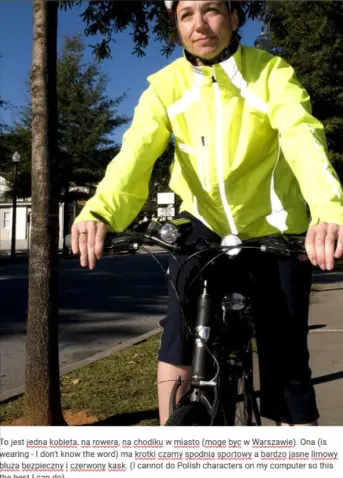
One thing that did not help - although now there is an element of them giving up on me - is the well intended over-correcting which just encourages me to stop speaking. I recently completed an assessment of my Polish skills and, at the end, I had to describe a picture of a woman on a bicycle who was wearing a helmet and high-vis jacket (See below). I had a good go at it and frankly almost every word I wrote was wrong (or it felt like it), even if the base forms of the words weren't too far off. When I showed it to a number of Polish people - aside from family - they all said that they understood what I meant (don't be confused by the red underlining - my computer is configured to English).
I can translate my own Polish :D
"It is a woman on a bicycle on a pavement in a city (maybe Warsaw) She [is wearing - I don't know the word] sporty shorts and a very bright lime coloured safety top and red helmet."
This also leads me to another stark conclusion. I would have to unlearn my bad forms before making progress and this may well be the biggest single obstacle; as it will in effect mean going backwards to go forwards.
There is hope however
One thing that is becoming evident is that Older_Rah is becoming more and more proficient in both languages, as will Younger_Rah, and in fact they are rapidly becoming my best teachers. They speak slowly and clearly and it gives me a chance to contextualise these mind-boggling Polish forms.
They may just help me to become more proficient in Polish.
As always stay safe and well my friends.





