
Albania is a country that I have a massive affinity with, having lived there for the best part of a year up until about a year before the events described in this post unfolded. As I describe what happened particularly around my friends it has always left me with one thought.
It could have been me too.
The Albanian Anarchy of 1997, often referred to as the Albanian Civil Unrest or Pyramid Crisis, was a dramatic collapse of order triggered by a perfect storm of economic mismanagement, political instability, and public outrage and it all started with the collapse of a number of pyramid schemes, most notably VEFA Holdings, which was closely tied to the then President Sali Berisha; making it not only a financial catastrophe but a political one too.
By 1996, around two-thirds of Albanians had invested in pyramid schemes promising outrageous returns—some offering 10–25% monthly interest. I remember our translator, Paulin (Paul), showing me a certificate at one point that was about A4 sized and he said it was like real money and its value was multiple thousands of Albanian Lek. He was proud and excited about the returns that it was promising and while I didn't really understand it (nor pyramid schemes at the time) I did feel a sense of scepticism. It seemed to good to be true. Admittedly, it didn't cross my mind that it was fraudulent, only that it wouldn't deliver on its promises.
These schemes were massive and according to some sources they absorbed nearly $1.2–1.5 billion, which at the time was about half of Albania’s GDP. The above mentioned VEFA Holdings was a major player with strong ties to the then government. Founded in 1994 by Vehbi Alimucaj, VEFA initially appeared to be a legitimate business conglomerate, with wide ranging investments in a number of different sectors, but then VEFA began accepting deposits from Albanians frustrated with the slow, unreliable banking system accompanied with a promise of high monthly interest rates, sometimes up to 6%, later reduced to 3%, and eventually halted payments altogether. In itself this is not unreasonable, but it was how it evolved. As competition from other schemes intensified, VEFA raised its rates to attract more investors and probably even unwittingly it turned into a classic Ponzi setup. The close association between the government and VEFA in particular only exacerbated the situation as Sali Berisha was seen as to be lining his own pockets.
Other factors that contributed to the implosion included the collapse of the ruling Democratic Party who did nothing to either regulate the organisations nor compensate victims, this in turn gave further cohesion to the idea that the government was complicit.
The pyramids fell like a deck of cards and the collective population realised that their fledgling savings and hopes for the future were as good as gone. Already impoverished by more than 40 years of the harshest form of Communism (Hoxha, who died in 1985, was considered by many to be even harder than Stalin) Albania had transitioned under Hoxha's successor (Ramiz Alia) to democracy as late as 1992. Rife with corruption and chronic economic problems, Albania was vulnerable and then when VEFA's downfall was announced via megaphone in Tirana, all hell broke loose.
The Albanian People - a warrior people - went mad!
I recall watching on the news nightly as armouries and military bases were raided for weapons. Only in one place, Elbasan, did the army resist and one reason why there was such little resistance to the popular uprising was that many of those working for the security forces had too lost everything and thus a power vacuum was created. Their sympathies lay with the protestors.
The UK nightly news even reported from Rreshen, where I had been living up until just a year before where the local population had stormed the local barracks and helped themselves to whatever they could get hold of. In fact the news reporters were using a guy as a translator who we as an organisation had taught English and the cameras went into his home and he showed proudly about 15 - 20 AK-47s hidden behind a sofa.
Huge numbers of weapons right across the country fell into the hands of the public and in one place they managed to steal a tank and in another a torpedo boat.
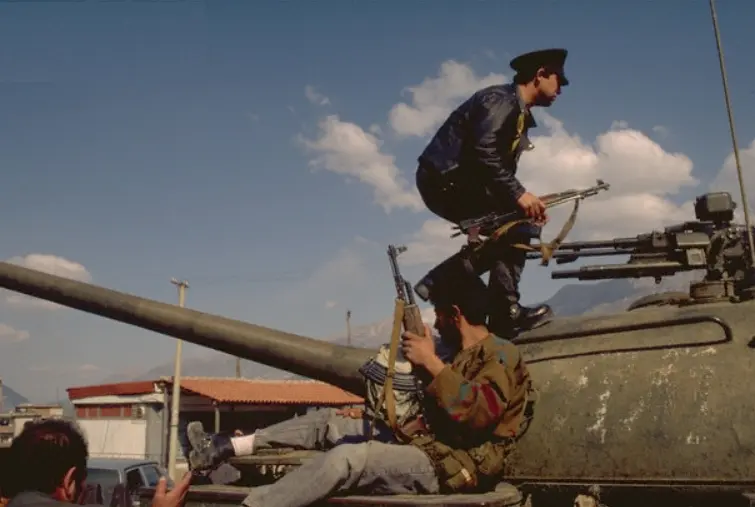
Incidentally, when things did calm down eventually the stealing of weapons led to an escalation of the Kosovo/a war in 1998 as this excess of weapons in public hands were now sold to the KLA (Kosova Liberation Army). This led to Serbia increasing its repression of the local Albanian population, with the Drenica Massacre being a turning point. The massacre created martyrs, in particular Adem and Hamez Jashari who in addition to the Racak Massacre were a rallying point when all out war broke out in 1999.
This arming of the populace had other consequences as large swathes of the country, particularly in the south fell under the control of a variety of militias and it is estimated that something in the region of 2000 people were killed.
Most internationals were evacuated from either the beach at Durres or the Qemal Stafa, the national stadium in Tirana. Again with the human interest angle to the story I watched the news cameras from the safety of home as many of my friends (even to this day) were evacuated I watched the drama unfold and especially the story of Ian, who had been my direct boss in Rreshen refused to be evacuated without his American girlfriend. I can't remember her name, but she too felt the same. The problem was that the US Military were only evacuating their own personnel and the British the same so keeping them together was something both military forces were unwilling to do. Not sure what happened in the end. Common sense must have prevailed though. Most importantly on a personal note, none of the people I knew were harmed or lost in any way.
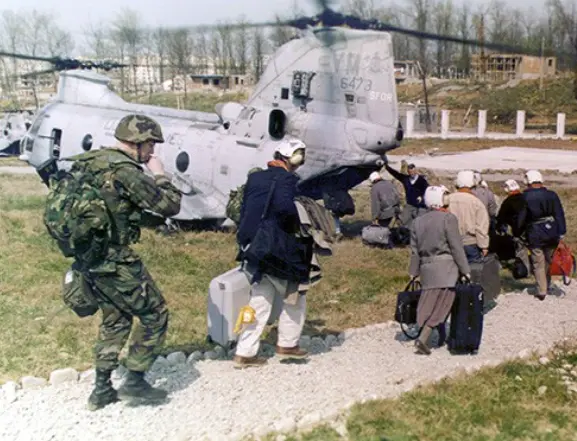
The country was finally stabilised by Operation Alba which was led by Italy. This mission, comprising of 7000 peacekeepers, helped stabilize the country and pave the way for new elections and ultimately the salvation of the country which for the last almost 30 years has been slowly dragging itself in the right direction as institutions are strengthened and corruption is being addressed.
This crisis wasn’t just a financial meltdown—it was a societal rupture that exposed the fragility of Albania’s post-Communist transition. VEFA’s story is a cautionary tale of post-Communist economic chaos, where weak institutions and desperate citizens created fertile ground for financial disaster.
The bottom line is that this all started with the collapse of a massive Ponzi!
As always stay safe and well my friends.






