
Remember KITT (Knight Industries Two Thousand, probably not the 2008 "Three Thousand" reboot!) who was essentially a self-driving car? Well he was when Michael let him (and I will return to that point in the conclusion). Of course it was 80s science fiction, but with the advent of AI it is getting closer to being a reality with each passing day.
Just imagine a system where cars will take you to your destination and you can "work, rest or play" during that time. Catch up on your email, write a P0x article or simply have a nap, or longer sleep if it is a journey of some distance. It will take the tedium out of driving, especially for frequent drivers. Delivery trucks will no longer need a driver to deliver their goods from point to point and if we believe the promise such a system will be safer than the current system of unpredictable human drivers, a major factor in almost all road accidents.
Such a system sounds great but it comes at a price most drivers are unwilling to pay. Let me explain.
The system will need to be all or nothing for it to be effective. I am going to illustrate this with an oversimpilification, but we must remember that AI can handle and process massive datasets, in this case literally thousands of vehicles on the road, even if they are broken down into large zonal systems where a vehicle is handed over from one system to another. I am only saying this because a countrywide system might be too much, although if it visualises each vehicle as a single pixel (with accompanying data eg vehicle size / type etc) this is not beyond the realms of possibility either. The gaming world has been doing it for years, including managing real data in real time.
The whole point of such a system is optimisation and safety and it would work in the following way. Please consider the following graphic in which all the cars are self-driving.
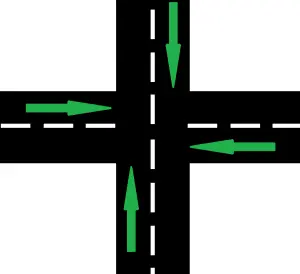
All four vehicles are approaching the same crossroads. What the AI will do is ensure that each car will pass through without crashing into another. The AI will be monitoring them as points on a map and see what is happening even hours beforehand and it will therefore either speed up some cars, lets say from 60 miles per hour to 62 miles an hour, and do the opposite for some of the other cars a couple minutes before the crossroads before returning all the cars to 60 miles per hour once the junction has passed.
In principle this works in a similar way to the automated anti-crash system deployed by commercial aircraft; the two planes actually talk to each other and when a proximity sensor detects that there is a chance of a midair collision, one plane drops its altitude a bit and the other climbs and thus they avoid each other.
I was actually on a flight when this happened once, the plane suddenly dropped altitude - I felt it for a just a second or two and it was very different to turbulence as it was smooth without any shaking or rattling. Maybe you have experienced something similar?
This AI manipulation of a cars speed is far more efficient than having even one car stop. In a not too dissimilar way to what happens in a pit stop in F1 a car loses more time when forced to a complete stop due to braking time and then the time it takes to get back up to speed. Also remember in the case of F1 cars, they have to drive at a restricted speed in the pit lane. A complete tyre change typically takes somewhere between 2-3 seconds, but time lost is usually 25-30 seconds due to the slowing down, stopping, actual tyre change, and then accelerating back up to speed, while maintaining the speed limit within the pit lane.
Of course drivers will not typically need to stop to change tyres etc, but the point remains that if a car has to stop at a crossroads to let another through the cost in time per stop, from the moment of braking to the moment of regaining full speed, would probably be 40 seconds to a minute per junction, and that is just for one passing car. The AI will be able to optimise this, by just making a small speed adjustment and it may even follow "rules of primacy", in that if there were no adjustments there would be a crash then the car(s) to be sped up would be the ones with right of way. In the above image this would be the cars running north to south (based on my simplified road markings). The point is that even the cars coming from the side roads will not have to stop and lose more time than necessary.
This is almost oversimple, but AI will be able to handle thousands of pieces of data, including thousands of road "anomalies" such as crossroads, junctions and roundabouts. It will of course need to be plugged into an AI controlled traffic light system so it knows exactly when it will face a red light necessitating the need to stop. AI will also be able to handle a driver wanting to stop at a cafe for a coffee. The driver simply punches a button on approach and the AI will take him to the cafe and take him temporarily offline until he has had his coffee and wants to reintegrate with the system in which case it will happen just like when he started his journey earlier.
Everything will run smoothly, at least until a cow wanders into the road! But even then, because the AI will control the speed and distance between cars, such a slow down / stop will be done safely and then a series of recalculations can be made, including redirecting the traffic on alternative routes where possible.
Now let's look at an alternative scenario.
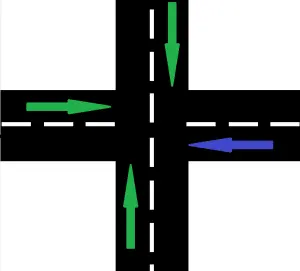
Now we have introduced a human driven car (in blue) and yes I deliberately put him on the side road. This changes everything simply because as a human he is likely to drive more erratically (please note he may not actually be driving erratically but he almost certainly will not hold an absolutely consistent 60 miles and hour like the AI can - sometimes he will dip below and sometimes go a bit faster). It all makes him completely unpredictable although if through GPS or a similar system the AI might be able to learn some of his patterns. Furthermore, on an approach he may think that he can beat the other cars to the crossroads. In the very least this will cause the AI to make the cars it controls slow down or even stop and thus lose their optimisation and at worst a collision can be the consequence.
And that is with just one human driver at one junction!
To summarise, and if it helps, think about a self-driving system as a macro-scale Amazon Warehouse if you like, but remember no single package moves autonomously and that is the whole point.
There is however one more point of human behaviour that will make this dream of a self-driving system impossible.
Many drivers (and particularly male drivers) are unwilling to relinquish complete control of their vehicles and especially to AI. I was discussing this, this morning with a client, hence the inspiration for my writing, and while it is a stereotype (which means it is generally true) most men prefer to drive when going somewhere with their partner even though she is a perfectly competent driver and statistically a safer driver than he. He might not even have a problem with her driving, but he needs to hold control (just like a man needs to have the TV remote control).
Just some food for thought.
As always, stay safe and well my friends.





