
Content in the public domain isn't protected by copyright law. This means that content within the public domain is free to use either personally or commercially. Look for content that meets any of the following criteria:
- Copyright Duration Expired
- If the author of the content has been dead for 70+ years, the content most likely falls into the public domain
- U.S. Federal Government Content
- Make sure that the content herein was not the product of a freelancer or consultant who was able to transfer copyright protection to the government
- Not in Tangible Form
- Speeches, lectures, and comedy routines are examples of this. As long as the content was not previously recorded in any form or manner, this content should fall within the public domain
- Proper Copyright Not Included Prior to March 1, 1989
- Before this date copyright notice was mandatory, so if it was not included within the content, the content falls within the public domain.
- Does Not Have Sufficient Originality
- Lists or tables with content from common sources or public documents
Simply put...if you would like to make money using content that someone else wrote there is no better place to get that content than from the public domain. Books, ebooks, images, photographs, music, audio, and more is available in the public domain and yours for the taking.
Here is a simple walkthrough I used to publish a cookbook online which sells around 5 copies a week. I know that is not much in terms of earnings, but I don't promote it in any way and I have many other publications for sale online that add to those earnings.
Step 1: Find Content in the Public Domain
I like to use university digital libraries to look for books that fall within the public domain. For this walkthrough, I will use the University of Pennsylvania's digital library at https://digital.library.upenn.edu/books/ to find a cookbook that was published prior to 1930.
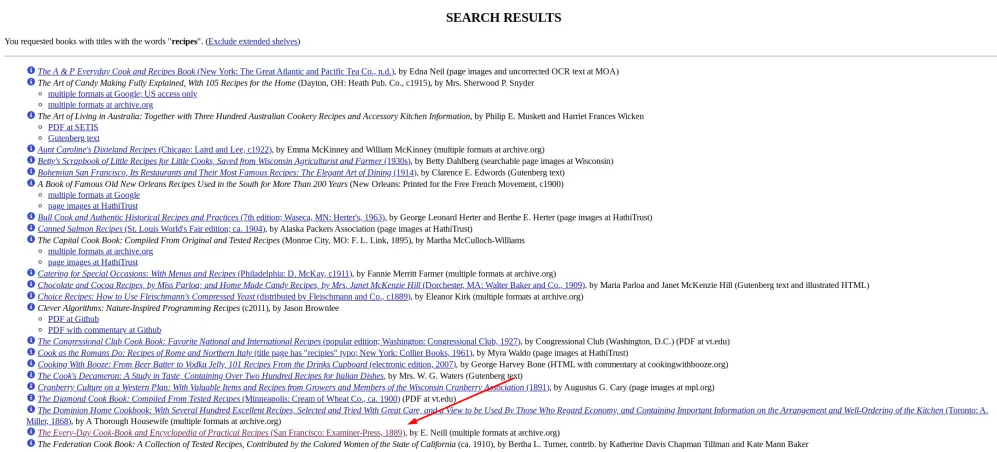
I feel like it is a pretty safe bet that "The Every-Day Cookbook and Encyclopedia of Practical Recipes" by E. Neill published in 1889 is in the public domain due to the fact there is absolutely no copyright mentioned anywhere within the book. However, it is never safe to assume that just because the content is really old it is available for you to use however you want. So, you should always make sure first.
Step 2: Confirm Content is in the Public Domain
Figuring out if the content you found falls into the public domain is not as easy as doing a simple internet search. The best method I have found is to follow the guidelines set forth by the United States Copyright Office in their document, "How to Investigate the Copyright Status of a Work." In some instances, it takes a bit of legwork, but it is worth it not to commit plagiarism which is a serious offense no matter how you spin it.
Step 3: Figure Out Your Target Audience
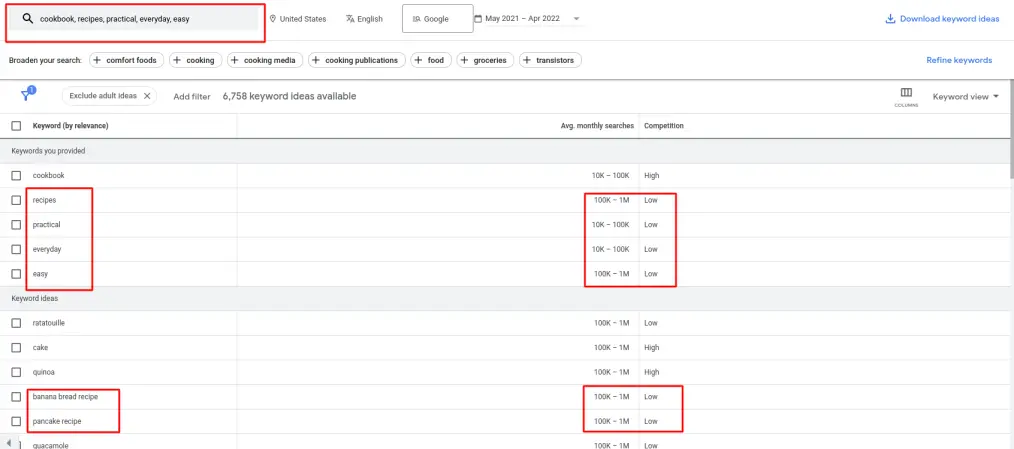
In order to do this, I use Keyword Planner by Google. I typed in the following keywords: cookbook, recipes, practical, everyday, and easy. This generated keyword ideas, the average monthly search for each of those keyword ideas, and the competition for content within those keyword ideas. I see that four of the keywords I used are searched anywhere from 10,000 to 1,000,000 times per month and there is "low" competition for that keyword.
The list of keyword ideas it generates helps me to find an audience. I only marked two of them in the image below, but the more I scrolled in this list, I noticed that the bread recipes had high average monthly searches with low competition markers. Bread recipes, it is!
Step 4: Compose the Public Domain Content
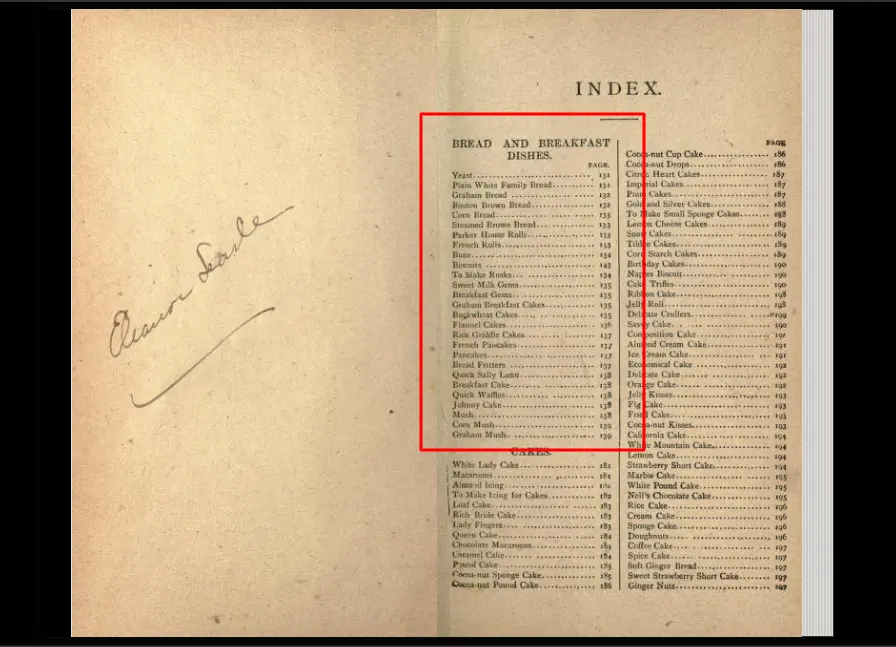
Luckily, the Internet Archive website has a free digital copy of "The Every-Day Cookbook and Encyclopedia of Practical Recipes" by E. Neill. The very first chapter is "Breads and Breakfast Dishes" and all of the recipes can be found on pages 131 - 139. At that point, I just mosey on over to those pages and make copies of each of those recipes which I then put into my own cookbook or blog.
Step 5: Market Your Content
This is a whole other animal and not something I want to cover in this particular post. I hate marketing content, but that doesn't mean I don't have the know-how. To get the most value out of your creation, you are going to need to market and promote it. I actually used these recipes to build a Facebook group where I sold Amazon kitchen products. I ended up selling that group to someone else and made a decent amount of money for my effort. No regrets.
Side Note: Recipes cannot be copyrighted. The list of ingredients and cooking directions of any recipe is fair game. However, the original author's comments and images are copyrighted so be careful when copying a recipe from somewhere else.
Disclaimer: Information in this post is for entertainment, educational, and instructional purposes in regard to the subject matter only. Please consult an attorney if you have questions about what is or is not within the public domain.






