
Zen blog post in Russian
https://dzen.ru/a/aeNzeQ9cm0ccnSZQ
Bad Internet in Russia: when it is possible to achieve recalculation, and when not.
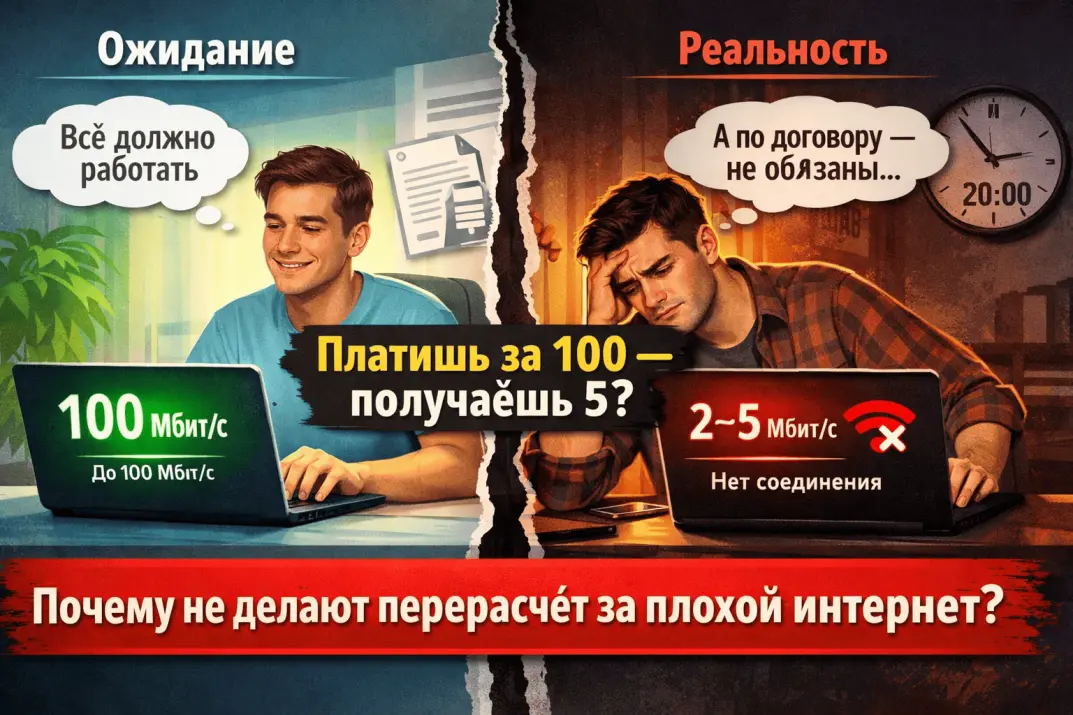
Why don't you get a discount when you slow down or turn off the Internet? There is a lot of contradictory and often false information on the Internet on the topic: if the Internet is not working well, the provider is "obliged to refund the money" or "reduce the price by 50%." The advice usually looks like this: call support, demand compensation, push — and you will get everything back. People often write in the comments that "it works," but the reality is more complicated. Let's figure this out calmly and without extremes.
Users are usually divided into two camps: "the provider does not owe anything at all" and "they are legally obliged to return the money." Both positions are simplifications. The problem is that there are laws, but they are not automatic, the contracts are complicated, and no one explains the technical nuances. As a result, a mixture of truth and myths appears.
The main thing to understand is that you are not paying for a fixed speed, but for a service with certain conditions. The tariffs almost always indicate: "up to 100 Mbit/s", "maximum speed". This means that drawdowns are acceptable and the speed is not guaranteed all the time. In addition, the provider is not obligated to recalculate automatically, but you must report the problem yourself and prove it.
It is important to understand that demanding a recalculation is not a "tantrum", but an adequate reaction. Because in fact, they sell you a "stable Internet", but during peak hours the speed can drop significantly and outages occur without compensation. It really looks like a degraded product for the full price. But there is a caveat - it's not your emotions that should work, but the evidence.
There is only one reason for recalculation: the service systematically does not comply with the terms of the contract. That is, not one-time drawdowns, but a regular problem, confirmed by measurements.
Providers do not make decisions "under pressure", but according to procedure. Necessary:
1. Fix the problem.
Take speed measurements at different times (several days in a row).
2. Check the contract.
Look:
- maximum speed.
- the usual one.
- the minimum.
3. Submit a written claim.
Briefly:
- what's going on.
- when.
- what is the evidence?
4. Give a deadline for correction.
Usually 1-2 weeks.
5. Escalation.
If they ignore it, then contact the regulatory authorities.:
- consumer protection.
- the court.
It is important to understand that cheating on your expectations is not equal to a legal basis. Phrases like "you deceived me" are understandable in human terms, but legally weak. Something else is working: non-compliance with the contract, confirmed by facts.
An example of a ready-made claim that can be sent to the provider:
Complaint about speed reduction/disconnection of Internet service
Whom: LLC "[Operator's name]",
Position: Head/Customer support service/
From: [FULL NAME],
Address: [full address],
Contact phone number: [number],
Contract number: [XXXX],
Connection address: [street, house, sq.m.],
The essence of the request:
From "[date]" to "[date]", the speed of the Internet service provided was significantly lower than the stated tariff, and partial or complete channel outages were also observed. During the specified period, the service was paid in full, but in fact I did not receive the same degree of availability and quality for which the subscription fee was charged.
The contract and the website specify the speed as "up to [X] Mbit/s" or "up to XX Mbit/s", however, under normal load and without technical failures, it steadily dropped several times and did not meet the minimum reasonable user expectations.
This situation, combined with the lack of compensation or recalculation, is formally equivalent to providing a degraded product at full price, which calls into question the integrity of the provision of services and contradicts common sense.
I demand:
to conduct an internal quality check of the service for the specified period;
provide a written explanation of the reasons for the speed drop/shutdown;
recalculate and/or compensate for the period when the service actually did not meet the stated parameters (up to a partial refund of the subscription fee);
in case of refusal, send an official response with reasons, indicating on which points of the contract and legislation you justify the impossibility of recalculation.
If this claim is ignored, I will have to contact the communications regulator, consumer protection authorities and, if necessary, the court to protect my legitimate interests.
Date: _
Signature: _
As for shutdowns due to emergencies (for example, UAVs), the situation is separate here. If the Internet is turned off due to government orders and security measures, this is considered force majeure. This means that the provider is not responsible, and compensation is usually not provided.
However, if necessary, the operator must present an official document from the government agency with the date, number, signature and time limits. If the provider simply says "UAV, sorry," but cannot show the order, this is already his problem, and you have the right to request a recalculation. Operators do not have the right to just turn off communication and hide behind the words "UAV" if there is no official document. In the case of UAVs, this is framed as a force majeure situation and a "decision of the security authorities." In this case, the provider is released from liability and there will be no compensation. The only practical advice is to carefully read the contract and require the operator to officially confirm that the shutdown was indeed authorized by government agencies. If there is no such confirmation, this is a reason for a claim.
There are real examples of compensation, but you probably won't get paid anything with the UAV. In case of force majeure, you can rarely get compensation through negotiations rather than through demands. If the problem is long-lasting, you record the facts and communicate calmly but persistently. There are such cases, but it is important to understand: this is not a "default right", but rather a combination of legal leads and competent pressure. When outages become regular, not one-time. In fact, force majeure is usually something rare and unpredictable, but it may look like a systemic service failure rather than an isolated event. In such cases, you can request a reduction in payment or early termination of the contract. When the service is not actually provided for a long time: there is no Internet for days or weeks and this repeats, then the argument is simple: "I'm paying for a service that objectively doesn't exist." When the provider does not inform and does not offer alternatives, it worsens their position and gives you more reason to demand concessions. Commercial, not legal logic - even if they "don't owe anything" under the contract, companies often give discounts to keep the customer, to reduce complaints, to avoid escalation. That is, you are not asking for a "duty", but a gesture of goodwill — and sometimes it really works. The correct submission of the request also plays a role: NOT "you are obligated, you are deceiving me", BUT "due to long-term interruptions, please consider recalculation or discount". And most importantly: shouting is useless, but fixing and demanding correctly works. If you've had a similar experience, please share it in the comments. Practice in this topic is often more important than theory.
I write and shoot. Join me
Author's video content
https://www.youtube.com/c/ViolettaWennman
Political trash
https://www.youtube.com/@Ship-Shard
I invite you to the telegram channel
https://t.me/shipshard
Highly Social on Zen
https://dzen.ru/shipshard
To buy caramels to ruin your teeth
https://dzen.ru/shipshard?donate=true
My hobbies are history, philosophy, psychology, music, economics, politics, and sociology. I write about this and much more. Professional model. She has performed at international music festivals (vocals, dancing, imitation of vocalists). I am studying at the Academy of Arts - the film and art industry, I am a producer and the owner of a video studio.
I am glad to see all of you in my blogs.

I'm waiting for you here so I don't get lost. https://t.me/shipshard






