
Publication in Russian on the Zen blog
https://dzen.ru/a/aeeKjZe6xmdgeFBR
They sang loudly and quietly sold out.
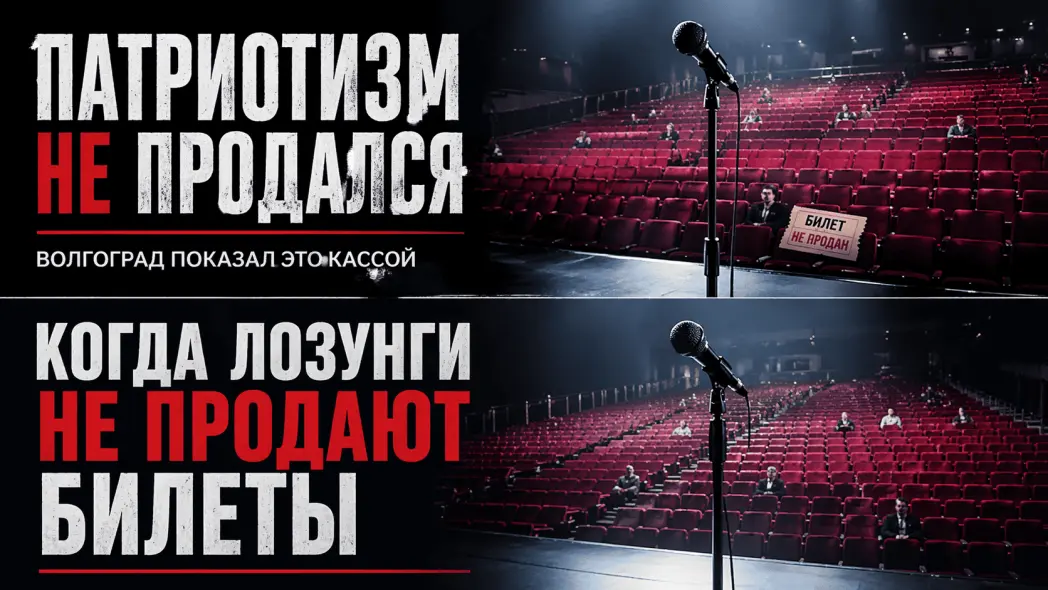
Patriotism is checked by the cashier. Slogans do not replace it. Volgograd did not scream. Volgograd just showed empty seats. And that's enough. Patriotism, which sings about a "great country," stops selling when the country lives in a different reality. The market is not lying.
"People have had enough of songs from the most patriotic singers. The World Cup is over." (Alexander Saigin, a political scientist from Volgograd).
"The time of SHAMAN and similar artists has come to an end, as the audience wants to see new performers on stage." (music critic Sergey Neighbors).
Volgograd very calmly explained to the registered "Z-patriots" that their time was running out. Tickets for Gazmanov and Maidanov did not sell out even close to box office success, and the Shaman's concert in the city has already been canceled — there is too little demand, too much ostentatious patriotism, too little real trust.
And this is perhaps the best marker of the era. When war is pouring out of every iron, when the Internet is being cut, when there are more and more coffins and arrivals, people's instinct for self-preservation begins to turn on, not the TV. Because war is no longer "somewhere far away", but right under the house. The audience very quickly distinguishes those who sing about the "great country" from those who live in reality. And the louder official patriotism sounds, the faster it turns into an empty decoration. Volgograd showed this without slogans, without rallies and without tantrums — just with a cash register.
In April, in Volgograd, this became especially clear — almost without interpretation, just by the fact that the halls were full and how quickly the numbers began to diverge from expectations.
Oleg Gazmanov, whose performance was announced for April 26, turned out to have more than two hundred and eighty unsold seats, after which the concert had to be moved to a smaller venue and actually "squeezed" the scale to meet real demand. Denis Maidanov's situation turned out to be even more difficult — about four hundred unsold tickets and the occupancy of the hall at about sixty percent, which visually turns the concert into a semi-empty space, where empty sectors are read faster than music. The Shaman's concert on April 24 in Volgograd was canceled altogether, officially for "technical reasons," although in reality such formulations most often appear where sales no longer reach the economy of the site.
And if you take away the emotions, there remains a simple and rather dry logic: the market is not about slogans, it is about occupancy. Where an artist does not even assemble a basic room, it is not a dispute about tastes that begins, but a recalculation of the economy. The venue is being reduced, prices are being adjusted, the format is being compressed, and in extreme cases the concert simply disappears from the schedule, because when the load is below a third, it ceases to be a business and becomes an expensive event "for show."
Volgograd is not an exception here, but rather the most obvious example. Because there is a comparison nearby, and it only enhances the effect.
On the same dates in the city, Grigory Leps gathers more than 80% of the hall at comparable prices, MAXIM is almost sold out, DDT holds the level of 90%+. That is, where there is no rigid political link to the stage, sales are steady, sometimes even with a shortage of tickets. And this is an important contrast: it's not about prices (they range from about 1,500 to 8,000 rubles), but about the nature of demand.
Against this background, the "Z-scene" in Volgograd has a different picture: 30-60% occupancy, transfers to smaller venues, cancellations, and a constant attempt to adjust the format to what is actually being bought. The Shaman has an actual failure to the point where the concert becomes unprofitable. Maydanov has an average workload, which keeps the event on the verge of payback. Gazmanov has already had to optimize the site after the start of sales.
And this is not a single plot. In Omsk, the Shaman's concert was postponed at first, then completely excluded from the tour. In Sochi, with a 2,500-seat auditorium, a significant portion of the seats remained empty, after which the second concert was canceled. In Krasnoyarsk, hundreds of unsold tickets remained a month before the performance, although the same city had previously given stable full houses. Hundreds of empty seats were fixed in Nizhny Novgorod at prices up to 5,000 rubles. And in some cases, the wording remains the same — "technical reasons", although in the context it is most often a question of weak demand. Ufa is a city where there is no direct data on cancellations and sales of Shaman, but there is an important marker — music charts. According to the results of the second quarter of 2025, not a single Shaman track made it into the top 100 most popular among Russians on various platforms. The group from Ufa, Ay Yola, with an ethno-pop direction, became the leader in auditions. That is, in Ufa they listen to their own people. And they don't listen to Z-artists. In a city where a musical leader has emerged who has surpassed the popularity of the entire patriotic stage, the Shaman's concerts simply have nowhere to go — the audience has already made a choice. Ufa did not cancel the concert. Ufa just wasn't expecting him.
Moscow and St. Petersburg live separately: there are announcements, price lists, and large sites, but there are almost no transparent statistics on occupancy. This is more of a showcase of the market than its real mirror. But the regions give a more honest picture — there the demand is not hidden behind the status of a city or site.
And gradually a simple pattern emerges: where everyday reality is stronger than television, where people perceive what is happening not as rhetoric, but as the background of life, the demand for such a scene becomes less stable. This is not a sharp collapse or disappearance, this is a stratification — some halls are still being assembled, some are no longer there, and some are being assembled only after the scale has been reassembled.
In parallel, the pop and rock scene continues to be noticeably more stable without a strict political agenda. There are no system cancellations, no permanent postponements, and there is no need to explain empty spaces with phrases like "technical reasons." The difference becomes apparent not in the rhetoric, but in the simplest thing — in how full the hall is.
And if you look at it more broadly, it looks like a clash of two popularity models. One (the mainstream) is based on emotional demand — an event, an effect, recognition, a sense of participation. The other (z-artists) is in a position that requires constant feeding with attention and information guides. And as soon as this supply becomes less stable, demand begins to behave erratically.
The shaman is particularly significant here: from explosive growth in 2022-2023, through stabilization in 2024-2025 and by 2026, where sold-out shows, failures and cancellations quietly coexist in the same tour. This is a classic sign that the HYPE is over - there is still a real audience base.
And in the end, it all comes down to a simple thing again, which the industry usually tries not to formulate directly. The concert should pay off. This requires not just the presence of people, but a sufficient number of them relative to the scale. When loading is below about 70%, problems with profitability and atmosphere begin, below 50% is an almost guaranteed minus, below 30% cancellation becomes not an exception, but a rational solution.
And if earlier such stories could be explained by chance or individual factors, now it increasingly looks like a systemic discrepancy between the chosen scale and real demand. Artists continue to enter venues that their audience no longer always fills as it used to.
And this, perhaps, is the main marker of the moment. No posters, no statements, and no tours. And a very simple and rather stubborn thing is a cash register.
I write and shoot. Join me
Author's video content
https://www.youtube.com/c/ViolettaWennman
Political trash
https://www.youtube.com/@Ship-Shard
I invite you to the telegram channel
https://t.me/shipshard
Highly Social on Zen
https://dzen.ru/shipshard
To buy caramels to ruin your teeth
https://dzen.ru/shipshard?donate=true
My hobbies are history, philosophy, psychology, music, economics, politics, and sociology. I write about this and much more. Professional model. She has performed at international music festivals (vocals, dancing, imitation of vocalists). I am studying at the Academy of Arts - the Film and Art Industry, I am a producer and the owner of a video studio.
I am glad to see all of you in my blogs.

I'm waiting for you here so I don't get lost. https://t.me/shipshard
I AM UPDATING THE PUBLICATION SPECIFICALLY FOR THOSE WHO ARE OUTRAGED IN THE COMMENTS.:
Data sources are checked online. Data on cash registers, data from the media, and data from experts.
Gazmanov: the concert was actually moved to a smaller hall due to weak sales, hundreds of tickets were not sold (280+ / even up to 900 according to various sources), prices decreased after the postponement. Low demand is confirmed by the facts.
Maydanov: There were about 439 unsold tickets left before the concert. The hall really wasn't full.
SHAMAN: the concert in Volgograd is really canceled. The sources explicitly state that the tickets were "bought reluctantly."Cancellation + weak sales is a fact.
Now the important thing: in my publication, the percentages (30%, 60%, 70%) — this is NOT direct data, but a reconstruction, an analytical interpretation, when we calculated the exact number of seats, tickets not sold for the scale of the event. The analytical data in the publication is even overstated. Fans of patriotic pop music should be grateful that I presented the data in a better light than it actually is.
The average ticket price was calculated at 3,000 rubles (actually 4,000). Between 3 and 6 million rubles are spent on one event, which includes the artist's fee and the cost of the concert. Therefore, the figures in the publication are estimated. But looking ahead, things actually look worse, with losses higher than the average estimated cost in the analytical model. Open sources record not percentages, but facts: hundreds of unsold tickets, transfers to smaller venues, and cancellations of concerts. This is enough to talk about problems with demand, even without accurate financial statements.
Total: the transfer of Gazmanov is a fact, hundreds of unsold tickets are a fact, the incomplete Maydanov hall is a fact, the cancellation of SHAMAN is a fact, weak demand is a fact
All the data confirm the thesis that there is a decrease in demand for concerts by artists with a pronounced patriotic agenda and an increase in the popularity of performers without strict political ties. This is not an example of Volgograd alone, it is a systematic phenomenon across regions.






