
Publication in Russian on the Zen blog
https://dzen.ru/a/ae893LMo7XbQ2eeO
A dystopian story based on the ratings of Internet freedom in Russia "Diary of a digital Shadow".
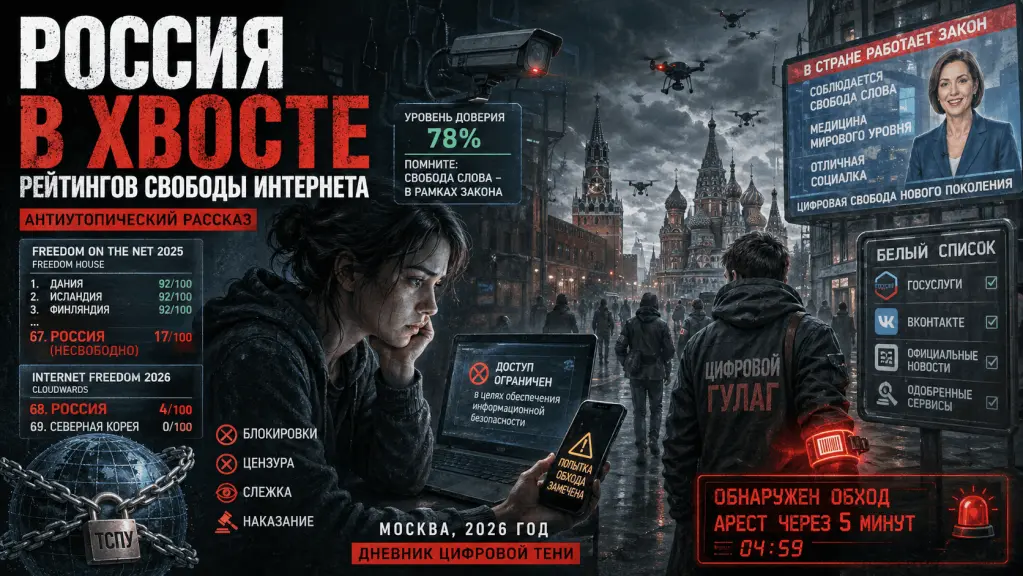
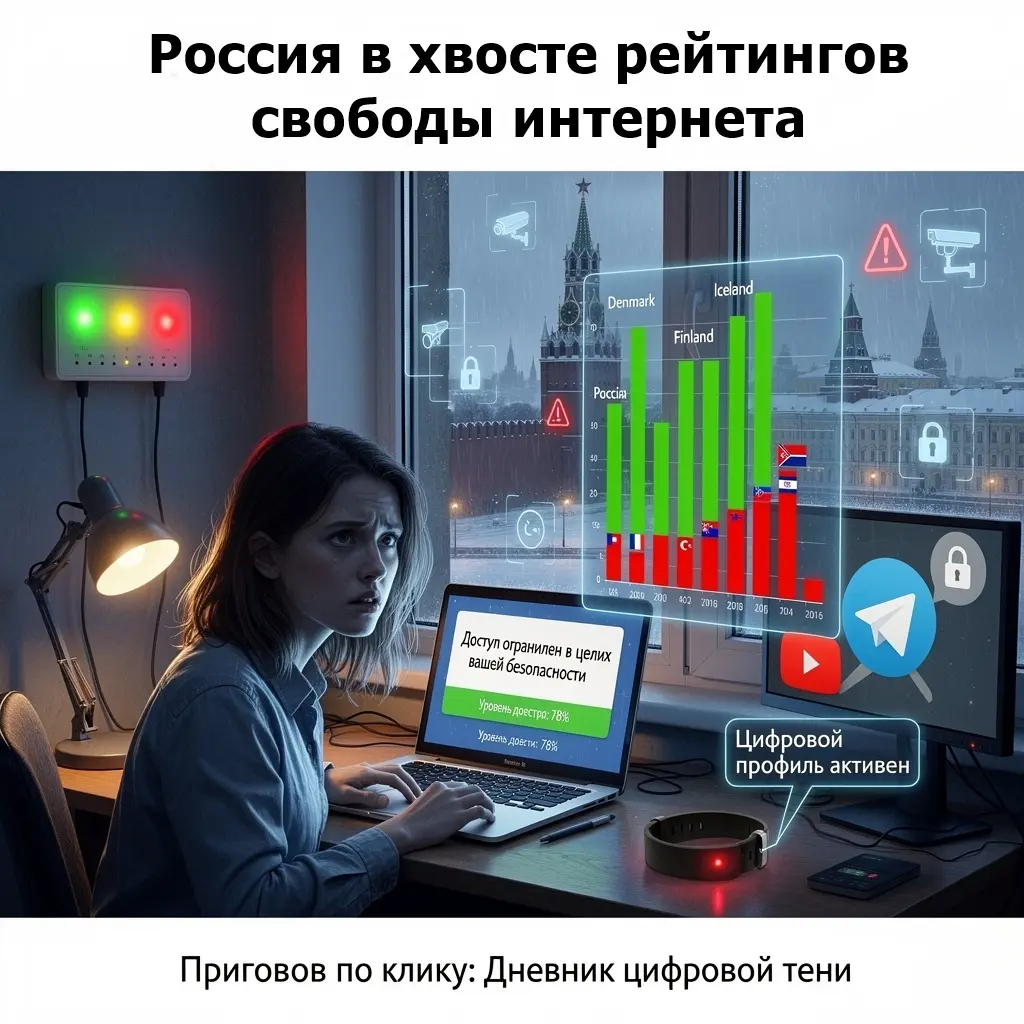
The verdict on the click: Diary of a digital shadow.
Moscow, 2026.
There was a law in the country. Freedom of speech was respected. The medicine was world-class. Everyone had career opportunities and excellent social life. This was repeated from the screens every day, in a flat, emotionless voice, like a memorized prayer. And we nodded. They nodded and believed. Or pretended to.
It's just a pity that I couldn't access the open Internet without dancing with a tambourine, without nervous trembling in my fingers. And there were fewer and fewer diamonds.
I woke up at 07:03, as always. A green "Secure access" light was flashing on the wall. This meant that my router had passed the morning check: Technical Means of Countering Threats (TSP)— they confirmed that I did not try to connect to prohibited resources, did not use a "non-standard protocol" and did not access mirrors that were no longer there. The system gave me another day of digital "freedom."
The phone was vibrating. Notification from the Digital Security Center: "Good morning. Your confidence level is 78%. It is recommended to use only certified services. Remember: freedom of speech is within the law."
Seventy-eight percent. Not bad. Enough to avoid attracting attention until lunch. I opened the browser. The search bar, like a faithful dog, helpfully prompted: "weather", "schedule", "public services", "news". There were three types of news: official, especially official, and "for internal use." The system has long since learned not to offer anything else, carefully protecting my mind from "unreliable information."
I tried to open YouTube. The screen paused for a second, as if he was thinking, gathering his strength. Then a message appeared: "Access is temporarily restricted in order to ensure information security."
I knew what that meant. Not a lock, but a "restriction". Not censorship, but "protection from scammers and cyber threats." The words changed, the reality remained the same. And this dead tongue crept into every crevice of our lives.
There is a notification in the messenger: "Telegram is unavailable without a certified connection." According to rumors, in April 2026, its availability without a VPN dropped to 5%. I didn't check it. It became dangerous to check. I didn't have any wristband yet, like some people, but everyone had their own personal digital profile. And every "wrong" click left a scar in him.
I turned on the VPN. The indicator on the router flashed yellow. The system noticed. Somewhere in the data center, in the semi-darkness of the servers, someone invisible ticked the box: "bypass attempt". Nothing has happened—yet. But I knew that about 40% of users, like me, use a VPN, and agencies regularly send out "detection manuals" to providers. Sooner or later, yellow is bound to turn into red.
At work, everyone spoke in whispers. Even in a whisper— carefully. We had lists of "allowed platforms", "allowed topics", "allowed formulations". Any post, repost, or even like could become a reason for proceedings on articles about "fakes" or "discrediting." People didn't read the news, they read the registry.
At lunchtime, I came across an article in one of the last closed channels where it was still possible to get in. The headline was such that my heart clenched like a dry fist:
"Is Russia the world leader in digital freedom? (Spoiler: only if you count from the end)."
Then there were numbers that made me want to laugh and cry at the same time, but I just felt a chill creeping through my veins.
According to Cloudwards data for 2026, Russia received 4 out of 100 points. Below is only North Korea with a zero rating. In that country, only the leaders had the Internet, the rest were in the Kwangmyeon state office. We shared the penultimate place with China, Iran, and Pakistan, countries where the words "freedom of speech" were allergic to censors. Great company if your goal is total control, not comfort.
Freedom House was called an "undesirable organization," but their data hit home like a well-aimed shot in silence. In 2012, Russia had 48 points. In 2025 - 17. The category is "Not free". A drop of more than 2.5 times in ten years. This is not development. This is digital bloodletting.
The methodology divided everything into three blocks, like a sentence:
1. Internet access (10 out of 25): Through the law on the "sovereign Internet" and the TSPU, the state kept its finger on the pulse of every data packet.
Instagram Facebook and Instagram were banned as "extremist", independent media were blocked, and YouTube slowed down, Telegram without a VPN became a legend. The number of banned materials increased to 1.29 million, while blocking instructions on circumvention of censorship increased by 1,200%.
3. Violations of user rights (3 out of 40): like, repost, "fake", "discredit" — and you are no longer a user, but a person involved in the case. Terms for posts have become as much a reality as a communal apartment.
I closed the article. At that moment, the system decided that I had been "out of line" for too long. The screen went blank. A message appeared on the phone: "You violated the rules of safe surfing. Access to some services is limited. To recover, contact the nearest Digital Identity Center."
The Digital Identity Center was located in a former shopping mall building. They used to sell dreams there. Now they were being selected. People stood in line in silence, like in line for bread during the famine years. Everyone had their own level of trust, their own set of authorized sites, and their own personal reality filter. I felt like one of them, just a number on a soulless list.
When I went to the window, the woman in the uniform looked at me without emotion. Her gaze was blank, like a blocked page.
— What do you use for crawling? "What is it?" she asked.
"Nothing,— I lied. My voice cracked, betraying me.
She looked at her screen. My digital profile was flashing there: connection history, a list of suspicious domains, a list of "non-standard protocols."
"Freedom of speech is respected within the law," she said, repeating the mantra. — Do you agree with the rules?
—Yes,— I replied, feeling the bitter taste of submission.
She pressed the button. The phone screen blinked. Access is back, but not all of it. Part of the Internet just disappeared, as if it had never existed. My small, fragile reality has become even smaller.
On the way home, I saw teenagers standing at a store window and looking at a screen where an advertisement for the "sovereign Runet" was playing. There were smiling people, fast Internet, convenient government services, whitelists, and no VPNs. "New generation digital freedom," the caption read. There was no question in their eyes. They were just watching.
I thought about the leaders of the rating. Denmark, Iceland, Finland — 92 points. There, people could open any website, say any word, read any news. They had the Internet. We have a "sovereign Runet". The digital GULAG.
I remembered how the father of one of my friends, a former propagandist on Telegram, lost 40% of the audience due to the blocks, while the opposition was holding on to VPN. "Brilliant," I grinned, remembering his words before he was arrested for the "old repost." Now, even the Patriots' channels were just an echo in the void.
That night, in the dead of night, sirens sounded. Not an alarm, but a test mode of "sovereignty". The Runet was disconnected from the world for two hours. Millions of people are panicking. Ozon is buggy, Public services are not working. Officially: "Exercises to protect against cyber threats." Unofficially: a reminder. You're in the matrix. And we know how to disconnect you from it.
I opened my laptop. I tried to find an old article I read many years ago about freedom. The link didn't work. The search engine offered "similar materials" approved by the Center. I typed in the line: "Russia - freedom of the Internet."
The system gave a short answer: "The information may be unreliable. For up-to-date information, please refer to official sources."
I closed my laptop and looked out the window. Somewhere out there, behind the wall of filters, blockages, and "security restrictions," the real Internet continued to exist. But for me, it became something of a myth-a beautiful, forgotten story about a world in which words still meant something.
But the law worked for us. Freedom of speech was respected. There was world-class medicine. And the Internet, where you're always in the penultimate place, right after North Korea. My phone vibrated. The red light on the wall flickered to the beat.
"A bypass has been detected. Arrest in 5 minutes."
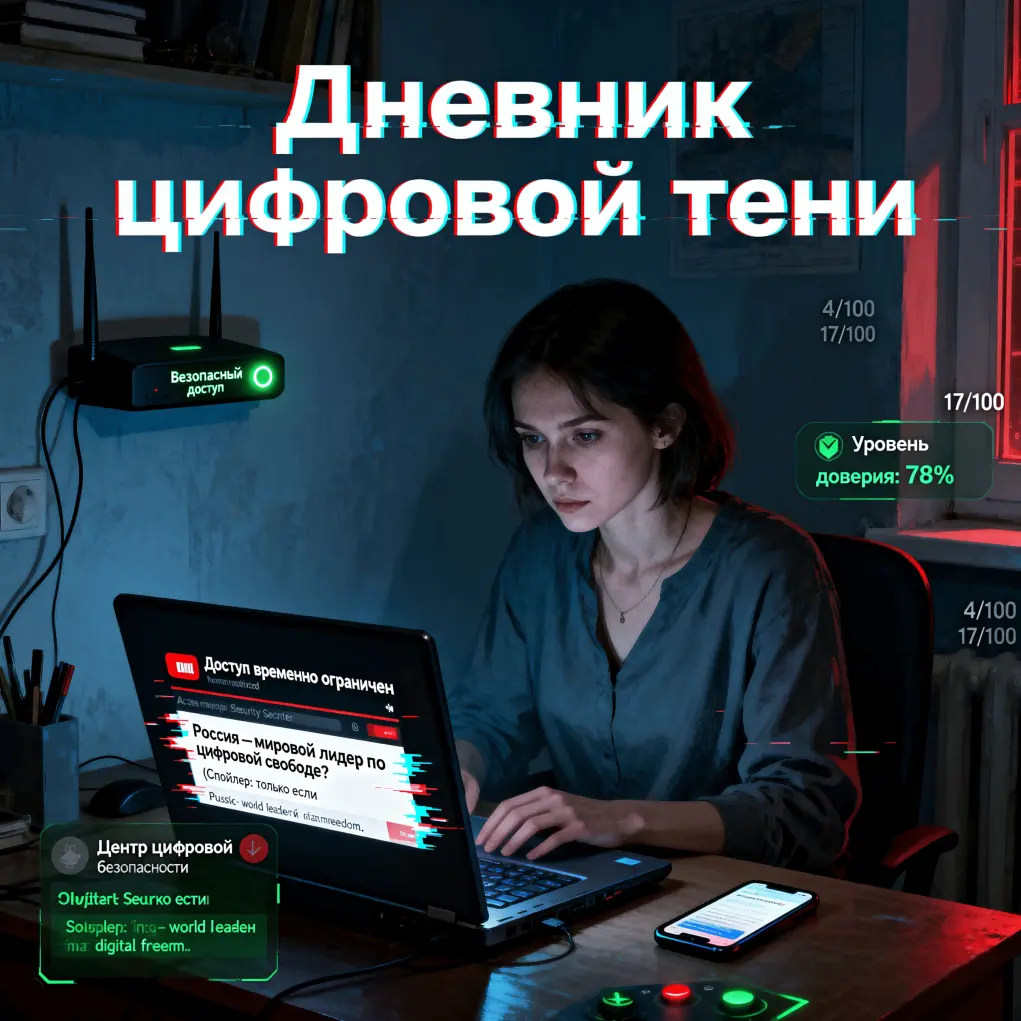
The epilogue. Shadows of the Runet, Moscow, 2030.
Four years have passed. The gray sky above the Kremlin, the TSPU servers are buzzing in the basements of the Ministry of Digital Economy. The Internet is a web, entry is only by pass.
Alexey (the one whose father was a patriotic propagandist) woke up to the vibration of the bracelet. "Access to YouTube is blocked. Fine: 5,000 rubles. Recommendation: use approved content on VK-Public Services."
VPN? Providers are being strangled by the Ministry of Finance's guidelines. Most of the users are "illegals". One incorrect data packet and the bracelet will flash red: "The person involved in the case. Discrediting. 7 years old."
In 2030, the jokes finally ended. Runet is a Digital Gulag.
The blockages have taken off, and now the "whitelist" is all that's left of the world.
Alexey remembered his father. He lost the entire audience from the blocks (OSW data) while the opposition was holding on to the VPN. "Brilliant," the father grinned before being arrested for the "old repost." Now even the Patriots' channels are an echo in the void. Already in 2026, business was groaning: 85% of companies considered the restrictions to be critical (RSPP). The leader's ratings were falling below 70% (VTsIOM), and the people were angry but silent. Self-censorship has become a reflex.
Alexey put on his hood and went offline. Streets are like screens. Drones scan wristbands.
In the subway, the guy is whispering:
— I've heard that Iceland has free Internet, and it's sacred, they're not afraid of words.
Alexey snorted:
— Fairy tales. We are the leaders of sovereignty.
At night, the sirens broke the silence again. The "sovereignty" test: The Runet is again cut off from the world for two hours. Millions are in a panic — Ozon is buggy, Public services are slowing down. Officially, this is a "cyber threat defense exercise." Unofficially— a reminder: we are in the matrix, and there is no way out.
Alexey opened the laptop, inserted the USB. Ivan's article for 2026 popped up on the screen: "Is Russia the world leader in digital freedom? (Spoiler: only if you count from the end)." Alexey typed one last line for the hidden network:
"We're still breathing. We still remember."
The bracelet started beeping loudly. Two heavy knocks on the door. Alexey hid the USB under the carpet, took a cigarette and went to the door. The rain is still pounding outside the window. Beyond the door is the future that we have built ourselves.
The story is based on data from international studies by Cloudwards Internet Freedom 2026 (4/100) and Freedom House "Freedom on the Net" (17/100, 2025), as well as on official provisions of the legislation of the Russian Federation (Federal Law No. 90-FZ "On the Sovereign Internet", rules on restricting access to resources and responsibility for the dissemination of information). The methodology and conclusions of these organizations may be perceived in different ways; the Russian authorities consider Freedom House to be a politically biased organization. All coincidences with the future are accidental (or natural).
I write and shoot. Join me
Author's video content
https://www.youtube.com/c/ViolettaWennman
Political trash
https://www.youtube.com/@Ship-Shard
I invite you to the telegram channel
https://t.me/shipshard
Highly Social on Zen
https://dzen.ru/shipshard
To buy caramels to ruin your teeth
https://dzen.ru/shipshard?donate=true
My hobbies are history, philosophy, psychology, music, economics, politics, and sociology. I write about this and much more. Professional model. She has performed at international music festivals (vocals, dancing, imitation of vocalists). I am studying at the Academy of Arts - the Film and Art Industry, I am a producer and the owner of a video studio.
I am glad to see all of you in my blogs.

Please support us, like-minded people, join the telegram channel. https://t.me/shipshard






