
Zen blog post in Russian
https://dzen.ru/a/afzT2cORJlFGmx-G
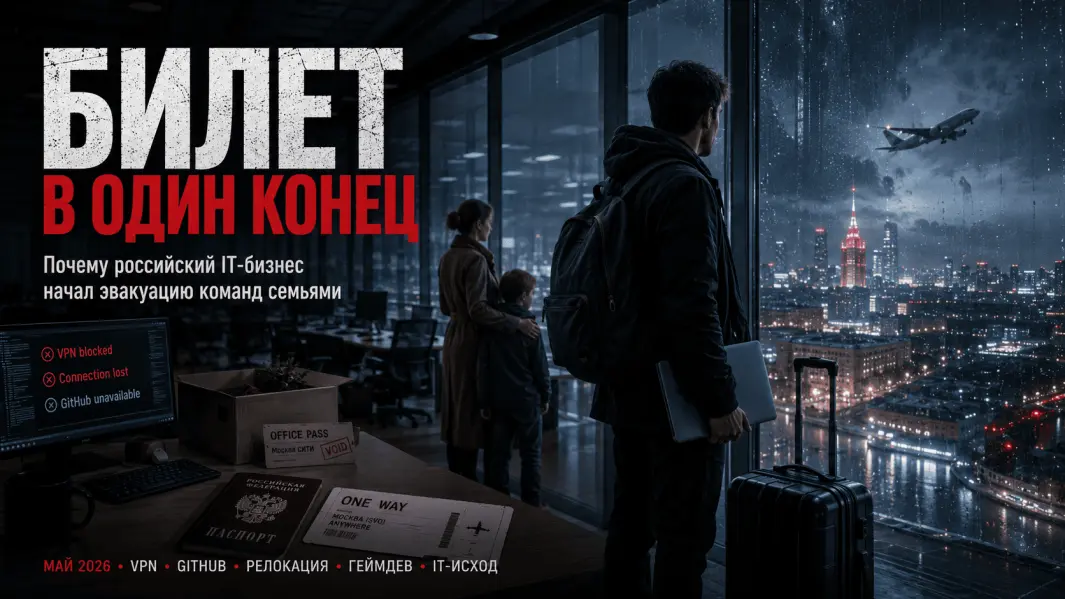
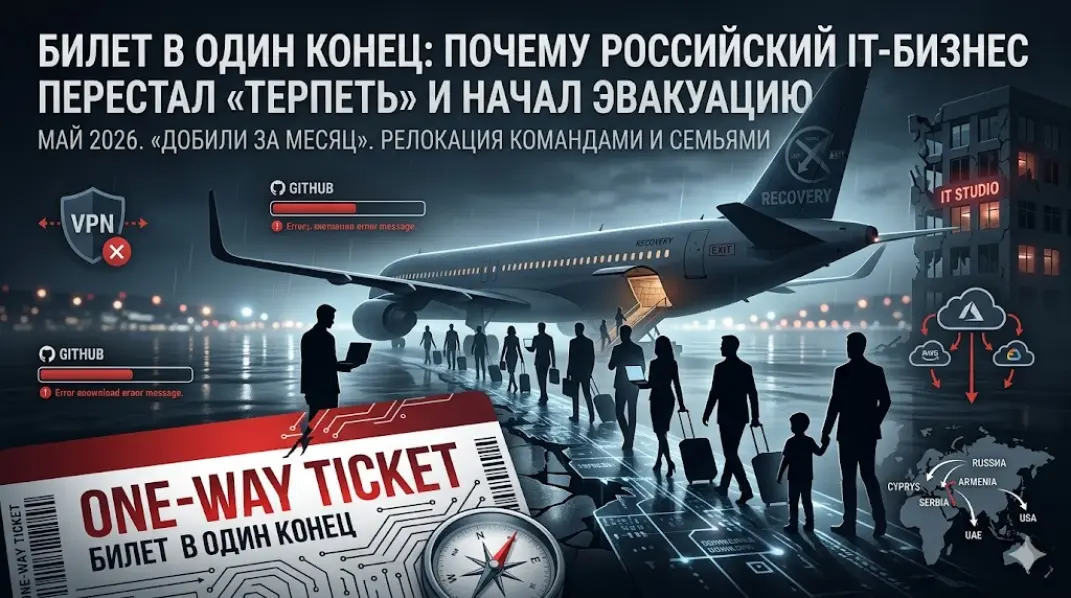
"Finished off in a month." Why are even those who held out until the last, taking IT teams away from Russia with their families?
May 2026. I just talked to a team leader I know from the Moscow office of a major game studio. Do you know what he told me? "They call us one at a time and offer us a move. With my family. For good."
And he's not alone. There have been dozens of such stories over the past two weeks. Not anonymous telegram channels, but real people whom I know personally. People who "held on" for four years, believed that it was possible to adapt, and looked for workarounds. And so they gave up.
What has changed this month? And most importantly, what should those who remain do now?
In short: what is it all about.
In short, for those who have just joined. There has been a wave of news in the Russian media, from IXBT Games to Kanobu and DTF: major IT and gaming companies are shutting down offices in Russia. Not startups, not "desks". Big, systemic players who have held on all these years.
The editor-in-chief of IXBT Games, Vitaly Kazunov, said a phrase that spread throughout the market: "And we are talking about those companies and those people who, no matter what, stayed. Finished off in a month. Well done"
By "finished off" he means a set of measures that have been taken over the past 30-40 days: tightening of "whitelists", massive VPN blockages, interruptions in access to GitHub, AWS, Azure, Unity, Unreal Engine, and most importantly — the discussion of fees for foreign traffic in excess of 15 GB per month.
Yes, paid traffic has not been introduced yet. But the very fact that such an initiative is being seriously discussed at the level of the Ministry of Finance has become the last straw for many.
Who exactly is leaving?
I'll just say something that annoys a lot of people. There will be no specific names. And this is not because I or the journalists are "hiding something." This is because the companies themselves deliberately do not advertise their departure.
Why? There are several reasons.
First, there are the legal risks. Business relocation from Russia involves hundreds of bureaucratic procedures. One careless public statement, and the process can start.
Secondly, saving the team. If you announce that you're leaving, competitors will start outbidding your people even before you have time to move them.
Third, industry practice. In IT and game development, silence is now part of the strategy. Companies leave in silence, without press releases.
What is known for sure? Two large game studios, both with offices in Moscow, are closing completely and relocating all employees. One is the whole thing. The second one is also completely closed, but it has already managed to close the Moscow office. Both belong to the category of "those who held on to the last."
These are not the "first swallows". These are the last of the Mohicans.
How does this wave differ from 2022?
Many people will say, "Well, they leave, and they leave. They also left in 2022." Yes, but it looked different then.
In 2022, top management and the most mobile specialists mostly left. Now we have full studios, teams, and families.
Back then, the reasons were sanctions, reputational risks, and personal fear. Now the main reason is the inability to work physically, because the infrastructure has ceased to be accessible and predictable.
As for employee support: in 2022, the company offered, at best, a one-way ticket and help with the first month. Now employees are given full-fledged relocation packages: housing, schools for children, visas, and legal support.
And the main difference is in the atmosphere. In 2022, it was chaos, panic, and spontaneity. Now there is a systematic, planned withdrawal of the asset.
Do you understand the difference? In 2022, people were running away. In 2026, they will be evacuated in an orderly manner as a valuable asset. Because without these people, the company will simply cease to exist.
One HR director from the departing studio told me on condition of anonymity, "We don't take people away because they're good guys. We're taking them away because there won't be anyone to write code without them. It is unrealistic to hire new ones in Russia. There are simply no seniors. The market is washed out."
Why now? There are three main reasons.
The first reason is whitelisting and blocking. Do you know what "whitelists" are? This is a list of resources that the RCN undertakes not to block. But here's the problem: not all the services needed for work get there. GitHub is working intermittently. Docker Hub is slowed down. Unity Asset Store is falling. AWS Management Console requires a VPN, and VPNs are regularly hacked. Developing games and sophisticated software is not about "watching a video." This is a constant exchange of gigabytes of data with foreign servers. And when this channel becomes a bottleneck, business gets stuck.
The second reason is paid traffic. Even if a fee for foreign traffic in excess of 15 GB is introduced, it will be pennies for an IT company. It's not about $2 per gigabyte. It's about a signal: the state is ready to create economic barriers to working with the outside world. For a business, this means complete unpredictability. Today it's 15 GB, tomorrow it's 5. Today it's 2 dollars, tomorrow it's 10. And the day after tomorrow, they will be banned altogether without special permission. Companies don't like uncertainty. Especially when it comes to business survival.
The third reason is payment systems and sanctions risks. This is less often reported in the news, but the fact is that making a payment from Russia to a foreign counterparty is a non—trivial task. And for a game studio, this is critical: pay for the Unreal Engine license, pay for advertising on Google Ads, receive revenue from the App Store or Steam, pay off a foreign artist or sound engineer. Each such payment is a risk. Banks can be blocked, accounts can be arrested, and the company can be added to the "unreliable list."
And when these three factors—blocking, paid traffic, and payment hell—overlap, any company asks a simple question: "Why would I do that?" And he gives a simple answer: "There is no need."
Where are they going?
The specific addresses of the company are not disclosed. But according to open sources and the stories of people from the industry, such a picture emerges.
USA — for example, Olkon Games studio moved there, to the city of Murray, Utah. It is expensive and difficult to obtain visas, but there is direct access to venture capital, global platforms and the English-speaking community.
Kyrgyzstan sounds unexpected, but Apple, yes, the very Apple, took most of the Russian employees there. It is close, there is no language barrier, a soft regulatory field. For many, it's the perfect compromise.
UAE, Dubai — classics. Zero income tax, advanced IT infrastructure, and the status of a "digital oasis". The downside is expensive living and the heat. Plus, there are direct flights from many cities.
Europe, especially London, Berlin, Nicosia, is for top management and headquarters. Expensive, difficult, but prestigious and understandable.
And, of course, Armenia, Georgia, Kazakhstan, Serbia, Cyprus are classic "relocation harbors" that combine adequate taxes, ease of obtaining a residence permit, and a vibrant Russian—speaking IT community.
Nothing fundamentally new. It's just that singles and small teams used to go there. Now there are entire studios.
What happens to those who stay?
But this is the most painful question.
Those who have decided not to leave or have not received an offer have to work in a new reality. And she's pretty tough.
Let's start with the personnel shortage. The number of responses for one technical vacancy today reaches 300. But that's not because there are a lot of good candidates. It's because there are only a few good ones, and they figure it out in three days. The remaining 297 are responses from juniors, overqualifiers, and just desperate people. The market has finally moved from the "job seeker's market" to the "employer's market". Companies dictate the terms. Salaries in certain areas — system analytics, DevOps, game design on Unreal — have increased, but at the same time, the requirements for candidates have increased significantly.
The second is the narrowing of the professional environment. When entire teams leave, internal knowledge about how legacy code works, connections with foreign colleagues, access to private chats and communities, and, most importantly, an understanding of "how smart people are doing now" disappear with them. The rest end up in an information bubble. And in IT, an information bubble is death.
The third is where the business goes. The remaining companies have two main niches. The first is government procurement and defense industry. They pay there, there is stability, there is no need to think about exports and foreign payments. But this is a completely different level of freedom and completely different risks. The second is local products for the domestic market. That is, the analogues of all that is gone. However, as practice shows, the quality of these analogues leaves much to be desired.
Private commercial development to the global market — this train is gone. If you haven't relocated, you're no longer a player in this segment.
What is the result? Three honest conclusions.
I'm not going to pretend to be an analyst. I'll say this as someone who sees careers and companies break down every day.
The first conclusion. This is not a crisis for the industry, it is a paradigm shift.
The crisis is ending. And that's forever. Companies take employees and their families away because they don't believe in returning. Not in a year, not in three.
Russian IT will no longer be global. It will be local, closed, and very specific. Like shipbuilding in Chelyabinsk, it may be of high quality, but it is not necessary for anyone outside the country. This is neither good nor bad. That's a fact. If you're building a career on global products, you won't be in Russia anymore. If you are ready to work for the domestic market and government orders, you have a chance.
The second conclusion. For those who remain, conditions will change harshly, but not fatally.
The remaining companies will be isolated. But isolation is not emptiness. This is a reformatting.
Will be in demand:
- Import substitution specialists (yes, it sounds boring, but there is real money there).
- Engineers who know how to work with open source and Chinese ecosystems (Huawei, Tencent, Alibaba).
- Those who quickly retrain and don't whine about Unity on GitHub.
Will not be in demand:
- Specialists whose expertise is tied to specific Western tools without analogues.
- People who hope that "everything will come back."
The country has lost the industry of complex commercial development. But she did not lose the engineering school completely. It's just that now this school is working for other customers. And when you accept it, it will become easier.
The third conclusion. For those who choose to leave or stay. Honestly, no snot.
I won't say "leave" or "stay." But I'll tell you which questions to answer honestly for yourself.
It's worth leaving if:
- Your career is focused on global markets and products.
- You are not ready to put up with the instability of access to tools.
- You are mobile, you don't have rigid attachments (mortgage, sick parents, children in a specific school).
- You understand that adaptation will take a year or two of stress, and you are ready for it.
It's worth staying if:
- Your income is linked to the ruble and local customers, and you're happy with that.
- You work in the public sector or the defense industry (where there is stability and money now).
- You have objective reasons not to leave, and you are ready to accept a new reality — a more limited but predictable one.
- You see a niche for yourself in a new environment and are ready to retrain.
All. There is no "choose with your heart." Choose with your head. Because the market has changed ruthlessly, and snot won't help here.
The last paragraph. Without pathos.
I do not know how it will be in five years. Maybe Unreal Engine and GitHub will grow. Maybe everything will slide into complete isolation. Maybe they'll open the borders and everyone will come back.
But I know one thing for sure: the companies that held out until the last gave up in a month. And even if they, with their resources and lawyers, have not found a way to work in Russia, this is a diagnosis. Diagnosis for the market and diagnosis for the country.
I write and shoot. Join me
Author's video content
https://www.youtube.com/c/ViolettaWennman
Political trash
https://www.youtube.com/@Ship-Shard
I invite you to the telegram channel
https://t.me/shipshard
Highly Social on Zen
https://dzen.ru/shipshard
For goodies
https://dzen.ru/shipshard?donate=true
My hobbies are history, philosophy, psychology, music, economics, politics, and sociology. I write about this and much more. Professional model. She has performed at international music festivals (vocals, dancing, imitation of vocalists). I am studying at the Academy of Arts - the film and art industry, I am a producer and the owner of a video studio.
I am glad to see all of you in my blogs.

Stay with me everywhere. https://t.me/shipshard






