
Publication in Russian on the Zen blog
https://dzen.ru/a/aeyb7f9P0n-Ut8zf
Beyond the wall of Paradise: why "Moscow 2042" is scarier than any news. Moscow beyond the Wall: how Voinovich's "Moscow 2042" became a mirror of the present. "Moscow 2042" by Voinovich: A dystopia that guessed too much, a satire that caught up with reality. A book that is embarrassing to read today: too many coincidences.
Sometimes fiction gets old fast. You read a novel about the future, and you can see right away that the author missed the mark. Not that kind of technology, not that kind of speech, not that kind of fears.
But it happens the other way around. Almost forty years pass, and suddenly the book starts to sound like it was written yesterday. This is exactly the feeling that Vladimir Voinovich's novel "Moscow 2042" leaves. The novel feels like a chronicle, not like fiction.
It was written in 1986 as a caustic satire on late Soviet reality. Voinovich came up with Moskorep— the Moscow Communist Republic of the future. Technically, it's fantastic. In fact, it is a grotesque model of the state, where power has closed in on itself, ideology has replaced reality, and propaganda has become the main way to control people.
Social life in the novel is a mixture of regulation and hypocrisy. The norms of morality descend from above, control penetrates into the most intimate spheres. At the same time, real life, as always, is looking for workarounds, generating even more absurdity. Voinovich shows how an attempt to completely control a person does not lead to order, but to a caricature of him.
The main idea that runs through the entire novel is that any utopia brought to a state of absolute truth begins to destroy reality itself. When ideology replaces facts, the system begins to feed on its own lies. And fear becomes a universal management tool.
"Moscow 2042" is not a prophecy in the literal sense. Voinovich did not "guess the future." He just caught the mechanism very accurately: how a system works in which power is self-contained, isolation is presented as a benefit, and absurdity is gradually becoming the norm.
That is why the novel today is read not as a fantasy, but as a scheme that is reproduced over and over again — with different decorations, but with the same principles.
And the further you go, the harder it is to read this novel only as a joke.
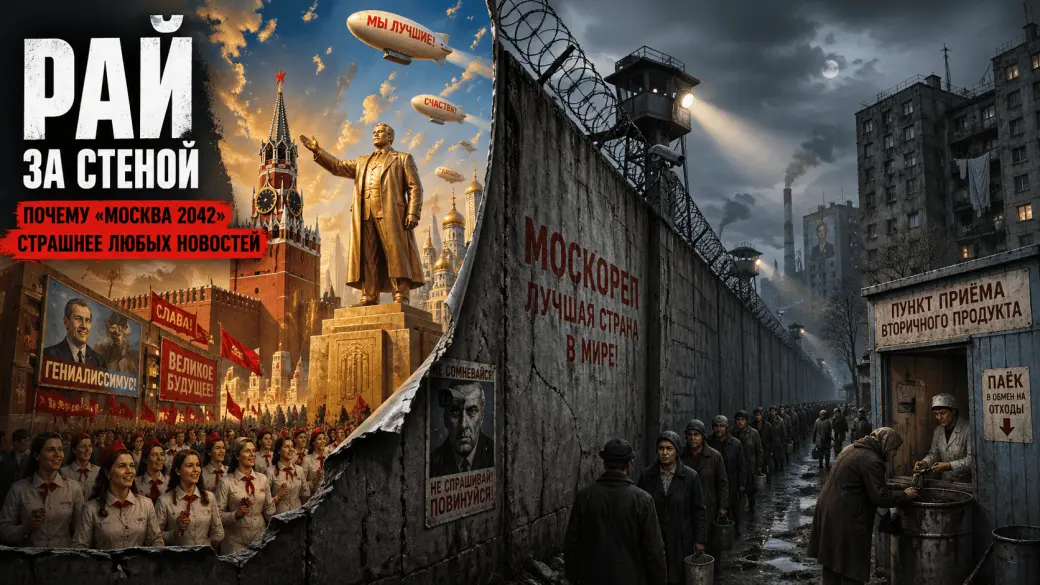
Paradise is beyond the wall. Voynovich's Moskorep is Moscow, fenced off from the rest of the world by a wall. Inside— there is supposedly happiness, order, and the triumph of a higher idea. There are enemies outside, chaos, savagery and almost cannibalism. It's a very convenient picture of the world: if you're inside, you're in paradise. If you're outside, you're in hell. And if you feel bad inside, it means that you just don't understand your own happiness correctly enough. This is the main absurdity of the novel. Moskorep does not look like paradise. There is poverty, fear, total surveillance, communal life, censorship, humiliation and the constant need to feign delight. But officially, it's still the best place on Earth. Familiar logic: the worse the reality, the louder you need to talk about greatness.
The Genialissimus and the cult of personality. In the center of the Moskorep is the figure of the Genialissimus. This is not just a ruler. It is a symbol, an icon, the only source of meaning. His portraits, monuments, quotations, obligatory admiration — everything turns into a ritual. Voinovich accurately grasped the mechanism of the personality cult: it is based not only on fear, but also on everyday habit. People get used to saying the right words, making the right faces, and participating in the right ceremonies. First for the sake of safety, then out of inertia, then without distinguishing the game from persuasion. And at some point, the state begins to resemble not a society of citizens, but a huge stage where everyone is obliged to play the play of loyalty.
A great idea and a small person. One of the novel's strongest details is the "secondary product" system. Residents of Moskorep donate their own waste to special points and receive a ration for it. Voinovich takes the Soviet idea of accounting, distribution, and utility to the ultimate grotesque. A person here is valuable not as a person, but as a function. He must produce, deliver, report, and confirm loyalty. Even his biology is becoming part of the state economy. It's funny, but laughter quickly becomes unpleasant. Because the caricature shows the main thing: the totalitarian system seeks to appropriate the whole person. His work, language, body, memory, desires and fears.
Isolation as a virtue. Moskorep lives in the logic of a besieged fortress. The entire outside world has been declared dangerous and morally corrupt. Any connection with him is suspicious. Any doubt is almost treason. In the modern world, walls are not necessarily built of concrete. They can be digital, informational, or linguistic. You can isolate yourself with blockages, lists of prohibited things, the fight against "alien influence", suspicion of everything external. The main purpose of such a wall is not to protect people from the world. The main goal is to protect the government from comparison. Because comparison is dangerous. It shows that life can be arranged differently.
An ersatz instead of a future. In the future, Voinovich will drive steam and gas-powered cars. Technological progress seems to be there, but it is strange, squalid, decorative. It's the future that pretends to be the future. This is often the case in closed systems.: instead of development, there is an imitation of development. Instead of innovations, there are big names. Instead of quality, there are slogans. Instead of real progress, there are stories that "your own" is necessarily better, even if it works worse. Voinovich's dystopia shows more than just poverty. It shows a degradation that disguises itself as a special path.
Moral control and absurdity. In Moscow, the government gets into everything: in words, in thoughts, in everyday life, in personal life. Even the intimate becomes not personal, but ideological. Sex, family, clothes, habits — everything should fit the line. This is an important feature of any utopia that has decided to build the "right person." Law-abiding is not enough for her. She needs internal surrender. So that a person doesn't just keep silent, but thinks correctly. He didn't just obey, but enjoyed being obeyed. Hence the eternal struggle for morality. Not because the government is really so concerned about morality, but because control over morality is control over everyday life.
Why the novel still catches on. "Moscow 2042" is not a prophecy in the literal sense. Voinovich did not predict the news and dates. He did something else: he described the device of the absurd. He showed a system where isolation is called sovereignty, poverty is explained by greatness, fear is presented as order, censorship as protection, the cult of personality as popular love, degradation as a special path, lies are repeated so often that they become an official reality. That is why the novel is being read so keenly today. Not because every detail matched, but because the principle matched.
Any utopia is dangerous if it has been given a cudgel. Voinovich's main idea is broader than Soviet satire. He's not just laughing at communism. It generally shows that any ideology that declares itself to be the only true one sooner or later begins to demand sacrifices. Communist utopia, monarchical dream, imperial nostalgia, "special path", "traditional values", "besieged fortress" — the names may change. The mechanism remains the same. First, people are promised harmony. Then they demand to be patient. Then they forbid doubting. Then they declare those who disagree as enemies. And in the end, it turns out that for the sake of a brighter future, the present has long been destroyed.
A satire that has stopped being funny. Voinovich wrote a funny novel. But his laughter is special — nervous, bitter. This is the laugh of a man who understands that the absurd is not harmless. It can become a management system.
"Moscow 2042" scares not with fantastic details. Not a wall, not a Genius, not steam engines, and not waste collection points. It is frightening how easily familiar logic is recognized in this grotesque.
The logic of a state that tells a person:
You are free, but only within the limits allowed.;
You're happy because that's what we decided.;
You live in a better country, even if you're not allowed to compare.
And, perhaps, that is why Voinovich's novel is worth rereading today. Not as an old anti-Soviet satire, but as a warning: when the government starts building a paradise behind a wall, ordinary people most often get not a paradise, but a wall.
I write and shoot. Join me
Author's video content
https://www.youtube.com/c/ViolettaWennman
Political trash
https://www.youtube.com/@Ship-Shard
I invite you to the telegram channel
https://t.me/shipshard
Highly Social on Zen
https://dzen.ru/shipshard
To buy caramels to ruin your teeth
https://dzen.ru/shipshard?donate=true
My hobbies are history, philosophy, psychology, music, economics, politics, and sociology. I write about this and much more. Professional model. She has performed at international music festivals (vocals, dancing, imitation of vocalists). I am studying at the Academy of Arts - the Film and Art Industry, I am a producer and the owner of a video studio.
I am glad to see all of you in my blogs.

Please support us, like-minded people, join the telegram channel. https://t.me/shipshard






