
Publication in Russian on the Zen blog
https://dzen.ru/a/afzsWFF-On7b0KGV
"The Last Byte: Chronicles of the Digital Exodus." A one-way ticket for IT.
May 2026 was the month when Moscow finally turned into the ruins of a digital empire. Not the ruins of bombs and fire, they can be rebuilt. These were worse: empty server rooms, frozen screens, corridors where the footsteps of those who were no longer there echoed. The city was glowing, but the light was dead, like the indicators in a switched-off data center.
No one noticed the exact moment when access to the world ceased to be a right. There were no sirens, no orders. It's just that one day the air became chargeable. And then those who could breathe deeper than others disappeared.
Countries rarely collapse all at once. First they lose the future. Then there are those who know how to create this future. And then the lights go out.
Now they don't build here — they save the remains here. And those who have not yet understood continue to believe that the black screen is not the end, but a pause. But the pause drags on.
Too long.
Too much.
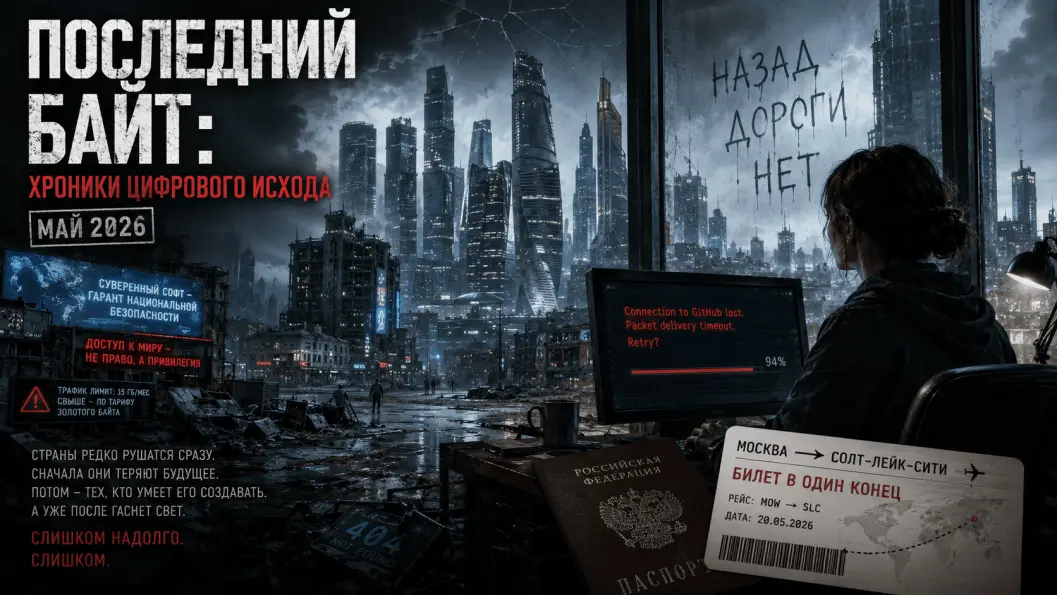
Chapter 1. A crack in the sky.
May 2026 entered Moscow not with the warmth of spring, but with a dead, flickering light that did not warm, but only exposed the geometry of emptiness. The towers of the City cut through the leaden sky like burnt silicon needles driven into the living, bleeding body of the metropolis. The acid neon of ads for sovereign cloud services was blurred by a fine, ozone-scented rain, turning the streets into the contours of a giant motherboard that no longer carried electricity.
Alina was standing at the thirty-meter panoramic window on the twenty-eighth floor. Her pale reflection in the glass looked like an indistinct file, compressed to a loss of quality. Behind her, in the depths of a sterile office designed according to the patterns of a bygone era of free game development, a quiet conversation was going on. The two top studio managers exchanged phrases with that special, frozen politeness that always hides a disaster.
— With my family. For good. Housing, documents, school for the child. The decision needs to be made in forty-eight hours.
It didn't sound like a promising contract offer. It was a verdict of evacuation. But instead of a convoy, there's a neat folder in the corporate cloud, an itinerary instead of a grid, and instead of sirens, there's the dry rustle of a printer printing out warranty obligations.
Alina turned her gaze to her terminal. The compilation line of her brainchild, the most complex AI controller for NPCs that she has been working on for the past three years, is stuck at 94%. The red lettering burned steadily, like a pulse bar on a medical monitor.:
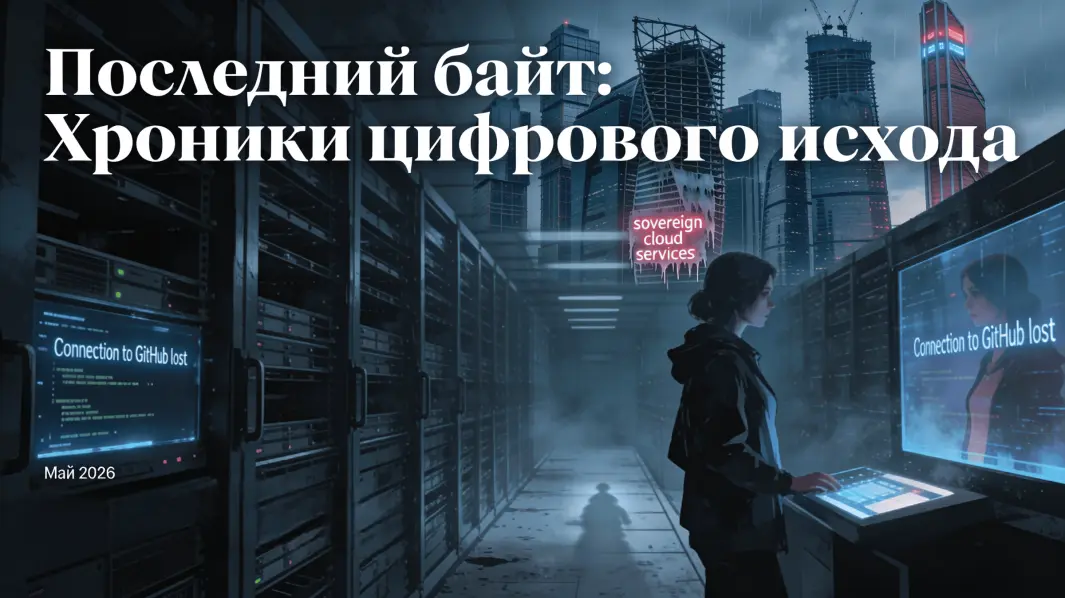
«Connection to GitHub lost. Packet delivery timeout. Retry?»`
"Again?" — the muffled voice of Lyosha, her lead system architect, sounded from the speaker. He didn't even turn on the hologram. In May of the twenty-sixth, a new etiquette appeared in the IT environment: no one wanted to look into each other's eyes in moments of digital agony anymore.
"Again,— Alina replied softly, her fingers habitually running over the touchpad, trying to find the working airlock.
Fifth VPN in a week. The one that saved them yesterday was burned out at the provider level tonight — Roskomnadzor's DPI filters have learned to stifle encrypted traffic instantly, as if squeezing the carotid artery of the network. The "whitelists" turned the global Internet into a sterile tiled corridor, where a step to the left or right was punished by a blank wall of time-out. AWS, Azure, Unity Asset Store, Unreal Engine —everything that the digital worlds were built on now lay on the other side of an insurmountable technological moat.
And the axe of "digital soldering" hung over the remaining ones — the limit of 15 gigabytes of foreign traffic per month, which is being discussed in the depths of the Ministry of Digital Economy. Above — at the golden byte rate. For a layman browsing through domestic social networks, it was unnoticeable. For a game studio churning out terabytes of graphics builds, this meant a quick, suffocating death.
Chapter 2. System dismantling.
— We were finished off in a month, Alin. Quiet and professional. Well done," Lyosha smiled bitterly at the speaker.
This phrase, thrown out by the editor-in-chief of iXBT Games, Vitaly Kazunov, has been circulating for a week through fading internal chats as the epitaph of the industry. Those who held out to the last, who spent four years building bypass bridges, taming proxy servers and believing that a compromise was possible, were turned off in thirty days.
Alina remembered the year 2022. Back then, the outcome was like a stampede of rats from a burning ship: chaos, broken contracts, suitcases at clogged train stations, sleepless nights at the borders. People fled from personal fear to nowhere, hoping to ride out the storm.
In 2026, the storm became the climate. And now something else was happening — a systematic, cold evacuation of assets.
"We're not saving the "good guys," Alina," Marina, an HR director with the eyes of a man who hasn't slept since early April, put a tablet with a contract in front of her. — We're taking out the code. Without your head, this project cannot be launched on foreign servers. And hire someone here... Take a look for yourself.
Marina opened the internal statistics. One vacancy for a leading engineer in Moscow now had up to three hundred responses. But this indicator was an illusion, digital noise. Two hundred and ninety-seven of them were desperate resumes from yesterday's couriers, taxi drivers, and graduates of the "Get into IT in Two Weeks" express courses. The lords no longer existed. The market was washed down to the rocky base. Those who could make silicon think had either already left or were packing their bags.
— Where is our department going? Alina asked, feeling a cold lump turning inside her.
— The studio has split up, — Marina adjusted her glasses, in the glasses of which the gray silhouette of the Federation Tower was reflected. — Top management and core architects are flying to the United States, Utah, the city of Murray. Direct access to Valve's venture funds and servers. We are evacuating junior developers and support to Bishkek. Apple has moved almost all of its employees from the Russian division there, and there is lax regulation. Someone chose Dubai, someone Belgrade or Limassol. We provide a complete relocation package. Tickets, lifting fees, visas, schools for children. For good, Alina. The Moscow office is closing. With the ends.
Alina was silent. She stared at the neat lines of the contract. Everything was decorated flawlessly, almost affectionately. But behind this corporate concern was an icy epitaph: her country was no longer a place to create a future. It became a closed system that did not need the creators of the worlds. She only needed maintenance engineers for the inner circuit.
Chapter 3. Air from a locked room.
In the evening, Alina walked through the city. Moscow tried to appear alive. Shop windows with Chinese appliances glowed, electric buses glided silently, people in coffee shops drank surrogate raf and laughed. But this life seemed to Alina like a high-resolution simulation running on a dying processor.
A patriotic video was broadcast on a giant media facade near Paveletsky Railway Station: "Sovereign software is the guarantor of national security." Underneath him, pressed against a concrete wall, stood soaked delivery couriers with thermal bags, illuminated from below by the screens of cheap smartphones. They looked like slaves to an algorithm that distributed pennies between them in a closed digital ecosystem.
In a taxi on the way home, the driver—judging by his accent, a former sysadmin from some closed research institute-was hoarsely telling someone on the speakerphone:
—Where am I going?" I have a mother here, a mortgage in Khimki... I'll go to the defense industry. They're paying steadily there now, and they're giving you reservations. I will be writing software for guidance systems. What's the difference between coding elves or drones? The code doesn't smell...
Alina turned to the window. She felt physically stifled. "The code doesn't smell." Here it is, a new reality. Those who remain will inevitably be drawn into this vortex. Free commercial development aimed at the global market has officially ceased to exist in Russia. Either you work for the Government and the defense industry — under the watchful eye of curators, isolated from the world's libraries and conferences — or you leave. The system did not leave a third way.
Her son met her at home. Ten-year-old Denis was sitting at his tablet, frowning.
—Mom, why isn't anything opening again?" I wanted to watch a tutorial on blender, and there's an endless download.
Alina sat down next to him and hugged his thin shoulders. Her throat tightened. How do you explain to a child that the world outside their apartment is slowly shrinking to the size of the state border? How can I tell him that the people in formal suits from the offices on the Old Square have decided that his connection to the planet is a threat that needs to be taxed and locked up?
"We're going on a trip soon, Deniska," she said softly, looking at the screen where the meaningless download wheel was spinning. "Where everything opens up."
"For how long?"
— For good.
Chapter 4. The last commit.
There was a signed contract in her mailbox. The studio's internal system has sent a notification: the booking for the Moscow — Istanbul — Salt Lake City flight has been confirmed for Wednesday.
Alina came to the office on her last work shift. The room looked like an outpost abandoned in a hurry on an alien planet. Half of the lamps were turned off for the sake of economy. There were forgotten mugs with dried coffee residue on the tables, office plants withered, and pieces of unfinished flowcharts of a project that would never be completed here remained on the marker boards.
She sat down at her work terminal. The network was stormy. The local synchronization server was quietly whining with coolers in the corner.
Alina opened the terminal and called up the command prompt. She needed to do one last thing — transfer the rights to the master branch of the code to the American office and erase the local backups from the Moscow physical disks. These were the publisher's security requirements. Not a single byte of her AI should have remained in a jurisdiction where it could be nationalized or used for military purposes.
My fingers flew over the keyboard. In this silence, the sounds of hitting the keys seemed like gunshots.
She remembered how she started here ten years ago. How they dreamed of creating a game that would change the perception of virtual reality. How they believed that code was the universal language of humanity, without borders, passports, or governments. What naivety. In 2026, silicon was separated by the barbed wire of government firewalls as securely as the earth was separated by concrete walls.
The final cleaning lines ran on the screen.
`Deleting local repository... Done.`
`Clearing cache... Done.`
`Sovereign node disconnected.`
She pressed Enter. The last commit went through a narrow, encrypted satellite channel provided by a foreign provider specifically for data evacuation. In the description line of the changes, Alice wrote a short:
`migrate.exe`
All. Kristall Studio has ceased to exist in Russia. The physical shell of glass and concrete remained, but her soul — millions of lines of unique code and algorithms — disappeared into the clouds over the Atlantic.
Chapter 5. One-way ticket.
The night before the flight was wet and heavy, like a locked airlock door. The taxi took Alina and Denis to Sheremetyevo along the deserted ring road. Silhouettes of factories, warehouse terminals, and rare communication towers floated past the window, looking like gigantic jammers guarding the peace of a sleeping empire.
Alina clutched her backpack to her. There were no jewels in it. There was a work laptop, a family archive on a secure drive, a child's drawing, and an old flash drive with her very first student project. Everything that could be saved from the digitized void they were leaving behind.
Terminal C was unusually quiet. There was no fuss of the usual international airport. The people in the queue for registration — almost all with distinctive posture, backpacks of famous brands and pale faces —were talking in a half-whisper. It was the elite that the system squeezed out of itself without even noticing that it was losing its brain.
At passport control, a young border guard stared at her face for a long time, comparing it with the photo on the biometric chip. His fingers slowly tapped on the keyboard, checking it against the databases. There was no hatred in his eyes, just the boredom of a man who sees his country's future leaving every day.
— The purpose of the trip? "What is it?" he asked in an impersonal voice.
—Work,— Alina replied.
He stamped it. The heavy, dull thud of the metal cliche against the paper sounded like a fuse flicking.
They went to the departure area. Their plane was parked behind the huge glass of the terminal. Raindrops glistened on its fuselage, reflecting the blue runway lights. There, ahead, was the unknown, a foreign language, the hardest process of adaptation, and the eternal status of outsiders. But there was air. There was a network that wasn't limited by whitelists and traffic taxes.
The plane took off at three o'clock in the morning.
Alina was looking out the porthole. Moscow was rapidly turning into a gigantic, fading scheme below. The lights of the avenues flickered like fading pixels on an old TV screen about to be unplugged. The huge city, which was once the technological heart of Eastern Europe, was going into darkness, voluntarily choosing isolation and slow extinction in its own juice.
Denis was already falling asleep next to her, burrowing into her shoulder.
Alina closed her eyes. The turbines howled steadily overboard, taking them away from the sovereign sky. Businesses voted with their feet, and she was part of this latest, error-free vote count. There was no turning back. It was a one-way ticket. And peering into the darkness behind the glass, she realized that the scariest thing was not that they had left. The scariest thing was that there was no one else to leave. The lights in the digital laboratory went out, and those who were left in the dark will soon forget that they once knew how to fly.
The Dark Art of Dystopia by Violetta Wennman
PARSING, SYMBOLS, MEANINGS.
WE ANALYZE, COMPARE, AND UNDERSTAND.
Welcome to a world where the future is already written.
I write and shoot. Join me
Author's video content
https://www.youtube.com/c/ViolettaWennman
Political trash
https://www.youtube.com/@Ship-Shard
I invite you to the telegram channel
https://t.me/shipshard
Highly Social on Zen
https://dzen.ru/shipshard
For goodies
https://dzen.ru/shipshard?donate=true
My hobbies are history, philosophy, psychology, music, economics, politics, and sociology. I write about this and much more. Professional model. She has performed at international music festivals (vocals, dancing, imitation of vocalists). I am studying at the Academy of Arts - the film and art industry, I am a producer and the owner of a video studio.
I am glad to see all of you in my blogs.

You won't lose me here. https://t.me/shipshard






